Select date

The Ghost of United Fruit Still Haunts Latin America


All Global Research articles can be read in 51 languages by activating the Translate Website button below the author’s name (only available in desktop version).
To receive Global Research’s Daily Newsletter (selected articles), click here.
Click the share button above to email/forward this article to your friends and colleagues. Follow us on Instagram and Twitter and subscribe to our Telegram Channel. Feel free to repost and share widely Global Research articles.
Donation Drive: Global Research Is Committed to the “Unspoken Truth”
***
Introduction
Of all the campaign issues that conservatives like to be overheard talking about, illegal immigration is among the top 6 or 7th in importance behind boycotting Bud Light, 2nd Amendment issues, and trolling abortion fanatics.
Beyond AOC conducting a staged photo-op crying next to an empty parking lot in order to try and make President Trump look like a racist for separating children from parents, (a policy that was a carry-over from the Obama presidency oddly enough), Democrats tend to avoid discussing the absolute flood of undocumented refugees currently awaiting processing, mostly because they don’t want to upset their sugar daddy George Soros or make President Biden look bad.
For the 12 months ending Sept. 30, 2022, Customs and Border Protection Administration CBP stopped migrants more than 2,766,582 times, compared to 1.72 million times for fiscal 2021, the previous yearly high. The 2022 numbers were driven in part by sharp increases in the number of Venezuelans, Cubans and Nicaraguans making the trek north, according to CBP. The major source of immigration is listed as Brazil, Columbia, Cuba, Ecuador, El Salvador, Guatemala, Haiti, Honduras, Mexico, Nicaragua, and Venezuela with 1,535,492 so far attempting to enter this year and 2,217,141 last year (see this).
US-run color revolutions and coups, economic warfare, sanctions, narco-terrorism, Communist/Maoist terrorism, natural disasters, and severe poverty caused by policies imposed by the International Monetary Fund and World Bank all make up the major reasons that people flee their countries of origin.
However, despite the utterly disgusting record of the United States throughout the 20th Century and the 23 years of this century in imposing grinding poverty, usurious debt payments, and virtual colonial economic conditions, too many Americans parrot the “illegal immigrant” line which is the favorite boogeyman scapegoat now that “Muslim terrorism/extremist” is not being repeated endlessly on cable news, or worse, state that “it’s not their concern” as one of my taxi customers stated recently when I described the topic of this article.
A surprising opinion given that there is group of 300 refugees being warehoused at an auditorium in Portland Maine from Algeria who are protesting their conditions and discussions are under way to bring refugees to my locality despite there being absolutely no means of supporting them. A brief glance at the latter half of the 20th century shows why such opinions are utterly immoral. After WW1, the US has conducted wars, coups, and other military operations of various kinds in the Western Hemisphere mostly using the cover of “fighting Communism.” Because of the complexity of Communist/Socialist/Maoist history, its strange relationship with the old British Empire, and how they fit into the perpetual conflict schemes of various geopoliticans and used to terrible effect on the lives of untold numbers of souls, that subject will be gone over at length in part 2.
For most of the 19th and 20th century up until the passing of statesman James G. Blaine, the assassination of President McKinley, and ascendancy of anglophile freak Teddy Roosevelt, the US policy of support for our “sister republics” via the Monroe Doctrine was subverted into a colonial policy.
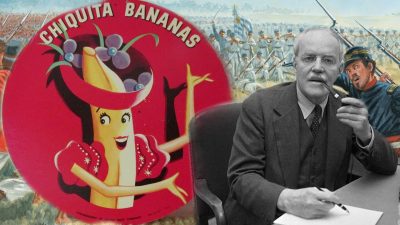
One company in particular, exemplified exploitation and looting of Central America and the Caribbean, The United Fruit Company, often called “The Octopus” because of its dominance over entire countries from which the term “Banana Republic” came.
I thought that you should get to see both the approved and sanitized narrative that is generally shown on numerous websites and videos that describe its history and then the ugly reality which brand x historians won’t touch with a hundred foot pole.

Birth of the Octopus
1870: The Boston Fruit Company was established by sailor Lorenzo Dow Baker when he started purchasing bananas in Jamaica.
1899: Minor C. Keith’s company Tropical Trading and Transport Co. merges with rival Andrew W. Preston’s Boston Fruit Co. to form the United Fruit Company. It engaged in the production, transportation, and marketing of bananas, sugar, cocoa, abaca, and other tropical agricultural products. Preston brought to the partnership his plantations in the West Indies, a fleet of steamships, and his market in the U.S. Northeast. Keith brought his plantations and railroads in Central America and his market in the U.S. South and Southeast. Within weeks, UFCo acquires seven independent companies that have been operating in Honduras. Preston is made president and Keith is vice-president. Preston’s lawyer Bradley Palmer is made permanent member of the executive committee and director and from a business point of view, Palmer was United Fruit.
1910: UFCo rival Samuel Zemurray conspires with the newly exiled General Manuel Bonilla and masterminds a coup d’état against Honduran President Dávila. On Christmas Eve, Samuel Zemurray, U.S. General Lee Christmas, and General Bonilla use Zemurray’s yacht “Hornet” with a gang of New Orleans mercenaries and attacks the ports of Trujillo and La Ceiba forcing President Dávila to step down. Bonilla becomes dictator and awards UFCo tax breaks and huge land grants.
1928: 25,000 banana workers in Columbia went on strike demanding a 6-day work week, payment with money rather than company coupons, compensation for work accidents, & increase in wages for workers earning less than 100 pesos per month. With the bottom line threatened, the strikers are branded Communists and UFCo gets the U.S. Government to threaten to invade, using the U.S. Marine Corps that were stationed off the shores of Ciénaga should the Colombian government not act to protect United Fruit’s interests. Dec. 6, 1928, Columbian troops gun down protesters outside of UFCo headquarters. The number killed is disputed, but a month later, the U.S. Ambassador to Bogotá, Jefferson Caffery, sent a dispatch informing Washington: “I have the honor to report…that the total number of strikers killed by the Colombian military exceeded one thousand.”

1929: After an unsuccessful price war against Samuel Zemurray’s Cuyamel Fruit Company which he had purchased in 1910, United Fruit decides to buy Zemurray out. He eventually becomes its biggest stockholder.
1930: UFCo. has absorbed more than twenty rival firms and is the largest employer in Central America. It owned or leased property in Honduras, Costa Rica, Guatemala, Panama, Colombia, Cuba, Jamaica, and numerous other Central American, South American, and West Indies countries.
1933: Members of UFCo’s board of directors vote to name Zemurray general director of the company.

1938: Zemurray becomes President of UFCo.
1947: United Fruit’s net worth is in excess of $250 million, and the company controlled nearly a half-mile of dock space in the Port of New Orleans for loading and unloading of its passengers, bananas and general freight.
June 1954 President Jacobo Arbenz of Guatemala became the first Latin American leader overthrown in a coup organized by the US government [SIC!]. On taking power, President Arbenz had proposed land reforms that were considered a threat to the interests of United Fruit Company despite the fact that only 15% of their land was being utilized. Arbenz was labelled a communist by Washington and the US company lobbied for his removal. BBC interview with President Jacobo Arbenz’s son.
1958: UFCo acquires the rights to explore petroleum and natural gas in Colombia, Panama, and Ecuador. During the 1950’s, UFCo. starts acquiring numerous companies such as A&W Root Beer and Foster Grants.
1959: Fidel Castro begins his agrarian reform and seizes the sugar plantations of United Fruit in Cuba.
United Brands (1970–1984)
Corporate raider Eli M. Black bought 733,000 shares of United Fruit in 1968, becoming the company’s largest shareholder. In June 1970, Black merged United Fruit with his own public company, AMK (owner of meat packer John Morrell), to create the United Brands Company.
1974: Central American governments began levying a large export tax on bananas. In September hurricane Fifi hit Central America, wiping out 70% of the company’s Honduran plantations and causing losses of more than $20 million. Rising feed costs puts Morrell $6 million in the hole. Black sells UFCo to Foster Grant for almost $70 million.
1975: Black commits suicide by jumping from his office in the Pan-Am building in New York. The investigations following his death reveal a multi-million-dollar bribery scandal in which Black and United Brands pay off Central American countries in exchange for reduced taxes.
Chiquita Brands International
After Black’s suicide, Cincinnati-based American Financial Group, one of billionaire Carl Lindner, Jr.‘s companies, bought into United Brands. In August 1984, Lindner took control of the company and renamed it Chiquita Brands International. The headquarters was moved from New York to Cincinnati in 1985.
2014 Chiquita Brands International conducts an all stock merger with the Irish Fruit Company Fyffes for $1.07 Billion and controls 29% of the global banana market. As of 2017 Fyffes is owned by the Japanese Sumitomo Corporation.
2019 The company’s main offices leave the United States and relocate to Switzerland.
“Chiquita Brands International operates in 70 countries and employs approximately 20,000 people as of 2018. The company sells a variety of fresh produce, including bananas, ready-made salads, and health foods. The company’s Fresh Express brand has approximately $1 billion of annual sales and a 40% market share in the United States.” Global corporate structure

Corporatism Writ Large in Mountains of Corpses
“I helped make Mexico, especially Tampico, safe for American oil interests in 1914. I helped make Haiti and Cuba a decent place for the National City Bank boys to collect revenues in. I helped in the raping of half a dozen Central American republics for the benefits of Wall Street. The record of racketeering is long. I helped purify Nicaragua for the international banking house of Brown Brothers in 1909-1912. I brought light to the Dominican Republic for American sugar interests in 1916. In China I helped to see to it that Standard Oil went its way unmolested.” –Excerpt from a speech delivered in 1933, by Major General Smedley Butler, USMC (retired).
When one brings up terms like corporatism, Mussolini or Hitler is referenced because of the overt relationship between financiers, industrial corporations and the government/ dictatorships. Long before any of that existed, there was the East India Company, a crown chartered company which plundered China and the Indian subcontinent for 300 years from 1600 to 1874 after which it was merged into the British Empire. In America, one finds around the Boston area, very old families that are given the descriptive moniker of blue bloods or Brahmins. See this.
Sociologist Harriet Martineau visited Boston in the 1830s and concluded its Brahmins were “perhaps as aristocratic, vain, and vulgar a city, as described by its own “first people,” as any in the world.”
Typically, these were merchant families who got filthy rich off of the slave and opium trade (or clipper trade). Among the American patrician families who have played key roles in both United Fruit and the British East India Company are the Forbes, Higginsons and Lees. Other old-line Episcopalian families involved with UFCo are the Peabodys of Morgan-Peabody, whose patriarch, J. Endicott Peabody, established Groton prep (the American Eton) to brainwash generations of U.S. policymakers in British Empire worship. In 1899, these and other Anglophile families arranged the merger of the Boston Fruit Co.’s “Great White Fleet” with International Railways of Central America (a railroad crisscrossing the region) to form the United Fruit Company. Sons of opium war Perkins Syndicate agent Joseph Coolidge, Thomas Jefferson Coolidge & Thomas Jefferson Coolidge II merged their Old Colony Trust Company with the First National Bank of Boston so that the boards of the Bank of Boston and the UFCo around 1929 were the same.
Also involved was the Swiss Iselin family through Central Trust Bank of New York, controller of railroads from New Orleans up to the midwest. The Bank of Boston will later play a part in helping organized crime take over Hollywood. In 1988 The Bank of Boston was caught laundering $2.5 million of drug money in connection with the infamous Columbian Medellin drug cartel connected BCCI bank, yet, got off with a $500,000 fine because of Attorney General William Weld, whose family also got filthy rich on the China Clipper Trade. See this.
For further information about this long ignored aspect of treason, please consult Anton Chaitkins ground breaking history research in “Treason In America.”

The other side of United Fruit came from Sicilians Joseph Macheca and his successor Charles Matranga, the mob bosses of New Orleans, the original organized crime organization in the US beginning in the Civil War era. See this.
Macheca was a protege of Anarcho-Revolutionary Guiseppi Mazzini, who in turn was an agent in the employ of Lord Palmerston, the 19th century architect of Britain’s opium wars. See this.
Macheca owned a small shipping company that shipped cargo from New Orleans to Central America starting in 1874. The Macheca Brothers firm eventually sold its shipping assets to United Fruit. His 1943 obituary lists Matranga as merely a retired stevedore for the United Fruit Company, and for Standard Fruit & Steamship Company but his funeral was attended by the business elite of New Orleans and the corporate board of UFCo.
The aforementioned Samuel Zemurray, also a mobster in New Orleans, had come to the U.S. as part of the same wave of immigration (sponsored by the Baron de Hirsch Foundation) that brought the Bronfmans, Jacobs, Fishers and others to this country. With Rothschild backing from London, they welded together a nationwide organized crime network during Prohibition, and then, in the mid-1930s, shifted their profitable business fronts from bootleg liquor to narcotics. According to past U.S. drug enforcement authorities, an estimated 25 percent of the cocaine that entered the United States annually was smuggled on United Brands’ ships.

To its “credit”, United Fruit in the last century has engineered two Marine invasions of Nicaragua, a war between Honduras and EI Salvador, an attempted Nicaraguan invasion of Costa Rica thirty years ago, and more than a dozen coups d’etat. In the bloodbath that followed the Company’s 1954 coup against the republican Arbenz forces in Guatemala, 35,000 people were murdered by death squads.
In 1929, the Justice Department demanded that Zemurray sell out to UF in order to stave off a war that the two companies had helped foment between Guatemala and Honduras. Another 40,000 to 50,000 have been killed by repressive rampages in EI Salvador and Honduras. When added to the deaths suffered under Anastasio Somoza García, Luis Somoza Debayle and Anastasio Somoza Debayle who ruled Nicaragua from 1933 to 1979, it is safe to estimate that United Fruit’s commitment to preserve “banana republics” and obliterate all potential for the development of sovereign nations modeled on America’s own founding principles has taken hundreds of thousands of lives during the last 100 years alone. This is the story of United Fruit: it is the anathema of everything the American republic ever stood for. It is the story of dope pushers, assassins, and mass murderers hired to keep Central America as a backward fiefdom of an Anglo-American “empire.” A deadly relationship of blue blood families setting policies, mobsters providing the muscle, and ruthless local dictators to keep the slaves in line.

True to its nickname El Pulpo or “The Octopus” one finds central figures like John Foster Dulles, who represented United Fruit while he was a law partner at Sullivan & Cromwell – he negotiated the crucial United Fruit deal with Guatemalan officials in the 1930s and was Secretary of State under Eisenhower; his brother Allen, who did legal work for the company and sat on its board of directors, was head of the Central Intelligence Agency under Eisenhower and Kennedy.
The law firm and both brothers were on the company payroll for 38 years; Henry Cabot Lodge (whose family ancestors were involved in the West Indies slave trade) who was America’s ambassador to the UN, was a large owner of United Fruit stock; Ed Whitman, the United Fruit PR man, was married to Ann Whitman, Dwight Eisenhower’s personal secretary. Sigmund Freud’s nephew, Edward Bernays was hired in 1941 as consultant.

His 1928 book “Propaganda” argued “The conscious and intelligent manipulation of the organized habits of the masses is an important element in democratic society. Those who manipulate this unseen mechanism of society constitute an invisible government which is the true ruling power of our country… It is the intelligent minorities which need to make use of propaganda continuously and systematically. In the active proselytizing minorities, in whom selfish interest and public interest coincide, lie the progress and development of America.” His method was used during the 1954 Guatemala coup by having reporters make up lurid stories of “communist terror” and that Arbenz was “going communist”. With such high powered American interests involved, to say that UFCo. was mixed up in the Bay Of Pigs incident, the Kennedy assassination, was involved in Israeli terrorist organizations, or promoted Malthusian depopulation schemes shouldn’t be a stretch.
In the late 1940s through Sam Zemurray and other employees, UFCo became engaged in a massive project to smuggle weapons to the Haganah and Irgun terrorist groups in Israel using puppet Central American governments. As one result of this project, the Israeli Mossad was created. Israel, in return was among the leading arms suppliers to UFCo’s puppet Central American dictatorships, particularly Anastasio Somoza. For the Haganah project, Sam Zemurray was co-opted by Edmund de Rothschild to the board of the Palestine Economic Commission (PEC) (see this) which would shortly evolve into the state sector of the Israeli economy. Co-sponsoring him for this high-level Zionist post was Sen. Herbert H. Lehman of the investment house, Lehman Bros., who headed the U.S. side of the PEC. Lehman Bros., which acquired its initial fortune running cotton and slaves past the Union blockade of Charleston and New Orleans, was the first bank brought onto UFCo’s board. (See this JSTOR Article)
Dr. Carlos Gutierrez of the post Somoza Government of National Reconstruction (GNR) gave an interview with Executive Intelligence Review about the recent history of Nicaragua in 1979
Q: Doctor Gutierrez, one of the facts we have been able to verify is that Zionism is in many ways supporting Somoza’s dictatorship. It’s well known that Israel supplies arms to Somoza. But that’s not all. United Brands formerly the famous United Fruit – is directed by a Zionist leader and it is known that Zionist networks involved in drug trafficking are intimately associated with Somoza and the National Guard. What can you tell us about that?
A: Well, the United Fruit problem has been reduced somewhat in Nicaragua. Many years ago we were a “banana country”; Nicaragua lived through a sorry experience. It was a country which produced bananas in fearful quantities. It produced tuberculosis in the same proportion. A member of the Group of Twelve made a documentary in the United States which includes 400 photographs showing the history of Nicaragua … with the whole process in which the United States has intervened since William Walker, a Filibuster from New Orleans who made himself president of Nicaragua [for 10 months in 1853- ed.], was recognized in less than 48 hours by the United States, and wanted to annex our territory to the slave states. In some of those photos, we see the homes – if you can call them homes – made of straw, of palm leaves, in the midst of water and mud, belonging to the banana workers.
Truly lamentable conditions of life. … And, on the other side, we see the mansions because they truly were mansions – lived in by the United Fruit executives. The production of bananas in Nicaragua fell as a result of the political ambitions of Somoza and the use of methods of exploiting current production without bothering to replant the banana trees. Naturally we still have plantations. Many, in fact, belong to Somoza and many of the fruit growing and fruit processing activities in Nicaragua are represented by U.S. companies or U.S.-owned companies associated with Somoza.
As far as Israel is concerned, we have simply this to say: it is unimaginable for a nation for which the word “genocide” was invented to be an accomplice in committing genocide. This is a tremendous incongruity and, believe me, I’m not saying that out of hatred, but out of anger. I, personally, and the Nicaraguans in general, cannot applaud the Nazi crimes against the Jewish people in any way. Like all humanity, we condemn them. For civilized man, it is impossible to accept things like that. But, at the same time that we condemn Hitler for his crimes against the Jews, we Nicaraguans have the painful obligation of condemning Israel for complicity in the genocide, in the massacre, of the people of Nicaragua. You know that there have been several proven cases of Israeli support for Somoza – not for Nicaragua, but for Somoza. It ranges from supplies of arms, munitions, rockets, mustard bombs to unconfirmed reports that the Israelis are testing certain arms in Nicaraguan territory.”
When Somoza helped sponsor the 1961 Bay of Pigs invasion of Castro’s Cuba, it was launched from Nicaragua’s Swan Island on land owned outright by UFCo. along with a radio signal tower run by the CIA. Plans for the Bay of Pigs invasion became utterly fantastic: Cuban exiles trained in Guatemala under protection of Castillo Armas were to be transported to Cuba on two United Fruit Co. ships; hit teams trained at a camp provided by the New Orleans mafia were to infiltrate Cuba and assassinate Castro; agents of mobster Meyer Lansky’s casinos and drug rings in Cuba were to proclaim a “national liberation struggle;” and the U.S. Naval fleet was to invade in support of these “patriotic” forces. The entire operation failed miserably because of President Kennedy’s staunch opposition to playing along with the British Empire’s manipulated Cold War intrigue despite the fact that his father Joseph Kennedy had made his initial fortune selling bootleg whiskey from exclusive British liquor franchises to the same gangster elements involved with UFCo.
Historian Anton Chaitkin describes the European groupings that General Lemnitzer inherited upon being fired and joining NATO; “a covert apparatus of Mafia killers, Hitler Nazis, Mussolini Fascists, French colonial diehards, and white mercenaries fuming about the loss of Africa.”
The close connections between the United Fruit Co. and the networks named by New Orleans District Attorney Jim Garrison as being behind Kennedy’s assassination shortly afterward is graphically illustrated in the case of William Gaudet, publisher of the UFCo funded Latin American Report in the 1950s and early 1960s.
At the time of his employment by UFCo, Gaudet worked out of the International Trade Mart (ITM), a New Orleans branch of the Permindex Corp., established in 1958, nominally as an international trading company arranging trade expositions and managing real estate projects housing corporate management offices. The founder of Permindex was Major Louis Mortimer Bloomfield, a personal protege of British Special Operations Executive head Sir William Stephenson. Bloomfield, in addition to having a pivotal position within the FBI Division Five and the Office of Naval Intelligence, was a leading financial conduit for the Meyer Lansky – run International narcotics cartel. Among the leading shareholders in Permindex were mob attorney Roy M. Cohn; George Mantello, an attorney for the Italian Black Nobility House of Savoy; Ferencz Nagy, the former pro-Hitler President of wartime Hungary; and Tibor Rosenbaum, the 1960s director of Israeli Mossad operations in Western Europe (based out of his Meyer Lansky – connected Geneva bank). Permindex had been expelled in 1962 from both Italy and Switzerland, and had also been identified as responsible for trying to organize the assassination of French President de Gaulle. Sharing offices with Gaudet was Lee Harvey Oswald’s “Fair Play for Cuba Committee” and many others named by Garrison as being involved with Oswald in the Kennedy assassination. Among these were Clay Shaw, who headed ITM with Zemurray’s successor in the New Orleans mob, Carlos Marcelo.
Also involved was Edward Bannister, Southeastern Regional Director of Division Five (Counterintelligence) of the FBI, for which Bloomfield served as the chief recruiter and agent-handler at the time of the Kennedy assassination. Bannister was named by Garrison as being in charge of providing Oswald with a credible Communist cover. When Oswald traveled to Mexico on his notorious trip to visit the Soviet and Cuban Embassies there, UFCo agent William Gaudet’s signature appeared directly below his in the registry of the American Embassy during an unexplained side-trip. Curiously, the Warren Commission never looked at Gaudet’s connection to Oswald, nor at Garrison’s other evidence.

At least three Warren Commission members had close personal or family ties to United Fruit Co. primarily the Dulles brothers but also prominent persons like John J. McCloy “Chairman of the Establishment”. An honorary Rockefeller family member, McCloy was chairman of the board of David Rockefeller’s Chase Manhattan Bank, a director of the Rockefeller Foundation and United Fruit. His pedigree can be summed up by his attitude on the interning of Japanese-Americans in 1942: “If it is a question of safety of the country . . . why the Constitution is just a scrap of paper to me.”
McCloy, along with Allen Dulles, Whitney Shephardson, John Foster Dulles, William Draper, and Averell Harriman schemed to purge the wartime and postwar intelligence services and postwar German occupation authority of any Franklin Roosevelt loyalists who were committed to eliminating all forms of colonialism. At the outbreak of the Cuban Missile Crisis in October 1962, John J. McCloy, ostensibly a private citizen but still serving as chairman of the President’s Arms Control and Disarmament Board, was abruptly recalled from a business trip in Europe and flown back to Washington. When first briefed on the existence of nuclear-capable missiles in Cuba, McCloy’s response was to call for immediate air strikes to take out the weapons.
Another top Wall Street oligarch, William F. Buckley, Sr., who worked with Standard Oil, Royal Dutch Shell, and Morgan-Lamont interests to stage multiple countercoup attempts against the Mexican Revolution until he was thrown out of the country in 1921 as a “pernicious foreigner” and his oil holdings confiscated. Buckley next moved to Venezuela, where he gained control over two-thirds of the country’s oil deposits as a junior partner of Rockefeller’s Standard Oil. Buckley, Sr. personally trained Nelson Rockefeller who worked with him at Standard’s Venezuelan subsidiary, Creole Petroleum, to carry out a series of revolving-door coups that used networks of Buckley, Sr.’s close associate Argentine dictator Juan Peron and Spanish corporatist dictator Francisco Franco. Creole Petroleum was later to provide cover for operations run by the Dulles brothers in the Caribbean, working with the United Fruit Company to orchestrate the 1953 Arbenz coup in Guatamala and the 1963 Bay of Pigs invasion. Coudert Brothers, the law firm for the Buckleys’ estimated $110 million oil empire, also had a fascist pedigree as the legal counsel to Vichy France. See this.
The Buckleys are associated with the Permindex networks. George De Mohrenschildt, a White Russian aristocrat who was assassinated before he could testify on his role as a “controller” of Lee Harvey Oswald, maintained close ties with the family. De Mohrenschildt worked for Nelson Rockefeller, then Coordinator for Inter-American Affairs, during World War II; later, he joined the Buckleys’ Pantepec oil firm in Venezuela which was integrated into Standard Oil’s Caribbean intelligence operations. When De Mohrenschildt left Pantepec, he developed several joint ventures with the Schlumberger Corporation, which is represented by the Buckleys’ law firm, Coudert Brothers. Schlumberger is not only a major part of the United Fruit/Creole Petroleum, private intelligence operation that virtually ran the Bay of Pigs, but Jean de Menil was on the board of Permindex, and his wife was an international sponsor of the Muslim Brotherhood terrorists. You might remember the central role Schlumberger played as Vice President Dick Cheney’s choice for looting Iraq while he was on the board of directors, a major stockholder and receiving $100,000 in deferred salary while his wife Lynne was a senior fellow of the American Enterprise Institute, a recipient of a “charity donation”.
An aside is necessary at this point because of the nature of discussing the Kennedy assassination and the problem of how the majority of historians replicate the methods of Sherlock Holmes when going through the minutia of what the main suspects were wearing, what did they eat for lunch that day, the spot they were standing on the day of November 21 at 3:32pm, and similar distractions. It should be obvious from what is discussed in the material that Kennedy was facing organizations that had no compunction about conducting high level assassinations when economic interests were threatened which was the ultimate theme that played out all during the administration’s existence. An excellent study is Battling Wall Street by Donald Gibson, a unique approach at exposing the fundamental battle between government “of, by, and for the people” and a government that serves selfish private interests before anything else. This has played out throughout our nation’s history whenever presidents have been murdered openly such as Presidents Garfield and McKinley or more secretly as in the case of Presidents Taylor or Harding and the result has been fundamental changes in national and economic policies. See this.
Cui bono? Who benefits? (See this and this)
Donald Gibson was interviewed by EIR editor Michelle Steinberg in May 5 2000. See this.
“EIR: You go into this in the final chapter in “Assassination Cover-Up” — the Wall Street Journal, Time-Life, Luce, etc. Bitter opposition.
Gibson: When I was finishing the first book, and I was getting a sense that Kennedy was, in fact, in deep conflict with Wall Street and other interests, I then looked at the cover-up process. People involved in creating the Warren Commission were essentially agents of the same powers who opposed Kennedy. So, that really set me off again, in terms of a new round of investigation and research.
EIR: There’s always some opposition. What do you think was so unique about what Kennedy represented, that would have made the Establishment take such drastic steps?
Gibson: What bothered them about Kennedy—Kennedy was aggressively threatening almost all of the broad strategies that the upper class was in the process of adopting, and in fact, he and, especially if his brother had followed him, would have gotten in the way of everything from post-industrialism to globalization. JFK’s nationally oriented, pro-development, pro-growth policies, not only for the United States, but also for other countries, would have been at odds with two of the central thrusts of the last 25 years: that is, the post-industrial society and globalization.”
Gibson interestingly brings up the role of Lord Bertrand Russell and his creation in early 1964, of the “Who Killed Kennedy Committee” (see this and this) months before the Warren Commission issues its report and his friendship with Warren Commission critic Mark Lane and his 1966 book Rush to Judgment, the first of roughly 400 books that have been produced, in which Gibson pinpoints Russell’s role in leading what “became a vast industry of misdirection about the assassination.” Adding to the obfuscation was the 1975 Rockefeller Commission On CIA Domestic Activities that was headed by Nelson A. Rockefeller, (see this) which featured Lyman Lemnitzer, the former lunatic head of the Joint Chiefs of Staff who was the most vocal for an invasion of Cuba and for suggesting in “Operation Northwoods” that the government use fake Cubans to carry out terrorist incidents in the US in order to terrify the public into supporting an invasion. You can read more about this in James Bamfords “Body of Secrets: Anatomy of the Ultra-Secret National Security Agency”.
Chief Investigator for the Warren Commission, David Belin, provided Sen. Richard Schweiker (D-Pa.) with CIA documents that implied a possible link between Castro and the Kennedy assassination based upon the statements of a Cuban defector. In leaking the documents to AP, Belin indicated that the Warren Commission had access to the same documents but had ignored them. Ironically, Belin, had just written an absolution of the Warren Commission’s “lone assassin” and magical “single bullet theory” for William F. Buckley’s National Review Magazine of Feb. 6, 1976.
UFCo.’s leading agronomist William C. Paddock became part of a group of neo-Malthusians calling for wartime style “triage measures” for Mexico and Central America in order to radically reduce populations. Paddock received training in plant biology at Cornell and began a career in tropical agronomy in the late 1940s. For the decade of the 1950s he lived in Central America, primarily Guatemala and Honduras, and took frequent trips to Mexico. In the 1960s, he established a private consulting firm in tropical agronomy, Paddock and Paddock, and devoted increasing portions of his time to work with his brother, Paul Paddock, in researching the issue of world population growth.
Paul Paddock (deceased in the early 1970s) was a career State Department officer serving in Mexico in the late 1930s. William served as the President of the Escuela Agricola Panamericana (Pan American Agricultural School), near Tegucigalpa, Honduras (see this). This school, founded by United Brands, has for decades been their flagship “research” center in the area, and is funded to this day by the United Brands Foundation. The Environmental Fund (see this), created in 1973 was to promote forced abortion and sterilization as opposed to the more mainstream family planning groups. Its statement of purpose described it as “an effort to stimulate thinking about the unthinkable.”
Zero Population Growth (now Population Connection PC Critique) and the Federation for American Immigration Reform (FAIR) were similar population reduction movements Paddock sat on the board of directors of and was a financier. His famous book Famine, 1975! America’s Decision: Who Will Survive? (1967) explicitly calls for coercive family planning, William Hardin, University of Chicago-trained biologist, issued a 1968 manifesto (see this) for the American Academy for the Advancement of Science which for the first time openly stated that the voluntary birth control programs were in