Select date

The Music of the Moon: Re-Enchantment and the Biggest Crime in History, by Tobias Langdon


More money, more sex, more status, more possessions, more gratification. That’s how too many people in the modern world would answer one simple question: “What would you like in your life?” When I asked myself that question, I was surprised by speed and naturalness with which the answer came to me: I’d like more stars and more butterflies.
Stealing the sky
To put it another way, I’d like more enchantment. Stars and butterflies are beautiful, mysterious, spirit-lifting, thought-provoking, and seemingly oblivious to human beings. They exist for their own sake. And yet what would they be without us? One summer I saw a bright rainbow across a field of horses. The rainbow was beautiful, heart-lifting, awe-inspiring. But the horses had their heads down, grazing. Horses don’t gaze at rainbows. Or follow the flight of a butterfly. And when night falls, horses don’t lift their heads in awe to a clear, star-jewelled sky. Nothing in the animal kingdom does, except for human beings.
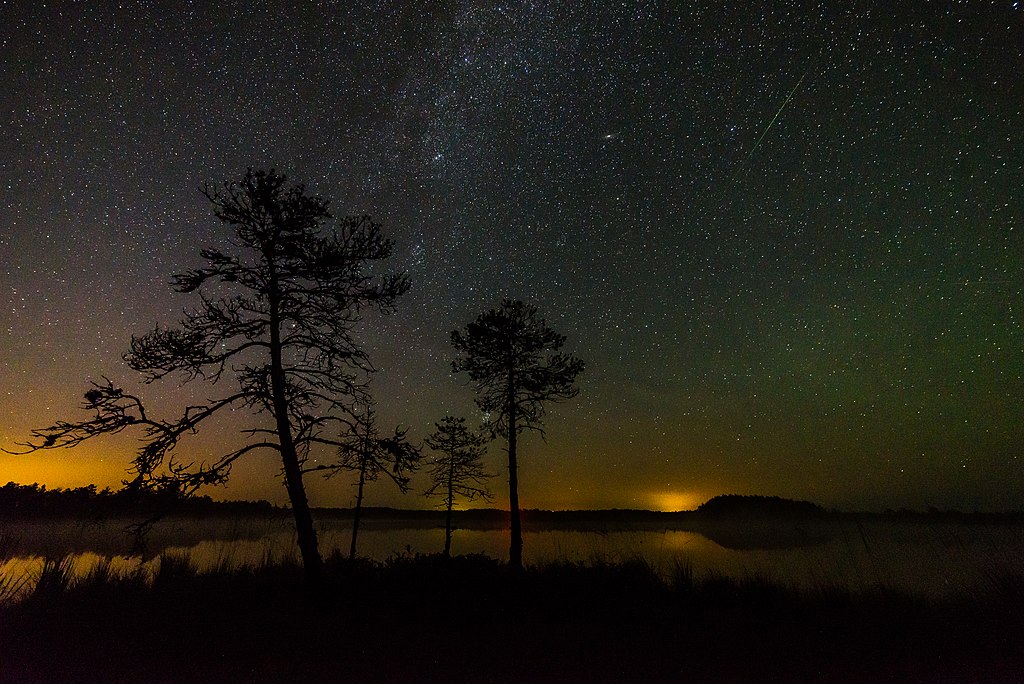
But fewer and fewer humans gaze at the stars and watch butterflies today, because light pollution drowns the night sky and butterflies have collapsed in numbers. I would say that light pollution has been the biggest crime in history. After all, it has stolen the sky from millions of people across whole continents. Reversing that enormous theft should be a priority of any serious and sane government. A clear sight of the night sky wouldn’t just restore to us the awe and majesty of the stars and moon: it would re-connect us with those long generations of our ancestors who watched and wondered and worshiped. There’s wisdom in the night. And brain-shaking power. Ancient Greek had the beautiful adverb ἀστέροθεν, asterothen, meaning “from the stars.” It also had the awesome adjective ἀστροβρόντης, astrobrontēs, meaning “star-thundering” and used of the god Mithras.
Poisoned by modernity
Modernity has stolen those ancient astral awes and inspirations from us, staining the night with light. And it’s stripped the day of another ancient source of beauty and otherness: those winged wonders known as butterflies. Reading A Curious Boy (2021), the autobiography of the British scientist Richard Fortey (born 1946), I was lost in wonder and envy at this description: “Small tortoiseshell butterflies, whose caterpillars feed on the common nettle, made orange clouds at the edges of fields.” (p. 65) He’s writing about the 1950s and goes on to say that, because nettles are now common: “Small tortoiseshells should be everywhere. Instead, [their] population has fallen by three-quarters in thirty years. The word ‘baffling’ has been used in official reports.” (p. 66)

More nettles, fewer butterflies — baffling! But it isn’t truly baffling. It’s a poisonous by-product of modernity, of the industrialization of farming and the countryside. And it’s an excellent example of what the great German sociologist Max Weber (1864–1920) called die Entzauberung der Welt — “the disenchantment of the world” that accompanied the industrial revolution and the rise of modern science. Ironically enough, the very word “disenchantment” is an example of what you might call the disenchantment of the English language. Entzauberung is pure German, but English lost its native ways of talking about magic and now uses French. And to my ear “dis-” is an ugly, bureaucratic prefix.
Re-enchant the familiar
So “disenchantment” is disenchanted. Which is appropriate enough. But if we had a native way of expressing the concept — “untivering” uses the same roots as the German — we wouldn’t know what we were missing. As John Lennon once sang: “You don’t know what you’ve got till you lose it.” When Richard Fortey was a boy in the 1950s, he perhaps wasn’t as enchanted by the actual sight of “orange clouds” of tortoiseshells as some of us, in the butterfly-bereft 2020s, can be by the mere thought of them. Similarly, do native speakers of German rejoice in the richness and rootedness of words like Entzauberung? No. Most of them don’t. It’s simply the word for that concept in German. And are they delighted by the consonant cluster that begins the word Zauber, pronounced tsow-ber and meaning “magic”? Again, no. But I’m not a native speaker of German and I love the ts- of Zauber, zeitig, zierlich, meaning “magic,” “timely,” “delicate.” It sounds to me like a little bell tinkling.
If you call that twee, then fine: I love the consonant cluster tw- in English too. Or I’ve learned to love it: we can re-enchant the familiar and learn to delight in what we once took for granted. If you don’t know the adjective twee, it means “excessively sentimental, pretty or coy.” It may come from a childish pronunciation of “sweet” (I like the consonant cluster sw- too). Winnie the Pooh (1924) is twee. You could even say it’s toxically twee, in the case of the Disney adaptation. But that book by Kenneth Graham (1859–1932) was an attempt at the re-enchantment of the world, at the reversal of the industrialization and urbanization that began to trample on the world in the Victorian era. Here’s another attempt at re-enchantment by a greater writer:
But where a passion yet unborn perhaps
Lay hidden as the music of the moon
Sleeps in the plain eggs of the nightingale. (“Aylmer’s Field” [1864])
That’s Tennyson (1809-92), who could conjure more with ten words than lesser writers can with ten thousand. I think Tolkien was a lesser writer. But a greater maker. And, born later, he saw even more clearly the harm done by the iron hooves of modernity. And by its glaring, glowing eyes. That’s why two things were so important to Tolkien: the trees trampled by the hooves and the stars banished by the eyes. Trees and stars are central to Lord of the Rings (1954–55), Tolkien’s flawed but literally fabulous attempt at the re-enchantment of literature:
Away high in the East swung Remmirath, the Netted Stars, and slowly above the mists red Borgil rose, glowing like a jewel of fire. Then by some shift of airs all the mist was drawn away like a veil, and there leaned up, as he climbed over the rim of the world, the Swordsman of the Sky, Menelvagor with his shining belt. The Elves all burst into song. Suddenly under the trees a fire sprang up with a red light.
‘Come!’ the Elves called to the hobbits. ‘Come! Now is the time for speech and merriment!’ (The Lord Of The Rings: The Fellowship of the Ring [1954], Book 1, chapter 3, “Three Is Company”)
Menelvagor is the real constellation Orion, perhaps the most easily recognizable star-shape and surely the most awesome. Tolkien has sharpened my appreciation of Orion with that singing phrase “Swordsman of the Sky.” But Tolkien was a Christian and also knew the power of a single star. When the magi came from the east in the Gospel of Matthew, they were following one astera, one star. And when it brought them to the birthplace of Jesus, “they rejoiced with exceeding great joy.” Was that Christian star an inspiration for a later passage in Lord of the Rings, when the overlooked and despised hobbits Frodo and Sam are starved and despairing amid the thorns and rocks of Mordor, poisoned realm of the Dark Lord Sauron? I think it must have been:
The land seemed full of creaking and cracking and sly noises, but there was no sound of voice or of foot. Far above the Ephel Dúath in the West the night-sky was still dim and pale. There, peeping among the cloud-wrack above a dark tor high up in the mountains, Sam saw a white star twinkle for a while. The beauty of it smote his heart, as he looked up out of the forsaken land, and hope returned to him. For like a shaft, clear and cold, the thought pierced him that in the end the Shadow was only a small and passing thing: there was light and high beauty for ever beyond its reach. (The Lord Of The Rings: The Return of the King [1955], Book 2, chapter 6, “Mount Doom”)
We can say the same of Clown World: it’s a small and passing thing. Its ugliness and evil will not endure. Starlight and the music of the moon will outshine and outsing the cacophoty and cacophony of modernity.