Select date

“Hatred of Anglos Is a Core Feature of Multicultural Ideology in Anglosphere Societies”, by Kevin MacDonald


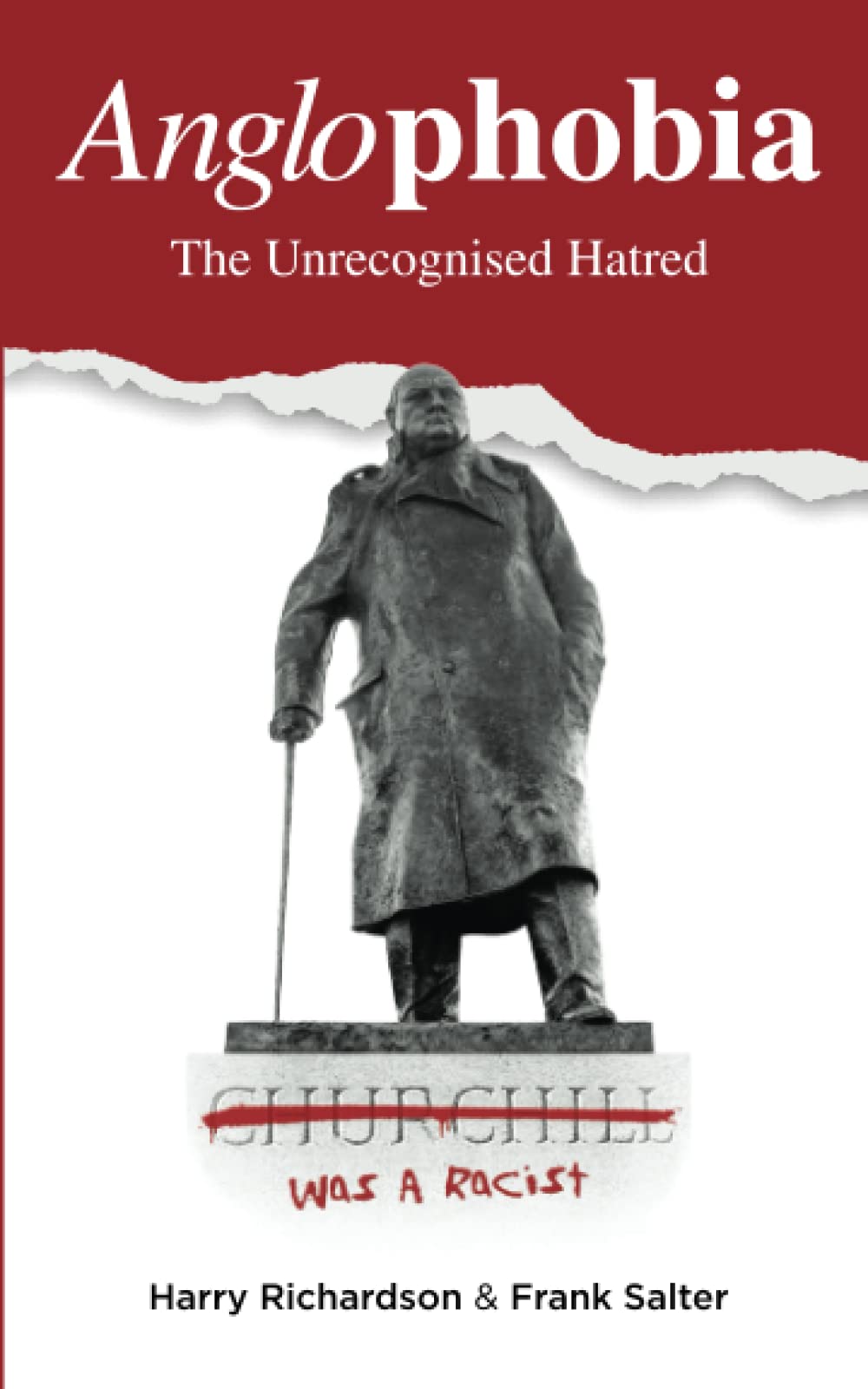
Anglophobia: The Unrecognized Hatred, by Harry Richardson and Frank Salter, is an excellent exposition of the hatred and dispossession of native White populations that is sweeping Western societies. Focusing particularly on Australia as a prime example, it is a valuable contribution to the effort to both inform European-descended peoples of the danger and injustice of the present situation and to motivate them to action on behalf of their legitimate interests.
Frank Salter needs no introduction to readers of The Occidental Observer (e.g., here and here). His theory of ethnic genetic interests develops a perspective that should be essential reading for a sophisticated understanding ethnicity and multiculturalism; it is foundational to the book under review. His co-author, Harry Richardson is the author of The Story of Mohammed: Islam Unveiled and editor-in-chief of The Richardson Post. They have written a highly readable book that, at around 200 pages, does not require a major investment of time.
Focusing on Anglos may be off-putting to some because it may seem to exclude European-descended groups not descended from the British Isles. However, the authors apply the term widely, to “people descended from the indigenous population of the British Isles in Australia and overseas as well as those who have assimilated into those populations. It can include people of European descent and western civilization as a whole” (5). Anglophobia, then, is hatred or mistrust directed at those populations. As they document in detail, Anglophobia is rife throughout the Western world, and often emanates from prominent figures in the elite media and academic world. Clearly Anglos and their interests are being systematically compromised.
As noted, this is a highly readable book, but it is also intellectually rigorous. Chapter 5, “Psychological and Biological Dimensions of Racism” notes that ethnocentrism is a biological universal that evolved for group living—likely in small groups of close kin. However, ethnocentrism spans a spectrum of variation, and “Anglos are among the world’s most individualist and least collectivist (in other words, non ‘racist’) cultures.” (16) Indeed, Western individualism is unique among the cultures of the world. But that doesn’t imply that Westerners have no tendency toward ethnocentrism at all, only that it is less central to Anglo cultures and more difficult to arouse. And when allegiance to the group is aroused, it is less likely to be directed at a group of co-ethnics, as we see with the phenomenon of civic nationalism—perhaps a fatal flaw in today’s multicultural West.
Underlying the theoretical basis of the book is Salter’s theory of ethnic genetic interests—that genetic diversity creates conflicts of interest between people and hence between people organized into ethnic groups, with the result that multiethnic, multicultural societies are prone to conflict: “As ethno-religious diversity increases, cohesion falls and conflict rises. Most people choose to live among their own people and to marry and make friends among them [as noted in their discussion of J. Philippe Rushton’s Genetic Similarity Theory]. Ethnic identity is adaptive because it allows people to defend their ethnic cultural and genetic interests” (22).
Chapter 6, “Sociological Dimensions of Racism,” discusses the costs of multiculturalism, citing some of Salter’s own research: “ethnic conflict sometimes leading to civil war, a loss of public trust and cooperation, reduced democracy, reduced economic growth, the emergence of ethnic criminal gangs, and psychological and social costs to majorities who become minorities” (24). Around the world we see societies racked by ethnic and religious conflict. The civil war in Syria pitted Sunnis against Shiites, and within these larger groupings there are particular ethnic groups, such as Alewites, Arabs, Kurds, Druze, and Assyrians. Then there’s China and the Uyghurs, Israelis and Palestinians, Hindus, Christians, and Muslims in India, and the Hutu and Tutsi in Rwanda. And then there are also the recent battles between Muslim migrant-descended groups versus the police in France and the Black Lives Matter riots in the U.S. in 2020. One would think that the reality of ethnic conflict would be obvious to anyone with or without any training in evolutionary biology, but this has not stopped our pro-multicultural elites from imposing it throughout the West.
Regarding the loss of public trust, the problem with collectivist, kinship-based cultures is that they do not produce high trust apart from close kin, resulting in much higher levels of corruption because individuals with power have a tendency to help their relatives; in Western cultures people readily trust and cooperate with non-kin on the basis of reputation (e.g., as honest or competent), not kinship connections.
The authors note that ethnic groups have common ancestors, that race is real, and that different races have different traits because they evolved in response to local environmental challenges. A nation, then, “is an ethnic group living in its homeland”—a definition that would imply, say, that ethnic Germans living in Germany constitute a nation. And it would also apply to settler societies like the U.S. and Australia that “developed as nation-states with unambiguous ethnic origins and identities” (28). Nationalism, then, reflects “the desire of a people for their own state” (29). Importantly in the current state of the West, “this analysis of nationalism … implies that they also wish their elites to share the nation’s identity” (30).
Such definitions would likely infuriate the left—for example, the Wikipedia article for ‘nation’ notes that “The consensus among scholars is that nations are socially constructed, historically contingent, and organizationally flexible”—ethnicity need have nothing to do with it. And it’s quite clear that Western elites typically do not identity with the ethnic identity of the native peoples. These elites desire top-down control of political institutions and utterly reject popular attitudes aimed at establishing the sovereignty of native, European-descended peoples.
Chapters 7, 8, and 9, describe the various types of Anglophobias. Chapter 7 “Examining Types of Anglophobia, Vilification” is by far the longest chapter, constituting 130 pages—~65 percent of the book. It is an exhaustive and well-sourced compendium of the hatred and distrust of native European-descended peoples throughout the West, with an emphasis on Australia. It begins with what is now standard wisdom among Western elites, that contemporary White people are responsible for any and all sins of their co-ethnics throughout history. This phenomenon of being able to blame contemporary Whites for past imagined or real grievances naturally leads to hatred of Whites, such as crude Anglophobic statements by Aboriginal activists (e.g., “in 2012 [Noel Pearson] was reported accusing government officials and a female journalist, to their faces of being ‘f***king racist white c***s’” (32).
But Aboriginals didn’t get to the point where such crude denunciations of government officials would become mainstream by themselves. They were aided by academic activists, such as Colin Tatz, perhaps the most egregious example of an academic with a major role in making anti-White hate mainstream in Australia (see Brenton Sanderson’s four-part article, “Colin Tatz and the Genocide Charge”). And in the U.S., we have Nicole Hannah-Jones, of the elite New York Times “1619 Project” fame, stating “the white race is the biggest murderer, rapist, pillager, and thief of the modern world” (34). Similar quotes can be found from anti-White activists in other Western societies. Clearly Western elites have no problem disseminating and condoning anti-White hate.
These points particularly struck me:
- Whites detract from but never enhance diversity: “Diversity in art requires reducing the number of white male artists whose work is shown in galleries.” (38)
- “Western colonialism is falsely portrayed as failing to provide any benefit to those who experienced it. In contrast, non-western colonizers such as the Ottomans, Moors, or Chinese, are mostly ignored or given mostly favorable coverage for their artistic, literary, musical, and architectural accomplishments.” (41–42)
- “Uniquely, Anglo and white people are blamed for slavery, despite the British being the first power to voluntarily end slavery, a process that began over 200 years ago.” (53)
- “For decades now, schools and universities in Australia and elsewhere in the Anglosphere have been teaching children to be ashamed of their history, culture, and people.”
- Andrew Jakubowicz, a Jewish professor of sociology and “seminal influence” on Australian multicultural education, preaches anti-White hate in the supposedly conservative Murdoch press, e.g., urging non-Whites to organize on behalf of their interests while condemning any attempt to do the same by White Australians. He also accuses “Australian journalists of suffering from too much ‘whiteness’ and ‘advancing white-only narratives.” (57–58)
- As always, media influence is important, so it’s noteworthy that the Murdoch empire also owns the Fox News Network in the U.S., the most widely viewed conservative network, the Wall Street Journal (also politically conservative), and multiple media outlets in the U.K., Australia, and throughout the world. The authors seem to have a special ire against Murdoch media and its woke political correctness while dominating conservative opinion. They also note that a column appeared in an Australian subsidiary of Murdoch’s empire stating “I just want to see less white mediocrity rewarded.” (63)
- “Critical Race Theory has enabled Structural Anglophobia,” in which people are rewarded for anti-Whites slurs. The entire reward-punishment structure of society is arrayed against Whites. (63)
- Any advocacy of White interests is routinely labeled “White Supremacy.” (69) “Today, anyone indicating even the mildest defence or advocacy of white or Anglo people risks being accused of a laundry list of epithets.” (69) For example, multiethnic immigration has resulted in loss of political and cultural power for Whites (74). Yet mentioning this critical interest of Whites is nothing more than “White Supremacy” in the eyes of our politically and culturally dominant hostile elites—elites that mandated or at least enabled these policies without popular support. Cultural change in the West is from the top down, and any sign of emerging populism is vigorously combatted.
- “Any differences in wealth, health, or education are … assumed to be due to ‘disadvantage’ which includes racism by the assumed ubiquitous power of whites.” (80) This ignores genetic and cultural causes for population differences, but bringing up issues such as race differences in IQ—a trait that is linked to a wide variety of outcomes associated with social mobility—would of course be immediately labeled as White supremacist pseudoscience, no matter how strong the evidence. The authors cite Charles Murray’s The Bell Curve and Arthur Jensen’s research in arguing that race is not a social construct and that genes are important for social class differences as mediated by traits like intelligence. (88, 90)
- But when you have media and academic power, there is no need to have real science on your side. And again, the “conservative” Murdoch empire spouts the leftist line, publishing a “Senior Journalist” who reviewed The Bell Curve as “morally offensive” and likened it to “Nazi pseudoscience”—“a mumbo jumbo amalgam of pseudo-science and highly dodgy statistics with, so far as I can see, zero intellectual credibility.” (92)
- While firmly coming down on the side of White ethnic genetic interests, the authors state that assimilation would solve the conflicts created by these population differences, but that elites favor multiculturalism in which different groups are encouraged to retain their identities and interests while Whites are condemned for doing so (95)—essentially a prescription for war against Whites and their interests. It should also be noted that some groups have resisted assimilation into Western culture. Particularly noteworthy are Muslim groups that are such an important aspect of European immigration. Other groups, such as Chinese who retain links to China or Jews involved in the powerful Israel Lobby in the U.S., may be highly assimilated to American culture but retain loyalties to other countries, resulting in potential conflicts of interest with the wider society. Still other groups, such as African-descended peoples, may have difficulty becoming part of the mainstream of Western societies because of low average IQ and proneness to crime.
- The authors examine motivations for Anglophobia. These are mainly progressive ideology, but include tribal sentiment. The authors note the Jewish community has taken a leadership role in promoting multiculturalism and immigration, for example by making alliances with more poorly organized, less motivated ethnic groups “In Australia, Jewish organisations sometimes act as de facto peak bodies for the multicultural sector as a whole, rallying, organizing, coordinating, and supporting the actions of other minority advocates.” (117) This leadership phenomenon also occurs in the US, where Jewish organizations have made alliances with a wide variety of non-White ethnic activist organizations.
- Irish-Catholics are another group with longstanding animosity to the Anglo-Australians. Their hostility toward Anglos stemmed from English colonial rule over Ireland, hostilities which were transported to Australia after Irish immigration. Discussion mainly features one Greg Sheridan, a journalist since the late 1970s for The Australian, another Murdoch publication. Like many multiculturalism advocates in the West, he has praised other countries, like India and China, for taking steps to ensure their cultural homogeneity. Influenced by his father, as a child he refused to stand for God Save the Queen or any other expression of British sovereignty in his school days. However, as in America, where such multicultural activism motivated by Irish hostility toward the British is residual at best, Jewish activism and its organizing influence on other imported minorities is quite clearly much greater than the residual anti-Anglo sentiments of some contemporary Irish-descended Australians. “Examples of Anglophobia can be found among Irish Catholics but that sentiment has not been general or inevitable.” (141) Examples can be found, but the organizational infrastructure, elite overrepresentation (implying the ability to make influential political donations and to fund NGOs), academic influence, and media ownership and influence are simply not there.
- The authors note that the colorblind, implicit ethnic activism typical of Anglo conservatives phrased in terms of abstract principles has repeatedly been defeated by explicit assertions of ethnic interests by those favoring multiculturalism and, I would argue, by the deluge of moralizing messages spewed out by the media (with the blessing of academia) that appeal to many Whites, especially women. I have presented the case that Western cultures create moral communities based on reputation rather than on kinship, and that conforming to messages disseminated by the elite media and educational system results in inclusion within a moral community that is now constructed and maintained by hostile elites, while ostracism and other penalties await those who dissent from these attitudes. And because of the weakness of such principle-based activism, a common thread among non-White activists throughout the West has been to promote the idea that Western nations are based on principles like egalitarianism with powerful moral connotations rather than the ethnic interests of their native peoples. However, these activists also advocate for some Western principles, such as freedom of expression, being sacrificed for moral reasons, the usual argument being that they might cause offense to “vulnerable groups,” thus preempting any discussion of race differences that may result in differences like IQ or criminality.
- Multicultural advocates never specify an end to immigration that would preserve a White majority, and the topic of the legitimacy of White identity itself is off limits for public discussion because of the power of hostile elites able to expunge opposing views from the media and academic world.
- The inevitable loss of White power that non-White immigration entails has not resulted in a utopian society of racial harmony but in ever greater levels of anti-White hate—an entirely predictable result. “Anglos face the prospect of becoming hated and powerless minorities in countries they established.” (149) All the utopias dreamed up by the Left inevitably lead to bloodshed—because they conflict with human nature. The classical Marxist Utopian vision of a classless society in the USSR self-destructed, but only after murdering millions of its own people. Now the multicultural utopian version that has become dominant throughout the West is showing signs of producing intense opposition and irreconcilable polarization.
- The authors make an important distinction between normal, legitimate ethnocentrism and hate. Thus, in discussing comments of Margaret Thatcher warning that Australia would become like Fiji where Indian immigrants had taken over, they note “She did not express dislike of Asians. She simply expressed affection and concern for white Australians.” (156) Similarly, as Salter has often noted, parents typically have a special love for their children without hating other children.
The long chapter on vilification leads into two brief chapters describing more extreme measures against the Anglo majority: hostile discrimination and violence. The many examples of vilification provide a warrant for hostile action. After all, if a group is indeed genocidal and intent on oppressing people unlike themselves, then aggressive measures against them are warranted. Hostile discrimination is indicated by governments ignoring examples of Anglo disadvantage (e.g., a higher rate of deaths in custody) while funding the ethnic activist infrastructure arrayed against the White majority and simultaneously excluding Anglo advocates from formulating policy, a phenomenon that began during the mid-1970s. White advocates are completely excluded from the mainstream media, including the conservative media.
Anti-White violence is fairly minimal in Australia, but there are ethnically constituted criminal gangs and Whites are fleeing some schools because of violence and hatred directed against Whites. A more extreme example comes from the U.K. where Muslim rape gangs have systematically preyed on disadvantaged White girls, with the authorities ignoring the problem for decades for fear of stoking racial tensions; a similar phenomenon is well known in Sweden where a 2018 study found that men with a migrant background constituted 58 per cent of rape convictions. The authors note that in the U.S., the vast majority of interracial crime is committed against White Americans.
The authors make special note of the sociopathic personalities of two of the Anglo leaders of the multicultural revolution, noting their criminal ties and the personal benefits they have received by championing multiculturalism. The same can be said about the many White politicians who have championed White dispossession while achieving fame and fortune in the process.
Finally, as predicted by Prof. Andrew Fraser, African immigrants have much higher rates of criminality in general than White Australians (e.g., Sudanese migrants are 22 times more likely to commit serious assault, 129 times more likely to commit aggravated burglary, and 17 times more likely to commit sexual assault than native-born Australians) (189). Fraser was convicted for making statements offensive to the African-Australian community.
* * *
ORDER IT NOW
To conclude, the anti-White revolution throughout the West is an elite project directed against the White majority. The main actors are:
- well-funded and well-organized ethnic minorities with historical or imagined grudges against the White majority;
- well-intentioned Whites who have optimistic views of the multicultural future and guilt about the past induced by the media and educational system that are hostile to White identity and interests;
- other Whites who conform to the reward-punishment structure of society established by these hostile elites and are loathe to suffer the consequences of dissenting from the establishment narrative;
- sociopathic Whites who are only too eager to betray their people to enhance their own fame and fortune.
This is an important book for White advocates to promote. It is a compendium of the anti-White hatred that has been unleashed by multiculturalism throughout the West and a terrifying glimpse into a future where formerly White majorities will inevitably become vulnerable, powerless, and hated minorities in the countries they built unless there is a sea change in the culture of the West that acknowledges the legitimate interests of White people.