Select date

Artificial Intelligence: The Release of the Upcoming Open AI Model, GPT-5



All Global Research articles can be read in 51 languages by activating the Translate Website button below the author’s name.
To receive Global Research’s Daily Newsletter (selected articles), click here.
Click the share button above to email/forward this article to your friends and colleagues. Follow us on Instagram and Twitter and subscribe to our Telegram Channel. Feel free to repost and share widely Global Research articles.
***
It has been just over two months since the launch of GPT-4, but users have started anticipating the release of GPT-5. We have already seen how capable and powerful GPT-4 is in various kinds of tests and qualitative evaluations. With many new features like ChatGPT plugins and internet browsing capability, it has gotten even better. Now, users are waiting to learn more about the upcoming Open AI model, GPT-5, the possibility of AGI, and more. So to find in-depth information about GPT-5’s release date and other expected features, follow our explainer below.
When GPT-4 was released in March 2023, it was expected that OpenAI would release its next-generation model by December 2023. Siqi Chen, the CEO of Runway also tweeted saying that “gpt5 is scheduled to complete training this December.” However, speaking at an MIT event in April, OpenAI CEO Sam Altman said “We are not and won’t for some time” when asked if OpenAI is training GPT-5. So the rumor of GPT-5 releasing by the end of 2023 is already quashed.
That said, experts suggest that OpenAI might come out with GPT-4.5, an intermediate release between GPT-4 and GPT-5 by October 2023, just like GPT-3.5. It’s being said that GPT-4.5 will finally bring the multimodal capability, aka the ability to analyze both images and texts. OpenAI has already announced and demonstrated GPT-4’s multimodal capabilities during the GPT-4 Developer livestream back in March 2023.

GPT-4 Multimodal Capability
Apart from that, OpenAI currently has a lot on its plate to iron out on the GPT-4 model before it starts working on GPT-5. Currently, GPT-4’s inference time is very highand it’s quite expensive to run. GPT-4 API access is still hard to get by. Moreover, OpenAI just recently opened up access to ChatGPT plugins and internet browsing capability, which are still in Beta. It’s yet to bring Code Interpreter for all the paying users, which is again in the Alpha phase.
While GPT-4 is plenty powerful, I guess OpenAI realizes that compute efficiency is one of the key elements for running a model sustainably. And well, add new features and capabilities to the mix, and you have a bigger infrastructure to deal with while making sure that all checkpoints are up and running reliably. So to hazard a guess, GPT-5 is likely to come out in 2024, just around Google Gemini’s release, if we assume government agencies don’t put a regulatory roadblock.
GPT-5 Features and Capabilities (Expected)
Reduced Hallucination
The hot talk in the industry is that GPT-5 will achieve AGI (Artificial General Intelligence), but we will come to that later on in detail. Besides that, GPT-5 is supposed to reduce the inference time, enhance efficiency, bring down further hallucinations, and a lot more. Let’s start with hallucination, which is one of the key reasons why most users don’t readily believe in AI models.
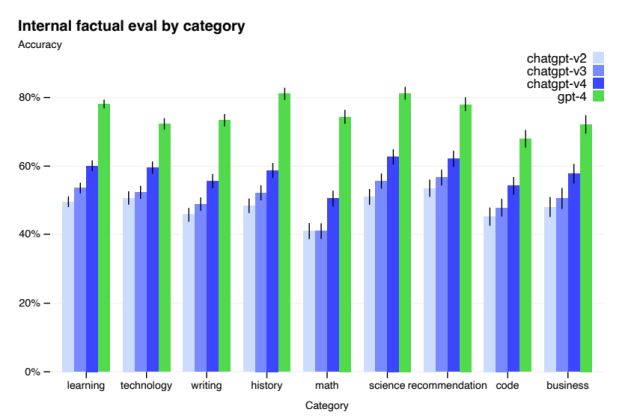
GPT-4 Accuracy Test
According to OpenAI, GPT-4 scored 40% higher than GPT-3.5 in internal adversarially-designed factual evaluations under all nine categories. Now, GPT-4 is 82% less likely to respond to inaccurate and disallowed content. It’s very close to touching the 80% mark in accuracy tests across categories. That’s a huge leap in combating hallucination.
Now, it’s expected that OpenAI would reduce hallucination to less than 10% in GPT-5, which would be huge for making LLM models trustworthy. I have been using the GPT-4 model for a lot of tasks lately, and it has so far given factual responses only. So it’s highly likely that GPT-5 will hallucinate even less than GPT-4.
Compute-efficient Model
Next, we already know that GPT-4 is expensive to run ($0.03 per 1K tokens) and the inference time is also higher. Whereas, the older GPT-3.5-turbo model is 15x cheaper ($0.002 per 1K tokens) than GPT-4. That’s because GPT-4 is trained on a massive 1 trillion parameters, which requires a costly compute infrastructure. In our recent explainer on Google’s PaLM 2 model, we found that PaLM 2 is quite smaller in size and that results in quick performance.
A recent report by CNBC confirmed that PaLM 2 is trained on 340 billion parameters, which is far less than GPT-4’s large parameter size. Google even went on to say that bigger is not always better and research creativity is the key to making great models. So if OpenAI wants to make its upcoming models compute-optimal, it must find new creative ways to reduce the size of the model while maintaining the output quality.
Came back to a project I was working on with OpenAI GPT-4 API, noticed the API response times were pretty slow.
Tested average response on a fresh context for "Can you show me a basic scatter matplotlib example?"
GPT-3.5: 13.4 seconds
GPT-4: 44.7 seconds.
⏱️