Select date

Sweet Dreams of Christian Nationalism, by Andrew Fraser


Introduction
Weak-willed Anglo-Protestants in Canada meekly acquiesced in official recognition by their federal government of Jewish political theology in the form of the Holocaust mythos. This is hardly surprising in light of their failure a few years earlier to resist repeal of a milquetoast Criminal Code provision prohibiting only the most egregiously vulgar displays of blasphemous libel. Having already surrendered the historical theological hegemony of Protestant Christianity in English Canada, Anglo-Protestants hardly seem likely to resurrect the ethnoreligious mythos which inspired the Old English church of their medieval ancestors. Such Protestant pusillanimity stands in stark contrast to the aggressively ethnocentric political theology of organized Jewry, not just in Canada, but across the entire Anglosphere. If contemporary WASPs had any self-respect, they would rush to remedy the absence of a spiritually compelling, bioculturally adaptive, Anglican/Anglo-Protestant ethnotheology.
Optimism on that score is probably unwarranted, however. Few WASPs know or care much about their ethnoreligious origins. Even most members of the Anglican church believe that it came into being with the sixteenth-century Protestant Reformation. It was then that Henry VIII formally broke with Rome for reasons of state. Before then, the ecclesia Anglicana had been absorbed within the institutional framework of a papal monarchy asserting universal jurisdiction. Allied with a French-speaking, Anglo-Norman ruling class, the Roman Catholic papacy had no reason to preserve the explicitly ethnoreligious character of the Old English Church. Nor did the break with the papacy precipitate an Anglo-Saxon ethnoreligious revival; beyond replacing the Pope with the King as the formal head of the Church of England, the new state religion retained its traditional commitment to the catholicity of the Three Creeds enshrined in the Thirty-Nine Articles. But, whatever the intentions of those who set the Protestant Reformation in motion, over the next few centuries, the combined impact of English and American Protestantism deformed beyond recognition the very idea of Christian nationhood.
As James Kurth writes, the doctrinal base of the Anglo-Protestant Reformation “protested against the idea that the believer achieves salvation through a hierarchy or a community, or even the two in combination.” Of course, the reformed Church of England “accepted hierarchy and community for certain purposes, such as church governance and collective undertakings [but] they rejected them for the most important of purposes, reaching the state of salvation.” Protestant reformers held that “the believer receives salvation through an act of grace by God.” It is divine grace that “produces in its recipient the faith in God and salvation that converts him into a believer.” Hence, “reformers placed great emphasis on the Word, as revealed in the written words of the Bible.” They denied that only a priestly hierarchy could deliver the right interpretation of the Bible to individual believers. Indeed, authoritative hierarchies were more likely to impede the work of divine grace upon individual believers seeking a direct relationship with God through personal study of the Holy Scriptures.
The initial “Protestant rejection of hierarchy and community in regard to salvation spread to their rejection in regard to other domains of life as well.” From the beginning, “some Protestant churches rejected hierarchy and community in regard to church governance and local undertakings.” Nowhere were such anti-institutional tendencies more pronounced than “in the new United States, where the conjunction of the open frontier and the disestablishment of churches in the several states enabled the flourishing of new unstructured and unconstrained denominations.”
Over the past five-hundred years, the Protestant faith gradually lost its spiritual intensity, a process which began when salvation by grace was replaced by the “half-way covenant” in which grace could be evidenced by works. Then, even “the idea of the necessity of grace began to fade.” Once “work in the world was no longer seen as a sign of grace but as a good in itself,” good works offered the promise of personal salvation. The transformation of religious experience into a personal relationship to God was an early expression of Anglo-Protestant individualism. In our own time, the transformation of religion into a personal and private matter has culminated in the recognition of universal human rights as the sacred birthright of every individual. According to Kurth, “this means that human rights are applicable to any individual, anywhere in the world.”
Thus, “the ultima ratio of the secularization of the Protestant religion” has become an “expressive individualism” in which the imperial self is free to express his/her/its “contempt for and protest against all hierarchies, communities, traditions, and customs.” In other words, Kurth writes, “the long declension of the Protestant Reformation has reached its end point in the Protestant Deformation,” producing a religion without God, “a reformation against all forms.”
Expressive individualism in America was inspired by the romantic-humanistic ethic prevalent among Progressive reformers in the late nineteenth and early twentieth centuries, most of whom were middle-class WASPs. But it was the massive wave of immigration from southern and central Europe which provided the raw material enabling the WASP clerisy to manufacture the cosmopolitan spirit characteristic of urban America during the Progressive Era.
Confronted with the tightly-packed masses of immigrants in New York and Chicago, middle-class reformers learned “to interpret Protestant Christianity in a very peculiar, almost secular way.” In adapting “the tenets of egalitarian humanism to their polyglot, culturally-charged context,” the reform movement established “settlement houses” to assist alien newcomers in adjusting to life in America. Anglo-Protestant reformers such as Jane Addams and John Dewey led the campaign to recognize and accept immigrant cultures “as a ‘gift’ to the American amalgam.” They implored the American nation “to shed its Anglo-Saxon ethnic core and develop a culture of cosmopolitan humanism, a harbinger of impending global solidarity.” Other Anglo-Protestant reformers such as William James urged their fellow WASPs to embrace a pragmatic approach to religious experience, choosing whichever “type of religion is going to work better in the long run.” It did not matter much whether God was dead, so long as “we form at any rate an ethical republic here below.”
An American century later, Kurth notes that, by then, almost every nation with a Protestant religious tradition has “by now adopted some version of the human rights ideology.” One might add that the many manifestations of Anglo-Protestant humanism in various corners of the Anglosphere do not always maintain logical consistency. In Canada, for example, the offence of blasphemous libel was removed from the Criminal Code in the name of the universal human right to free expression just four years before the decision to criminalize anyone who condones, denies, or downplays the Jewish Holocaust. No-one should be surprised to learn that organized Jewry overwhelmingly approved both pieces of legislation. After all, Jews are now held up as exemplary victims of those who would deny or abuse human rights. At the same time, however, neither measure appears to have encountered any serious opposition from Anglo-Canadian Protestants, even though both (especially taken together) would have been interpreted as deformations of Christian nationhood by earlier generations of Protestants in English Canada. Almost everywhere in the Anglosphere, such Protestant deformations of traditional Christian mores have been consecrated, sooner or later, by globalist churches with the full support of the Holocaust industry.
All too often, either the Church of England or its Anglican successors in Australia, Canada, New Zealand, and the United States have been in the vanguard of that moral declension. We need to understand the historical roots of such dysgenic institutional behavior. Unfortunately, even the recent rise to prominence of “Christian nationalism” in the USA is unlikely to reverse the Protestant Deformation.
Christian Nationalism, American-Style
A recent book by Stephen Wolfe making The Case for Christian Nationalism has much to recommend it. As an unapologetic paleoconservative, the author blames the postwar Global American Empire (GAE) for undermining Christian nationhood at home in the USA, perhaps terminally. “In the New America,” he observes, “the ground of patriotic sentiment is away from the Old America. Thus, civic holidays, national heroes, memorials, and patriotic events are all colored according to the grand narrative of progress.” Even mainstream conservatives are committed to the progressivist narrative of US history, so much so that they are the staunchest supporters of the military which, they believe, fights to defend “the American way of life.” But, despite his experience as a West Point graduate serving in the U.S. army in the world-wide “fight for democracy,” Wolfe now advises young men not to get “blown up in the name of liberal imperialism; shed blood to open up markets for Netflix and Pornhub; [or to] make the world safe for dudes in dresses.”
He holds the GAE responsible for undermining the moral and cultural foundations of Christian nationhood. Not only has the imperial regime imposed homosexual marriage upon all the states by judicial fiat, it also steeps young minds in critical race theory and gender-bending ideology. Meanwhile, the floodgates have been opened to a tidal wave of non-Western immigration, further eroding the once-dominant Anglo-Protestant character of American national identity. Nevertheless, in opposition to the relentless onslaught of nihilistic disenchantment, Wolfe holds out the hope that Christian nationalism could inspire a “true revolt against the modern world.” He believes in the possibility of “the pursuit of higher life—both the life to come and a life on earth that images that life to come.” Indeed, he insists that Christians can still regard the world as their “inheritance in Christ.” With undisguised passion, Wolfe presents Christian nationalism as “a collective will for Christian dominion in the world.”
But what prevents Christians from exercising the biblical mandate to exercise dominion over this world? The problem, as Wolfe sees it, is essentially psychological. American Christians “have been so conditioned to affirm what we feel to be good that the feeling determines for us what is true. Conversely, we deny any thought that we feel is bad.” Some beliefs, notably Christian nationalism, are psychologically more difficult for churchgoers to entertain than others.
Most Anglo-American Protestants, for example, have long been conditioned, by both church and state, to regard religion as a private and personal matter. Wolfe’s vision of Christian nationalism cuts across the grain of those habits of religious privatism. For example, Wolfe calls upon civil government to protect and preserve the exclusively Christian identity of the nation by penalizing “open blasphemy and irreverence in the interest of public peace and Christian peoplehood.” Few mainstream Christians will be “comfortable” with his argument that “Sabbath laws are just, because they remove distractions for holy worship.”
Similarly, Wolfe’s case for upholding the legitimacy of traditional gender hierarchies has already attracted accusations of “misogyny.” On this issue, however, Wolfe pulls no punches. He declares that Americans “live under a gynocracy—a rule of women.” He concedes that this “may not be apparent on the surface, since men still run many things. But the governing virtues of America are feminine vices, associated with certain feminine virtues, such as empathy, fairness, and equality.” Any such defense of “toxic masculinity” runs contrary to feminist norms eagerly enforced by the established secularist regime. But Wolfe remains unrepentant, declaring flatly that the “rise of Christian nationalism necessitates the fall of gynocracy.”
Inevitably, therefore, the very idea of Christian nationalism represents an existential threat to the Woke liberal regime. Wolfe bluntly characterizes “the secularist ruling class” as “the enemies of the church and, as such, enemies of the human race.” At the same time, he recognizes that to resist the moral and political consensus enforced by a godless regime, Christians must summon the hitherto absent strength of will necessary to affirm what is true even when it causes them enormous psychological discomfort.
To his credit, Wolfe admits that many Christian leaders deliberately undermine political action in opposition to the secularist regime. Instead, they “advance a sort of Stockholm syndrome theology” which excludes “Christians from public institutions” but requires them “to affirm the language of universal dignity, tolerance, human rights, anti-nationalism, anti-nativism, multiculturalism, social justice, and equality.” Wolfe deplores the fact that any Christian who “deviates from these dogmas” faces exclusion from the ranks of respectable churchgoers. What, then, is to be done? Wolfe turns to Christian political theory in search of an answer. Unfortunately, the result, even for many of his Christian readers, leaves much to be desired.
Nationalism and Christianity
Wolfe’s book has attracted wide interest in a multitude of online reviews and podcast discussions. Understood as a political program, Wolfe’s conception of Christian nationalism is often pronounced DOA, dead on arrival. For example, Neema Parvini, author of The Populist Delusion, dismisses Christian Nationalism as a “political fantasy.” In fairness, however, Wolfe himself readily agrees that, on the national level at least, the idea has little chance of success. He does not present the book as a viable “action plan.” Instead, he sets out the principles that should guide any Christian nation. Wolfe’s preferred model of Christian nationalism is grounded in a Reformed Presbyterian version of two-kingdoms theology which distinguishes between God’s redemptive work of salvation and his providential governance of earthly affairs.
Accordingly, he defines Christian nationalism in the following manner:
Christian nationalism is a totality of national action, consisting of civil laws and social customs, conducted by a Christian nation as a Christian nation, in order to procure for itself both earthly and heavenly good in Christ.
In other words, “Christian nationalism is nationalism modified by Christianity” which is to say that “the Gospel does not supersede, abrogate, eliminate, or fundamentally alter generic nationalism, it assumes and completes it.” Apart from Christianity, therefore:
Nationalism refers to a totality of national action, consisting of civil laws and social customs, conducted by a nation as a nation, in order to procure for itself both earthly and heavenly good.
According to Wolfe, “the specific difference between generic nationalism and Christian nationalism is that, for the latter, Christ is essential to obtaining the complete good.” The ordering of people to heavenly life would have been “a natural end for even the generic nation” but for the fall. “Had Adam not fallen, the nations of his progeny would have ordered themselves to heavenly life.” Following the advent of Christ as the Redeemer, “the Gospel is now the sole means to heavenly life.” If nations are to achieve their “complete good,” even “earthly goods ought to be ordered to Christ.” Without Christ, pagan and secularist nations may be “true nations but they are incomplete nations. Only the Christian nation is a complete nation.”
Wolfe situates all nations and nationalisms, Christian or otherwise, within a Reformed Presbyterian vision of salvation history. Wolfe describes his argument as a “Christian political theory” rather than a “political theology” grounded in his own biblical exegesis. His understanding of Scripture relies instead upon the work of sixteenth- and seventeenth-century Reformed theologians. That Reformed tradition developed within a metanarrative framework established by Augustine of Hippo (354–430 AD). Augustine and the later Reformed tradition posit a fundamental metaphysical distinction between the City of Man and the City of God. Both interpret Scripture through the lens of a Hellenistic hermeneutic envisioning the creation ex nihilo and future destruction of the earthly world as the appearance and foreordained disappearance of corruptible material existence following the Day of Judgement.
Augustine’s neo-Platonic cosmology presupposed the absolute dependence of both mankind and the material world itself upon an omnipotent, omniscient, and omnipresent God. Following in Augustine’s footsteps, Wolfe believes that modern Americans seduced by the delights of mortal life in Mammon have wandered far from heavenly goods, thereby losing sight of “the invisible things of God.” Given the inherent difficulty mortal beings experience in apprehending such invisible divine “objects,” Wolfe, too, recognizes our spiritual debt to the revealed Word of God. He holds fast to the Augustinian doctrine that, guided by the light of the Gospel, Christian nations should view their entire existence as a journey towards the unchangeable heavenly life, and their affections should be entirely fixed upon that.
It follows that “politics” in every Christian nation must be understood as “the art of establishing and cultivating necessary conditions for social life for the good of man.” The point of a Christian political life comes from God; it must aim to create civil governments capable of shoring up the social order “for man’s complete good.” In other words, the difference between generic nationalism and Christian nationalism is that the latter “expresses a Christian nation’s will for heavenly good in Christ and that all lesser goods are oriented to the higher good.”
Presented in such universalistic, all-encompassing terms, Wolfe’s “Christian political theory” transforms “politics” into “public administration.” Civil government, he says, must aim to identify the most effective earthly means within any given society to realize a heavenly destiny common to faithful believers in every Christian nation.
Action versus Behavior in Political Theory
In this context, the “totality of national action” is better understood as a socially ordered system of behavior premised upon the existence of one common interest, i.e., the interest of every Christian society not just in its own earthly survival and collective vitality but also in the heavenly salvation of every believer. Public administration, as distinguished from politics, may become detached from natural persons and lodged instead in a social life-process which requires that human behavior conform to the developmental needs (both spiritual and material) of society. Wolfe seems unaware that “politics,” strictly speaking, originally required the institutionalization of a realm of freedom in which civic action became possible.
The distinction between “action” and “behavior” was central to Hannah Arendt’s political theory. In her view, “action” was the means by which the individual could distinguish himself from others in the public realm. For a citizen to leave the private sphere of the household “to devote one’s life to the affairs of the city demanded courage” because entry into the “political realm had first to be ready to risk his life, and too great a love for life obstructed freedom, was a sure sign of slavishness.” With the administrative victory of society over the public realm, the possibility of individual action gives way to the statistical regularities of human behavior, while the equality of men possessed of the acknowledged right to reveal themselves in their own distinctive public persona becomes degraded into conformism to the assumed common interest of society as a whole.
Not only does Wolfe’s “Christian political theory” fail to offer an “action plan,” it fails even to recognize the existential need for a public realm. It is only in such a res publica that individuals, families, tribes, and nations are able to distinguish themselves, one from the other, through exemplary modes of civic action. Such recognition of the distinctive character of political life has been the exception rather than the rule in human affairs. Arendt may have been concerned primarily with the phenomenology of politics, but she well understood that the unique character of a civic mode of action was first discovered in ancient Greece, most famously in the Athenian polis. To fully understand the early experience of politics and its decline in the totally administered societies characteristic of the modern transnational corporate welfare state, it is necessary to study, not just its biocultural preconditions but their historical development and the history of theological-political subversion. Unfortunately, Wolfe’s argument treats Christianity, nationalism, politics, and civil government in generic, free-floating terms altogether detached from the biocultural history and theological presuppositions of any particular Christian nation.
Christian Meier observes that “ever since the Renaissance it has been possible to use the word politics to designate any action of which the state is capable.” Wolfe simply assumes that this modern sense of the term effectively delimits its meaning, past, present, and future. In classical Athenian democracy, however, the polis became identical with its citizens and “the majority of citizens gained supreme authority (with the help of those nobles who placed themselves in their service).” For Aristotle, the word political meant “appropriate to the polis.” His concept of politics denoted it as “the science of the highest good attainable through human action.” Politics presupposed the unity of the citizenry as a whole: “the general civic interest…transcended all particularist interests.” As a consequence, “there was no way in which anything resembling a state could establish centralized power or state institutions that were divorced from society.”
This great experiment in participatory politics rested on the “importance of familial and religious piety in Athenian democracy.” Indeed, “those who failed in their familial, religious, or military duties” could be excluded from the polis. The civic unity of the polis “was founded on family, patriarchy, community, military courage, common ancestry, and an intense patriotism.” Indeed, it has been said that Athenian democracy was based upon a prototype of “racial citizenship.” In contrast to other Greeks, “Athenians claimed to be racially pure…having supposedly sprung from the Attic soil as true autochtones.” Bolstered by that myth of autochthony, the direct democratic politics associated with Athenian citizenship “was grounded in strong racial identity and pride in one’s lineage.” In short, Athens was “a spirited and nativist democracy” in which even prominent residents not of Athenian blood (such as Aristotle) were excluded from citizenship.
There was also an important geopolitical dimension to the character of the Athenian polity. This can be seen in the contrast between Athens and Sparta. In the eyes of an imperial power such as the mighty, multinational, military monarchy of Persia, Athens and Sparta represented a Greek power which “was that of patriotic, fractious little republics, defined by civic freedom.” The particular forms of civic power in each city-state emerged out of very different geopolitical circumstances. Sparta was a land power characterized by autarchy, hierarchy, community, and a rigorous military discipline organized to guard against the danger of rebellion by an enslaved population of helots. Athens was a sea power in which international trade and a strong navy encouraged a commercial culture, democracy, individualism, and technology.
Guillaume Durocher suggests that “Athens embodied the long-term superiority of dynamic commercial, democratic-individualist, and technologically advanced systems over static, austere, hierarchical-communitarian, and primitive ones.” Like the modern, Anglo-Saxon thalassocracies in Great Britain and the United States, Athens was “dynamic and expansive in peacetime” while “able to adopt sufficiently hierarchical-communitarian characteristics in wartime.”
At the same time, the high level of social solidarity in both polities and its vital contribution to their respective war-fighting abilities gave the Greeks a sophisticated and distinctive understanding of the friend-enemy distinction. A bright-line distinction was drawn between one’s enemies inside the polis and outsiders threatening society as a whole. The modern German jurist Carl Schmitt identified the difference between friend and foe as the existential essence of politics. He took note of the gradations in the Greek understanding of enmity encoded in the koine dialect of ancient Greek and later carried over into the New Testament. Unfortunately, the linguistic precision of the Greek original was lost when translated into English or German. As we have seen, Wolfe relies upon English versions of Reform theology for his rare forays into biblical exegesis. He may never have recognized, therefore, that the (mis)translation of Matthew 5:43-44 conceals a fundamental fault line between idealist and realist political theologies.
When Jesus enjoined his followers to “love your enemies,” he was not laying the moral foundation of Christian pacifism. Wolfe is no pacifist, however; he vigorously defends the martial virtues “as a necessary feature of masculine excellence.” Nevertheless, like most Christians, Wolfe strenuously resists the temptation to build our identities by discriminating between “us” and “them.” Having internalized the anti-discrimination ethos of the civil rights revolution, many Christians mistakenly believe that Jesus asked his followers to “love” their persecutors. As a matter of fact, he merely urged them to “pray for them which despitefully use you, and persecute you” (Matt.5:44). Carl Schmitt took a more realistic view of the Sermon on the Mount. He tackled the translation issue, clarifying what Jesus meant when asking his audience to love their “enemies.” In the Greek original, Jesus uses the word echthroi to denote persons who might be “private” or “personal” enemies of their fellow citizens (or, in this context, fellow Jews engaged alongside him in a spiritual battle to fulfill the law of Old Covenant Israel). He was not talking about the “public” or “alien” enemies (polemoi) of the Jewish people as a whole.
Unless one keeps that distinction in mind, Christian charity can easily degenerate into a pathological altruism incapable of addressing existential threats to one’s nation as such. Christian nationalism should be based upon a realist political theology which, in turn, should ground itself in a multi-dimensional understanding of the history and biocultural foundations of every Christian nation.
The Origins and Ends of Mankind in History and Christian Mythology
History can be understood as an intellectual discipline providing narrative or analytical accounts of past events based upon the empirical investigation of more or less reliable sources. It is worth noting that “scientific” history in this sense was the product of two Greeks writing in the fifth century BC. According to R.G. Collingwood, Herodotus and Thucydides “quite clearly recognized both that history is, or can be, a science and that it has to do with human actions.” Their histories were not legends; they were research. They were “an attempt to get answers to definite questions about matters of which one recognizes that one is ignorant.” Nothing could be further from this methodology than Wolfe’s universal, one size fits all, and thoroughly unscientific schema of salvation history.
Needless to say, the study of human biocultures is also a scientific enterprise which relies upon the empirical study of interactions between biological and cultural phenomena as they have evolved within various population groups. By contrast, Wolfe’s account of Christian nationalism simply presupposes a neo-Augustinian vision of the divinely-ordained stages of the salvation history of mankind, a generic “Christian narrative of creation, fall, redemption, and glorification.” This story presents the past, present, and future of humanity in general as it unfolds in four stages: a state of integrity; a state of sin; a state of grace; and, finally, the state of glory.
Wolfe’s speculative account of the prelapsarian state of integrity is truly breathtaking in what one critic describes as its intellectual irresponsibility. He spends an entire chapter describing the sort of “civil fellowship” that Adam’s progeny would have arranged but for the fall. As Bob Stevenson observes, Wolfe’s vision of the prelapsarian world rests on the biblical account found in
61 verses, comprised of 1,253 words describing the world before our first parents saw the goodness of the forbidden fruit, took and ate. If we only include the parts where humanity exists—and thereby human society, sociability, diversity of gifts, normative roles etc.—that number is reduced to 36 verses, consisting of 764 words.
It is impossible to construct an account of what a counter-factual prelapsarian world would look like on the basis of those 764 words. Wolfe’s uses his own reason and imagination to reconstruct the structure of the unfallen world that might have been. Wolfe contends that families, tribes, nations, and cultural diversity would all have been natural in the original state of integrity. So, too, would have been hierarchy and the need for the masculine leadership and the martial virtues essential to self-preservation. Wolfe’s portrait of the state of integrity calls to mind the image of the sinless noble savage and is equally devoid of evidence grounded in physical or cultural paleo-anthropology. Wolfe appears to be one of those Christians for whom it has long been “standard doctrine that every member of the human race is descended from the biblical Adam.” How interesting, therefore, that it was a seventeenth-century “Calvinist of Portuguese Jewish origin from Bordeaux” who challenged Christian orthodoxy with the “beguilingly simple” claim “the human beings existed before the biblical Adam.”
The impact of Isaac La Peyrère (1596–1676) on theological hermeneutics was such that many modern Christian scholars now accept that, in Hebrew hermeneutics, Adam need not be, and probably was not conceived as the first human being (see also Andrew Joyce’s comments, here and here). On that reading, sin was in the world well before Adam. Adam’s story was not about universal human origins but rather about the origins of Israel. Having been created at the exodus and brought to the promised land of Canaan, Israel was bound by a law which it disobeys, suffering exile as a consequence. In this way, “Israel’s drama—its struggles over the land and failure to follow God’s law—is placed into primordial time.”[38] In other words, the biblical Adam is better understood in mythical terms as proto-Israel.
In any case, after the fall, according to Wolfe’s rendition of the orthodox Reformed hermeneutic, the world becomes subject for the first time to sin, creating the need to augment the powers of civil government to suppress sin and maintain civil order. With the advent of Christ, however, the redemption of mankind becomes possible and “Christians take up the task of true and complete humanity.” Wolfe contends that “restorative grace sets the redeemed apart on earth—constituting a redeemed humanity on earth—and, on that basis, Christians can and ought to exercise dominion in the name of God.” In that way, “grace perfects nature.” Christians “are perfected for heavenly life but also restored in their perfection for obedience in earthly life.”[39] Wolfe never considers the possibility that the mission of the historical Jesus was limited in scope: i.e., the redemption of Old Covenant Israel, not humanity at large.
Nations and Ethnicity

Stephen Wolfe
When discussing the meaning of nationhood, Wolfe rejects “the so-called creedal nation concept” according to which a nation is “united around a set of propositions that creedalists consider universally true or at least practically advantageous for all and so readily acceptable by all.” His target is the “egalitarian themes and rights-talk” characteristic of mainstream American political discourse.” He concedes, however, that his argument “does not preclude political or social creeds that serve to unite a people.” He gives as an example of a “universally true statement” the proposition that “Jesus is Lord,” claiming that it “certainly serves to unite the people of a Christian nation.” Wolfe claims that “Christianity is the true religion” as another example of a universally valid spiritual proposition. One wonders whether and how that spiritual truth was recognized during the religious wars of the seventeenth century in Europe or the American Civil War during the nineteenth century.
Wolfe acknowledges that such Christian propositions cannot and do not serve as the “foundation for nations.” The question then, of course, becomes: What is the foundation or basis for nationhood, Christian or otherwise? Unfortunately, Wolfe never provides a clear answer to that question. The cover of Wolfe’s book with the image of a cross radiating beams of light superimposed upon a map of the lower forty-eight United States suggests that his project will be focused upon an American version of Christian nationalism. But, as one of his critics observes, “the interior of his 478-page tome tells a very different story. Indeed, America hardly comes up in the first nine [of ten] chapters, and much of what he writes could be applied to any Christian (by which he means Protestant) nation.”
For Wolfe, it is axiomatic that every “Christian nation acknowledges God as the author of nations in general and as the providential author of their particular nation.” But the “universal truths of Christianity do not nullify national particularity. Each Christian nation has a distinct way of life.” It is true, he says, “that fellow Christians, regardless of nationality, are united spiritually, as fellow members of the kingdom of God.” But this “is chiefly a heavenly or eschatological relation, made possible by grace, not nature.” The spiritual brotherhood making man “fit for a heavenly kingdom” is not well suited to provide the practical tools (such as a common language) enabling the everyday cooperation between individuals and families necessary “to procure the full range of goods required for living well in this world.”
While Wolfe recognizes the particularity of every nation, he locates the sources of that particularity in a “lived experience” shared by everyone, a “sense of familiarity with a particular place and the people in it.” This “sense of we,” is not “rooted…in abstractions or judicial norms (e.g., equal protection) or truth-statements.” He appears not to notice that he grounds his own argument in a general “truth,” applicable to all nations, tribes, and peoples, before and after the fall. All of us, Christians and non-Christians alike, share “a pre-reflective, pre-propositional love for one’s own, generated from intergenerational affections, daily life, and productive activity that link a society of the dead, living, and unborn.” Particularity, for Wolfe, is a property attached “to a people in place.” He describes his concern for the “lived experience” of particular peoples in particular places as a “a sort of phenomenological topography.”
He admits that the “idea of a nation is notoriously difficult to define, and identifying true nations is equally challenging.” But he is careful to deny that nationhood can or should be identified “on the basis of a modern racialist principle.” He disavows any suggestion that his position is “a ‘white nationalist’ argument.” On his view, “the designation ‘white,’ as it is used today, hinders and distracts people from recognizing and acting for their people-groups.” Having rejected the concept of race, Wolfe then uses “the terms ethnicity and nation almost synonymously,” if not necessarily very consistently. His use of the terms as synonyms is especially confusing when he announces that he will use “nation…to emphasize the unity of the whole” since “every people-group has internal differences” (e.g. those based on class) “though no nation (properly speaking) is composed of two or more ethnicities.” Most readers, I suspect, would take the latter observation to imply that there can be no American nation. After all, is not the United States today composed of a patchwork of different ethnicities (not to mention “races”)?
But Wolfe almost immediately begins to fudge the issue of ethnic and national identity. “Ethnicity, as something experienced,” he declares, “is familiarity with others based in common language, manners, customs, stories, taboos, rituals, calendars, social expectations, duties, loves, and religion.” All of these permit communication and completion of common projects. What about blood ties? According to Wolfe, while a “community of blood” may be “crucial to ethnicity. But this should not lead us to conclude that blood ties are the sole determinant of ethnicity.” He prefers to think of ethnicity or nations as a function of “soul” or “spiritual principle.”
Accordingly, “the ties of blood do not directly establish the boundaries of one’s ethnicity. Rather, one has ethnic ties of affection because one’s kin conducted life with other kin in the same place.” In other words, if a Southern White man’s kin lived in a particular place alongside the extended families of Black slaves or sharecroppers, together they would leave “behind a trace of themselves and their cooperation and their great works and sacrifices.” Both groups, White and Black, could then be said to share a common Southern or even American ethnicity because their collective kinfolk “belonged to this people on this land,” and were bound together by a common Volksgeist.
Wolfe never specifies his own ethnicity. Instead, he waves the issue away with the commonplace observation that “white Americans” often assign their ethnicity “to some distant European ancestry.” The closest he comes to coming out of the closet is when he writes that “I might say that I’m Italian, German, and English” without making it clear whether that is an autobiographical fact or, instead, just a hypothetical example of a typical White American response to the question of personal “ethnic identity.” Perhaps Wolfe actually is just some random Euromutt castaway. On the other hand, he could be related somehow to the prominent Anglo-Irish family of the eighteenth-century English Major General James Wolfe.
Once upon a time (not so very long ago), every English-Canadian schoolchild literally sang the praises of General Wolfe as “the dauntless hero” who “planted firm Britannia’s flag on Canada’s fair domain.” Wolfe died on the Plains of Abraham near Quebec City, having defeated the French General Montcalm. British North America was thereby rid (for a time) of a dangerous imperial rival. Ironically, Wolfe’s victory smoothed the path of rebellious American colonists ready to break with the British Crown to create a continental empire of their own.
Many English-Canadians, including myself, would be proud to claim General Wolfe as an ancestor. (Indeed, though I can boast no such connection, I have a large print of Benjamin West’s famous painting of Wolfe’s death hanging on the wall of my library). Wolfe of West Point, however, prefers to believe that one’s genetic origins, while “not entirely irrelevant…say little about who you are, at least with regard to your everyday life.” At most, they provide little more than “some mildly interesting fact you use in small-talk.”
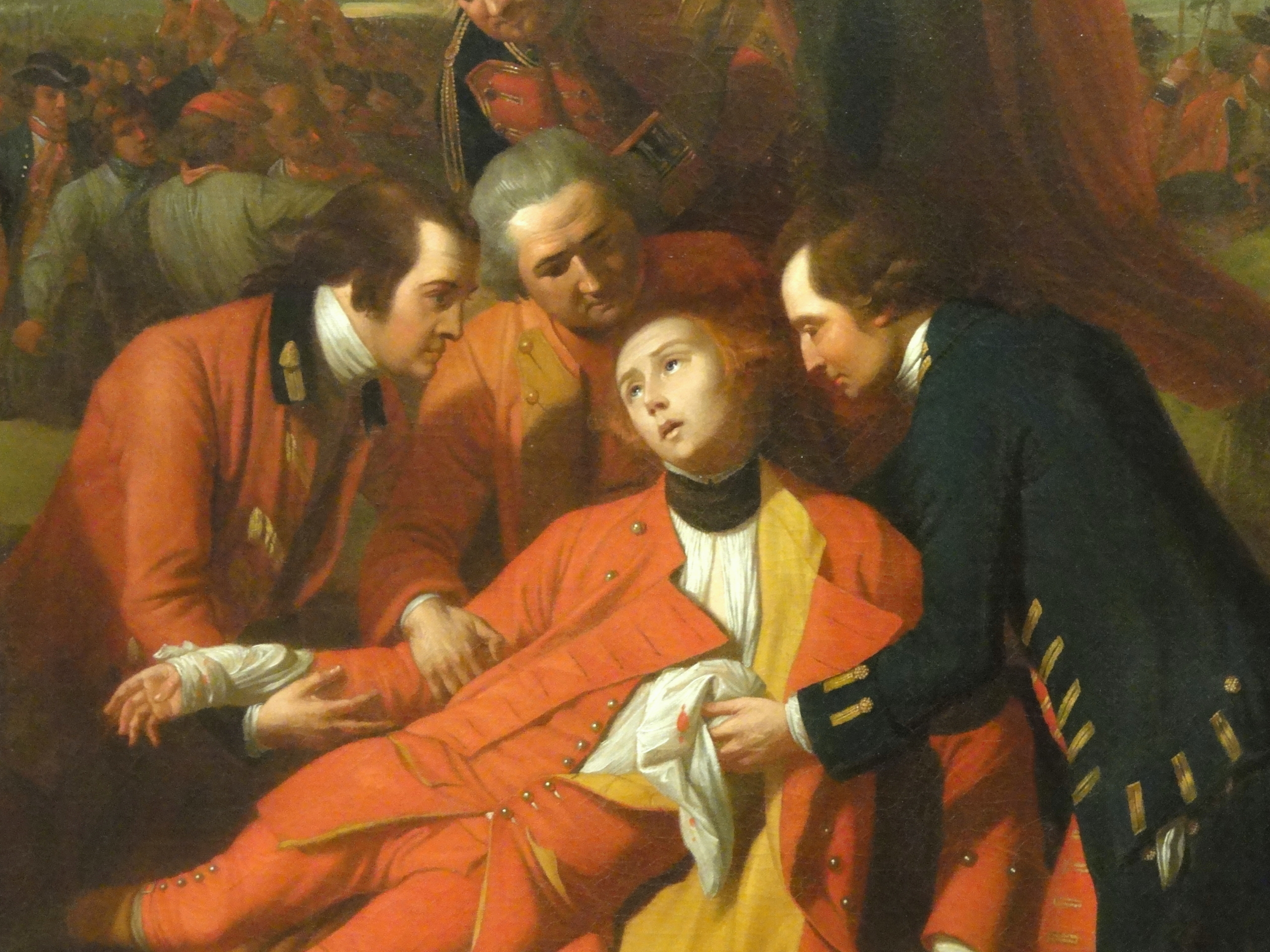
Relating ethnicity primarily to the topography of lived experience has the effect of obscuring the intertwined significance of history, biology, and culture. Wolfe has no apparent interest in either in the historical origins or the “ethnic genetic interests” of his own people, whoever they might be. Indeed, he writes that “Given my friendships and associations with people of different ancestry, I can say that being ‘white [much less of British ancestry] is unnecessary both to recognize themselves in what I describe and to cooperate with someone like me in a common national project.”
Remarkably, in Wolfe’s mind, ethnicity can cross racial lines. According to Neil Shenvi, Wolfe has affirmed in a personal conversation that “People of different ancestral origins can be part of the same ethnicity.” How else can Wolfe entertain the hope that an American Christian nationalism will emerge? Kevin DeYoung remarks that “the all-important concept of ‘nation’ sometimes operates in Wolfe’s thinking more organically like an ethnicity, sometimes more loosely like a culture, sometimes more locally like a love of people and place, and sometimes more traditionally like a nation-state with a recognizable set of laws, a governing magistrate, and the power of the sword.”
Wolfe argues that all nations can be Christian nations seeking “their temporal and eternal good through their own civil arrangements.” He devotes a chapter to defend the proposition that a Christian nation has “a natural law right to revolution against tyrants to that end.” Of course, so long as “a legitimate ruler uses civil power to command what is just and the people disobey this command, they are disobeying God himself…because the law itself, though human, is an ordinance of God.” But God does not bestow civil authority “to command what is unjust…for God’s ordinances to man are always just.” It follows that no unjust command can bind the conscience. A tyrant, “though he may have the appearance of civil authority, is but a man ordering fellow men to great evil.” If necessary, forcible resistance to such commands may be justified. Even a Christian minority may “revolt against a tyranny directed against them and, after successfully revolting, establish over all the population a Christian commonwealth.”
In Wolfe’s Christian political theory, it is axiomatic that “although civil administration is fundamentally natural, human, and universal” it “was created to serve Adam’s race in a state of integrity, as an outward ordering to God.” In our redeemed state of grace, “those who are restored in Christ are the people of God. Thus, civil order and administration is for them.” This raises the question of the political status of non-Christians in a Christian commonwealth. Any answer to that question is a matter of prudence, recognizing, of course, that the civil administration “must guarantee equal protection and due process with regard to human things for all people…But this does not entail equal participation, status, and standing in political, social, and cultural institutions.” Non-Christians cannot “be expected to take an interest in conserving the explicit Christian character and ends of these institutions and of society.”
Wolfe invokes the Anglo-Protestantism practiced in Puritan New England as a source of inspiration in shaping any future Christian commonwealth. There and in the new nation during the founding era, liberty of conscience was to be respected. No one could be compelled to believe or profess the Christian faith. The civil power dealt with heresy or dissent with a view to “practical considerations” relating to the “public harm caused by public error and on the limitation of civic action for spiritual reformation.” Accordingly, the civil power acted not to wreak vengeance on the enemies of God but “as a means to safeguard the souls of those under the magistrate’s care.” Punishment was meted out only to those who publicly sought to promote heresy and unbelief, to subvert the established church, to denounce its ministers, or to instigate rebellion against Christian magistrates. The fundamental Anglo-Protestant view was “that the Gospel and religious belief cannot be coerced; it is a matter of persuasion, and one must decide for oneself.”
What went wrong? Why did the American republic not remain as a Christian nation, on the Anglo-Protestant model? Wolfe’s answer in a nutshell is: modern R2K theory. That is to say, the mainstream Anglo-Protestant view still rests upon a two kingdoms theology distinguishing church and state but the radical two kingdoms view is that only pastoral vocations in the church are part of God’s kingdom while the state rests on a natural law that applies in a neutral fashion to all men everywhere, Christians and non-Christians alike. This, of course, begs the question: how did the R2K position come to dominance in the church? To answer that question requires a realistic political ethnotheology of Christian nationhood, one willing to confront a number of highly-charged issues that Wolfe is at pains to avoid and obfuscate. What was it about the Anglo-Protestant tradition that led to the erosion of its earlier determination to create and preserve a Christian nation in America?
The Elephant in the Room
One scholar suggests that WASPs were their own worst enemy. According to Eric Kaufmann, the decline of Anglo-America was not due to external factors; in particular, it did not follow an organized campaign by rival ethnic groups seeking to challenge WASP hegemony. He contends that the decisive “forces of dominant-ethnic decline” emerged instead “from within Anglo-Protestant America.” There is a large element of truth to the Kaufmann thesis. The modern American corporate capitalist society that emerged in the late nineteenth century was the unique product of the interaction between a kind of person, a kind of economy, and a kind of religion.
Brian Gatton suggests that the most significant psychological and spiritual force driving WASPs to commit hari-kari was the other-directed nature of the “social self” fabricated by the corporate system. In the early modern period a God of Will was worshipped by the bourgeois individual of the Protestant ethic, whose enterprising ways helped the modern capitalist economy to take off. But while the driven personality of the inner-directed Protestant supplied power on the runway, once in flight the economy relied on technique, not on character, to keep itself aloft. As Donald Meyer put it in his study of the American gospel of positive thinking, “if at the center of nineteenth century social imagination stood a man, in the twentieth he was replaced by a system.”
The dominant ethos of the Anglo-American corporate system depends upon a novel blend of psychology, economics and theology. The economy became an object of religious devotion for the managerial and professional classes. Today, in all sectors of society and culture, economic development has become an occasion for dependency rather than belonging. Our abject subjection to the mysterious movements of the global economy parallels the relationship of Protestant believers to their “hidden God, the God of Will” who can be known “only in His works, not in His nature. In an awful recurrence, we are returning to the situation of the early Protestants as an abyss opens up between us and an economy invested with all the attributes of divinity. Its inner workings surpass ordinary human understanding. Among our elites and opinion leaders, insight, knowledge, and intelligence can do no more than serve the disembodied forces animating the society of perpetual growth. It is not the courage or the strength of our political and corporate leaders, nor our respect for tradition that sanctifies the system. It is faith alone. Awesome and inscrutable, spectacular and self-propelling, the system invites adoration.
No doubt the emergent other-directed character of the WASP middle-class was a uniquely Anglo-American adaptation to the organizational imperatives of corporate capitalism. But if the home-grown “corporate self” provided the seed-bed for the cosmopolitan spirit of the Progressive Era, the WASP clerisy had plenty of help from other ethnic groups, especially Jews, in nurturing a full-blown cult of the Other. Indeed, Kaufmann credits Felix Adler, a leading Jewish intellectual, with a leading role in awakening Progressive reformers to the possibilities inherent in this new pluralist vision of American national identity. In his own recent book, Whiteshift, Kaufmann, too, is remarkably sanguine about the demographic, cultural, and political impact of mass third world immigration on the future of the White majority in Anglo-American society.