Select date

Kentucky Joins Growing Movement to Blacklist ESG Banks


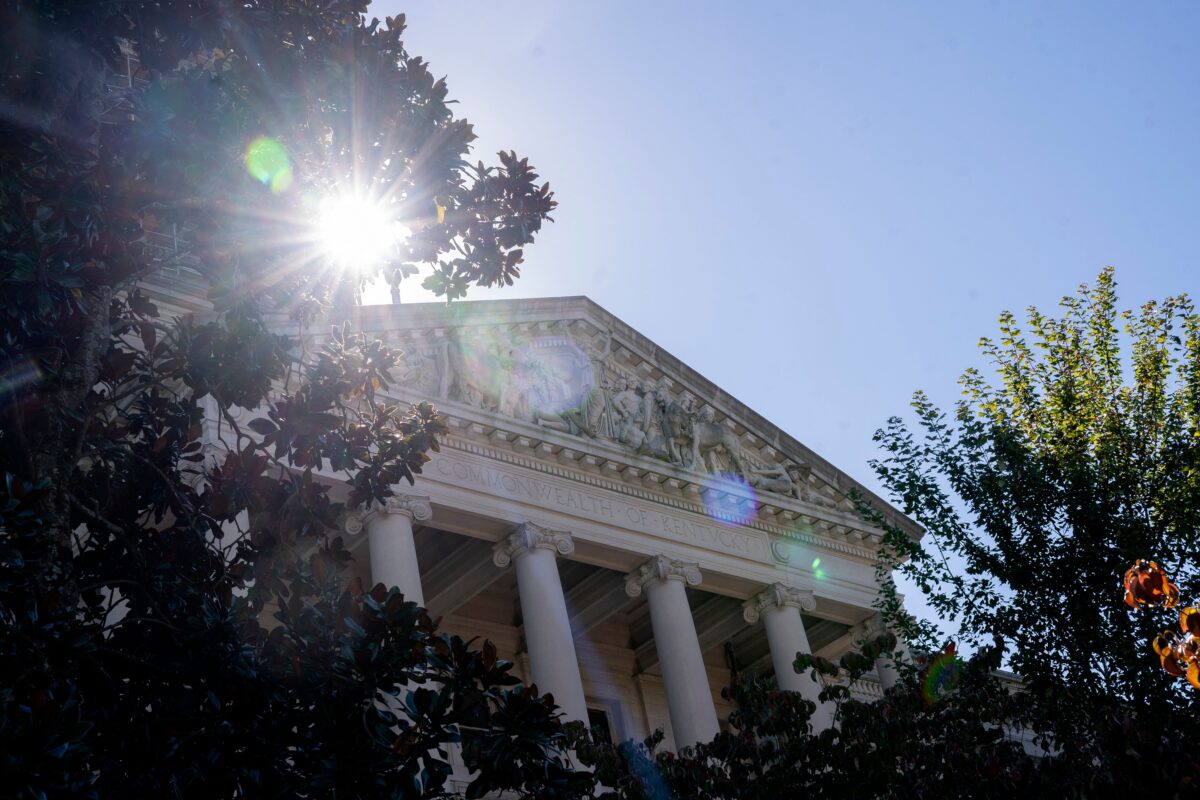
Kentucky has joined a growing list of conservative states that have begun to boycott banks they charge are discriminating against the fossil fuel industry.
In compliance with a Kentucky law passed in March, State Treasurer Allison Ball yesterday released a list of banks that “are engaged in energy company boycotts.” This list included Wall Street giants BlackRock, Citibank, JPMorgan Chase, BNP Paribas, HSBC, and six other smaller banks.
“Energy is important in Kentucky,” Ball told The Epoch Times. “It’s important to the nation, but in Kentucky in particular, about 7.8 percent of our labor force is from the energy sector. We have a lot at stake just because it’s a part of our economy.”
Kentucky’s action to protect its fossil fuel industry follows similar measures by West Virginia and Texas last year. Kentucky is the seventh-largest state in coal production and 71 percent of its electricity depends on coal-fired plants. Kentucky is also responsible for 1.6 percent of America’s oil refining capacity and 2 percent of its natural gas storage. More than half of Kentucky households rely on electricity to heat their homes.
“From an ideological perspective, those industries have been have been targeted for the last few years by the ESG movement,” Ball said. “So our state legislature in Kentucky passed last year a bill that said, ‘If you are boycotting the fossil fuel industry, then we don’t want to do business with you as a state.’ We don’t want to use taxpayer dollars to support an ideology that’s actually targeting and harming our signature industries.”
According to the Kentucky law, known as SB205, the banks on the boycott list have 60 days to dispute the charge and 90 days to “cease engaging in energy company boycotts in order to avoid becoming subject to divestment by state governmental entities.”
Derek Kreifels, CEO of the State Financial Officers Foundation, lauded Treasurer Ball’s action, stating: “She and other state financial officers across the country are leading the movement to ensure that money earned by hardworking American families is used in accordance with their values, not weaponized against them.”
Kreifels told The Epoch Times that he expects more states will follow the lead of Kentucky, Texas, and West Virginia in 2023.
“ESG is front and center in this next legislative session,” he said. Issues of concern could range from fossil fuels to firearms, to plains states like Nebraska, Kansas and Iowa working to protect their farming industries that feed the nation.
“We see the harm that ESG is doing, and we applaud any state official who’s willing to stand up to this scam that is being pushed across America from the White House to Wall Street,” he said.
Many of the financial institutions on Kentucky’s boycott list have signed pledges to reduce carbon emissions across their lending and investment portfolios as members of international clubs like Climate Action 100+ , the Glasgow Financial Alliance for Net Zero (GFANZ), the Net Zero Banking Alliance (NZBA), and the Net Zero Asset Managers initiative (NZAM). While firms who have joined these groups insist that they remain active investors in fossil fuel companies and do not discriminate against them, investment firm Vanguard is one of the few financial firms to withdraw its membership in these clubs.
“It’s remarkable to me that any of these institutions say that they’re not engaging in boycotts, because they have statements that say that they are, and some of them very explicitly,” Ball said. “Blackrock has been very explicit in wanting to cease business with coal companies.”
At a December hearing before the Texas state senate, representatives from State Street and BlackRock testified that they only join these clubs to discuss climate issues with other members, rather than to force an agenda on companies whose shares they own. Despite the pledge of members of Climate Action 100+ and NZAM to “reach net-zero emissions by 2050 or sooner across all assets under management,” many banks and asset managers insist they are doing no such thing in practice.
BlackRock recently received a three-year exemption from the Federal Energy Regulatory Commission (FERC) to buy up to 20 percent of U.S. public utilities. Vanguard is currently seeking similar approval.
As the largest asset managers in the world, BlackRock, Vanguard, and State Street typically do not divest from fossil fuel companies, but rather buy and hold their shares and work with management regarding the changes they want to see. Larry Fink, CEO of BlackRock, the world’s largest asset manager, issues an annual letter to CEOs that details what he considers the most important topics for them to focus on in the coming year, which often includes “sustainability” issues.
“We engage with companies in our portfolios; we do not divest,” State Street Global Advisors’ Chief Investment Officer Lori Heinel stated at the Texas hearing. But Heinel added: “We do not discriminate against companies in any sector, including energy companies … That means we do not tell those energy companies to shift their strategy or to drill more wells.”
In a May letter to the Texas comptroller, JPMorgan Chase wrote: “We provide financial services to many companies that engage in the exploration, production, utilization, transportation, sale or manufacturing of fossil fuel-based energy and intend to do so in the future. Our credit exposure to Oil & Gas as an industry was $42.6 billion as of December 31, 2021.”
Having pledged allegiance to climate-activist causes, however, these firms are now caught between red states that fear their industries and jobs are being targeted, and blue states that insist they honor their pledges to reduce the use of fossil fuels.
New York City Comptroller Brad Lander, who controls the city’s pension funds, lambasted BlackRock, stating that despite its climate-action pledges, “BlackRock now abdicates responsibility for driving net zero alignment in its own portfolio by saying that it does not ask companies to set specific emissions targets, and that its participation in NZAMi does not mean BlackRock is setting or meeting any net zero targets.”
In a scathing letter last September, in which Lander threatened to withdraw New York City pension funds from BlackRock, he charged that “the fundamental contradiction between BlackRock’s statements and actions is alarming. BlackRock cannot simultaneously declare that climate risk is a systemic financial risk and argue that BlackRock has no role in mitigating the risks that climate change poses to its investments by supporting decarbonization in the real economy.”
BlackRock, State Street, and Vanguard, known as the “Big Three” asset managers, are collectively the largest shareholders in 90 percent of S&P 500 companies. Together, they manage approximately $20 trillion in investment and retirement assets.
Texas state senators struggled for more than six hours last week to get straight answers from Wall Street giants BlackRock and State Street, two of the world’s largest asset managers, regarding what they are doing to compel companies whose shares they own to get in line with the ESG movement.
The World Economic Forum (WEF) will host its annual meeting in Davos next month, and for the second year in a row, The Dossier is the first publication to publish a list of speakers attending the invite-only, ruling class gathering in Switzerland.
In April, the Federal Energy Regulatory Commission (FERC) approved a request from BlackRock to increase its ownership up to 20 percent of a public utility’s voting shares without being deemed an “affiliate” and incurring the regulatory scrutiny and disclosures that come with that. To gain FERC approval, BlackRock and Vanguard promised they would be “passive” investors and not use their share ownership to influence management.
In its 2023 Global Investment Outlook, multinational investment firm BlackRock stated that “we’ve entered a new world order,” in which “geopolitical cooperation and globalization” are “evolving into a fragmented world with competing blocs.”
Over the past weeks a coordinated all-out assault on our agriculture—the ability to produce food for human existence—has begun. The recent G20 governmental meeting in Bali, the UN Agenda 2030 Cop27 meeting in Egypt, the Davos World Economic Forum and Bill Gates are all complicit. Typically, they are using dystopian linguistic framing to give the illusion they are up to good when they are actually advancing an agenda that will lead to famine and death for hundreds of millions not billions if allowed to proceed. It’s driven by a coalition of money
Florida is yanking $2 billion worth of state assets managed by BlackRock, escalating the GOP standoff with the world’s largest money manager over its ESG investment policies
The monitoring of personal behavior by banks will take another step forward as Canadian credit union Vancity launches a new credit card technology to report users’ carbon emissions.
Most people are bewildered by what is a global energy crisis, with prices for oil, gas and coal simultaneously soaring and even forcing closure of major industrial plants such as chemicals or aluminum or steel. The Biden Administration and EU have insisted that all is because of Putin and Russia’s military actions in Ukraine. This is not the case. The energy crisis is a long-planned strategy of western corporate and political circles to dismantle industrial economies in the name of a dystopian Green Agenda. That has its roots in the period years well before February 2022, when Russia launched its military action in Ukraine.
Sam Bankman-Fried, the founder of FTX, which was, until last week, the world’s second-largest cryptocurrency exchange, is today facing prison time for allegedly defrauding his customers of billions of dollars. Bankman-Fried, 30, donated to many progressive causes allied with the “effective altruism movement,” including pandemic prevention and response. He spoke at, and presumably donated to, the World Economic Forum’s Davos conference last May and the Clinton Foundation’s Clinton Global Initiative in September. Bankman-Fried is similar to Bernie Madoff in that both men used philanthropic giving, and the veneer of humility, to create a positive reputation while running pyramid schemes that should have set off red flags among investors, regulators, and journalists.
The concept of “fascism” was originally entered into the Encyclopedia Italiana by Italian philosopher Giovanni Gentile, who stated that “Fascism should more appropriately be called corporatism because it is a merger of state and corporate power.” Benito Mussolini would later take credit for the quote as if he had written it himself, but it’s important to note because it outlines the primary purpose of the ideology rather than simply throwing the label around at people we don’t like as a dishonest means to undermine their legitimacy.
Overall, like the Young Global Leaders program, the Global Shapers and New Champions represent another piece of the globalist octopus which has become quite effective at penetrating and manipulating world governments.
Marketed as a climate friendly alternative, a major digital asset becomes the frontrunner for a global central bank digital currency.
Notice that no nation has managed merely to print money and tax its citizens on the path to prosperity. Real wealth cannot simply be conjured from thin air. There must be recognized value in what a nation and its citizens possess.
Unless you’re reading this from Belarus or North Korea, safely outside of the WEF clutches (for now), your state is losing its sovereignty right in front of your eyes.
They'll never admit to it openly, but getting woke makes companies broke. Hollywood has been overtly progressive for decades, but this is nothing compared to the social justice invasion since 2016. After around five years of an unprecedented leftist onslaught on the entertainment industry we are finally starting to see the rampage lose oxygen. There's a weakness within woke productions that the alternative media has been pointing out for a long time – They don't make a profit because they are designed to appease a minority of leftist zennials that don't have any money. This is the wrong crowd to rely on for cash flow.
This offers a little insight to the genesis and history of ESG ideology to kill coal, oil and natural gas through behavior modification. As Technocracy was primarily defined in the 1930s as the “science of social engineering”, ESG is a potent weapon but it is failing to live up to its original promises. Nevertheless, it will continue to create societal chaos until it is totally rejected by society