Select date

Biden’s Amnesty Plan for Illegal Immigrants


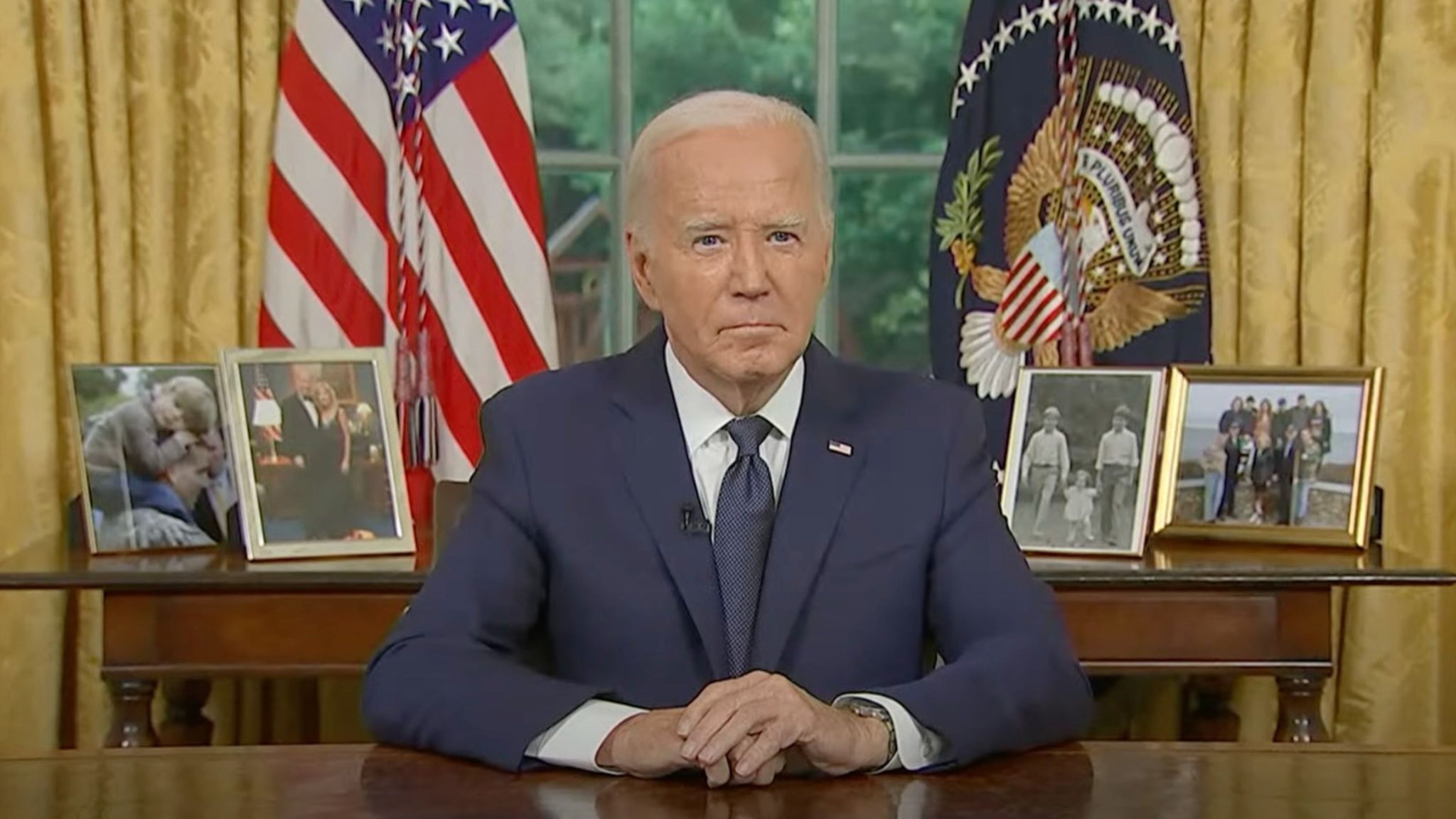
◼ That Biden chose the twelfth anniversary of DACA to promulgate his new immigration order is fitting. Indeed, all that was missing was a commemorative sign that read, “Twelve years of ignoring the Constitution.” Adopting his decreasingly persuasive tough-guy pose, Biden told the audience, “Folks, I’m not interested in playing politics with the border or with immigration.” Considered from any angle, this was a disgraceful thing to say. For a start, Joe Biden has, in fact, “played politics” with the border, and he did so again in this speech, when he pretended preposterously that it was “Trump and the Republicans”—rather than the progressive wing of his coalition—who were standing in the way of his ability to deal with the problem. More broadly, though, “politics” is precisely what has been missing from this White House’s approach to immigration. President Biden did not consult Congress when he decided to open up the border, and he has not consulted Congress now that he has decided to pursue a mass amnesty. Were the border to be secured, the public might well be more open to dealing sympathetically with the often difficult question of whom to prioritize for deportation and whom to put on a path toward legalization. But the border has not been secured, and there seems no prospect of the border’s being secured anytime soon, and, as a result, there exists a great deal of skepticism toward rewarding yet another generation of lawbreakers. Just this month, polling showed that, in nearly every demographic group, majorities of American voters have come to support mass deportations. That President Biden’s response to this has been to announce the ultra vires amnesty of hundreds of thousands of illegal immigrants is not solely bad politics; it is an affront to our constitutional system, to our democracy, and to the claim that nobody is above the law.
◼ According to a report by the Congressional Budget Office, the U.S. is now facing a deficit of $1.9 trillion for the 2024 fiscal year—up $400 billion from its February estimates. The bulk of the changes came from an increase in spending on student loans thanks to the Biden administration’s debt-forgiveness action, higher-than-expected spending on Medicaid, and the recently passed foreign-aid bill—all of which added to an already grim fiscal outlook. Cumulatively, over the period 2021 to 2024, deficits are now $2.6 trillion higher than what the CBO had projected for the same period in February 2021, before any Biden policies had gone into effect. We wish we could say that Donald Trump is providing a clear contrast with Biden when it comes to tackling the deficit problem. Unfortunately, neither Trump’s record nor his current rhetoric inspires much confidence. Most significantly, neither candidate wants to do anything serious to rein in entitlements, which are the main driver of the nation’s long-term debt problems. Thanks to Social Security, Medicare, and Medicaid, even if the next president does no further harm and the programs just run on autopilot, the fiscal situation will get worse. In 2027, the public debt will reach 106.2 percent of gross domestic product—eclipsing the record set during World War II. Unless major changes are made to alter the current path, Americans will face harsh trade-offs, with the possibilities including: crushing tax increases, severe spending cuts, the degradation of military readiness, economic stagnation, or some combination of all of the above. This is a recipe for American decline.
◼ Web welfare ran out of money at the end of May, and we hope it will stay that way. The Affordable Connectivity Program provided a $30 monthly subsidy for internet bills to qualifying households. It was designed to follow the classic Washington path from temporary to permanent, beginning as an “emergency” program after the Covid pandemic and being defended as a life necessity by political supporters as funding expired. The emergency never existed: Hardly anyone lost internet service during the pandemic, and broadband has been becoming more affordable over time. A significant chunk of the subsidy, especially for low-income recipients, was captured by internet-service providers, who lobbied Congress hard to extend the ACP. Senate Democrats’ efforts to tie the program to reauthorizing the authority of the Federal Communications Commission to conduct spectrum auctions failed, and naturally they blamed Republicans. Senate Commerce Committee ranking member Ted Cruz and other Republican ACP opponents should wear Democrats’ ire as a badge of honor.
◼ Senator J. D. Vance (R., Ohio) and Representative Michael Cloud (R., Texas) have introduced the Dismantle DEI Act. The bill would bar school-accreditation agencies from requiring DEI in schools and stop financial agencies, including Nasdaq and the New York Stock Exchange, from instituting diversity requirements for corporate boards. It would effectively rescind President Biden’s June 25, 2021, executive order, which pushed DEI requirements and ideas into “all parts of the Federal workforce.” That executive order alone helps to sustain an entire private industry of DEI consultancies and lobby groups, by giving all federal agencies the power and the mandate to contract for “diversity and sensitivity trainings.” It’s wrong for such politically charged content to be in the federal government’s training and development programs. But the government’s practice here isn’t just about executive-branch employees. The norms it sets also become a template for private-sector employers and HR groups who want their workplaces to avoid lawsuits. Divisive ideologies like those that underlie diversity, equity, and inclusion have trouble surviving without sponsorship and promotion by the government. No sane entrepreneur thinks that his or her business is the proper forum for adjudicating and correcting man’s inhumanity to man stretching back into millennia of history. But if the government can inflict such mandates on its own employees, states are only a few steps behind doing so for the private sector. The bill is a blow against government overreach, against crony-ideological sponsorship, and against the politicization of the workforce and everyday life. It immediately attracted 20 co-sponsors in Congress, and deserves more.