|
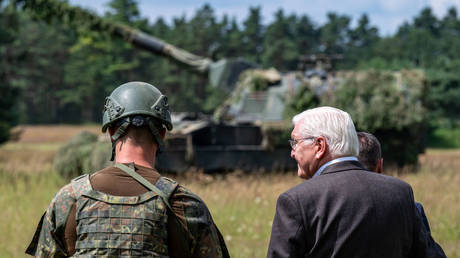
On May 6, the Ministry of Defense of the Russian Federation announced it would conduct nuclear-weapons exercises in Russia’s Southern Military District, a large zone crossing between Russian and Ukrainian territory. Two weeks later, they went ahead with them, inside Ukraine’s internationally recognized borders. These drills simulated attacks with relatively small warheads—tactical nuclear weapons, designed to destroy limited territory. The decision, the Kremlin elaborated, was a response to recent statements by Western leaders that threatened to escalate the war. It was just days after France’s President Emanuel Macron had confirmed his longstanding position not to rule out sending European troops to help defend Ukraine.
A few weeks later, on May 31, Dmitry Medvedev—Russia’s former president, now the deputy chair of its Security Council—warned that Moscow’s conflict with Ukraine and the West could result in nuclear war. “This is, alas,” he said, “neither intimidation nor bluffing.”
Since the end of the Cold War 30 years ago, Russian officials had never threatened to use nuclear arms—until after the invasion of Ukraine in February 2022. That April, Foreign Minister Sergei Lavrov began warning that the danger of nuclear war was “serious” and “real.” Five months later, President Vladimir Putin emphasized that the precedent for using atomic weapons was, after all, set by the U.S. Now the Ministry of Defense, the Kremlin, and Medvedev are all repeating the same menacing idea. What’s happening here?
Sergey Radchenko is the Wilson E. Schmidt Distinguished Professor at the Johns Hopkins University’s School of Advanced International Studies and the author of The Atomic Bomb and the Origins of the Cold War. As Radchenko sees it, Moscow isn’t just bringing back a threat it used during the Soviet era; it’s revived an entire mindset of nuclear brinksmanship from the Soviet era. Which means extreme uncertainty about whether and when Moscow might follow through. Washington and the West understand this uncertainty; they take it very seriously; and altogether, Radchenko explains, this dynamic is a key to understanding the course that the war—and the indirect conflict between the U.S. and Russia behind its scenes—has taken from the beginning … |
|
|
|
|
From Sergey Radchenko at The Signal:
“What does “existential” mean to Putin? Would he use nuclear weapons to prevent the loss of the Donbas region in Eastern Ukraine? It’s not clear. Would he use them to prevent the loss of Crimea? Again, not clear. We just don’t know where his red lines are.”
“Moscow has an official nuclear doctrine that lays out the circumstances in which it would use nuclear weapons. The document says it could use them if Russian sovereignty and territorial integrity were threatened, or if the country’s early-detection system were under threat. But interpreting this document is complicated. Consider the question of Russian territorial integrity or sovereignty being under threat: You could argue that because Russia has annexed parts of Eastern Ukraine, those are now parts of the territory that Moscow will defend with nuclear weapons. Now, Ukraine took back some of that territory in the fall of 2022, and Russia didn’t react with nuclear weapons. So you could see that as an example of Moscow’s bluff being called.”
“Putin’s interest is to make the West think he’d use nuclear weapons sooner rather than later. Which is in line with what, back in the 1970s, U.S. President Richard Nixon would call the madman theory: If the other side thinks you’re crazy enough to use nuclear weapons—or just plain crazy—it will deter the other side from being too assertive in their foreign policy. Putin has been trying to create this madman image of himself in the West—the impression that he’s crazy enough to use nuclear weapons in Ukraine. … In general, he bluffs a lot. If you put yourself in his shoes, you might bluff a lot, too. But the fact that he might bluff 10 times does not mean that he will be bluffing the eleventh time. That creates radical uncertainty, because the stakes of a nuclear conflict are just so high. As a Western policy maker, even if you calculate that there is a 1 percent chance of nuclear war, you have to adopt policies that will reduce the possibility even further.” |
|
|
|
|
According to Deloitte, the blue-chip art investment market is predicted to grow by nearly $700m over the next few years. How can everyday investors to take advantage of the trend? |
|
|
|
|
FROM THE FILES |
Everything Is Under Control
|
|
|
|
The Chinese Communist Party is expanding its clampdown on Muslims, with Beijing now surveilling and destroying the mosques of Hui communities across China. The Mandarin-speaking Hui are the country’s largest Muslim minority and—though they trace part of their ancestry to Arab and Persian traders from the ancient Silk Road—visibly indistinguishable from the Han majority. In March, to undermine Islamic teaching in schools, local CCP officials in Yuxi—a Hui city in Yunnan Province—authorized investigating local children for fasting during Ramadan.
Throughout Hui communities, authorities have forbidden children from learning scriptures or entering religious buildings; restricted them from participating in religious retreats or activities; and prohibited religious schools—or madrasas—from organizing either. The authorities have also removed signs advertising halal food and knocked down the domes and minarets from hundreds of Hui mosques. Now they’re importing Han teachers for the madrasas and kicking out Hui ones, to secularize teaching.
In September 2023, Kalbinur Sidik examined Beijing’s repression of Uyghurs, Kazakhs, and other Muslims in northwestern China, where more than a million people have been incarcerated since 2016. Uyghurs who’ve had any contact with the outside world or outwardly displayed their Muslim faith end up, Sidik says, in internment camps—where they’re shackled, unable to clean themselves, poorly fed, and tortured. It’s all as part of a campaign to “reeducate” them away from Islam and their ethnic traditions—a campaign the CCP has called the “People’s War on Terror.” |
|
|
|
|
Join The Signal—to support our independent current-affairs coverage, explore our archive, and unlock our full conversations with hundreds of contributors: |
|
|
|
|
Coming soon: David A. Hopkins on who controls the U.S. Democratic Party … |
|
|
|
|
This email address is unmonitored.
Please send questions or comments here.
To advertise with The Signal, inquire here.
Add us to your address book.
© 2024 |
|
|
|