Select date

Architecture and Art, by Edward Dutton


In May last year I found myself in Budapest, surrounded by Neo-Classical architecture. The centre of the city is incredibly beautiful, and so consistently so, that it’s easy to become lost. A young, and rather cynical, female student I was with actually commented, referring to two London skyscrapers: “Budapest needs a Gherkin or a Shard, just so there are a few landmarks.” It’s the little details that are so uplifting: gargoyles, tessellations . . . These edifices were built with beauty in mind.
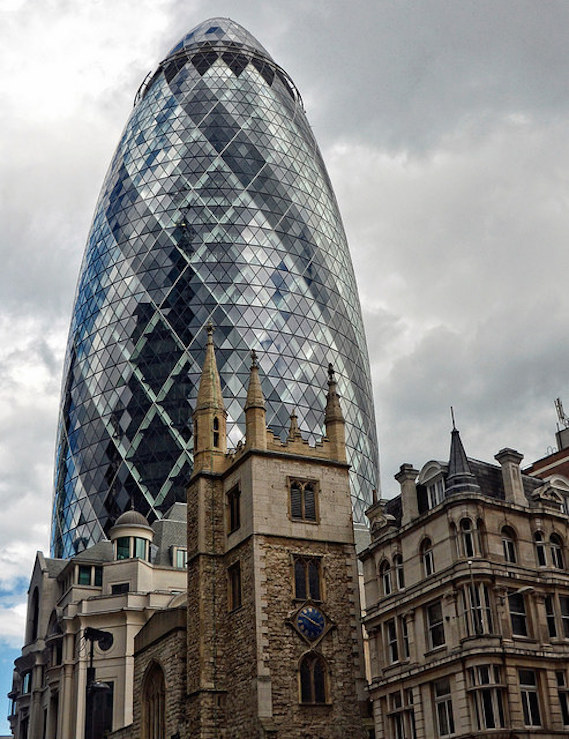
The Gherkin Juxtaposed to Some Examples of Traditional London Architecture
How different it is walking around most British city centres, marred as they are by brutal post-War architecture, where “beauty” is almost a dirty word. The same is clearly true of Art. Modern Art is quite deliberately vile and shocking: Damien Hurst’s cow cut in half, the Chapman Brothers’ child mannequins with anuses on their faces, flowers (“Piss Flowers”) ultimately cast from artist Helen Chadwick’s urine and so on. English philosopher Roger Scruton bemoaned the hideousness of Modern Art and Modern Architecture. But why does it have to be so revolting? The answer is surprisingly simple and it can be traced all the way back to the most primitive humans, eking out an existence on the Savannah.
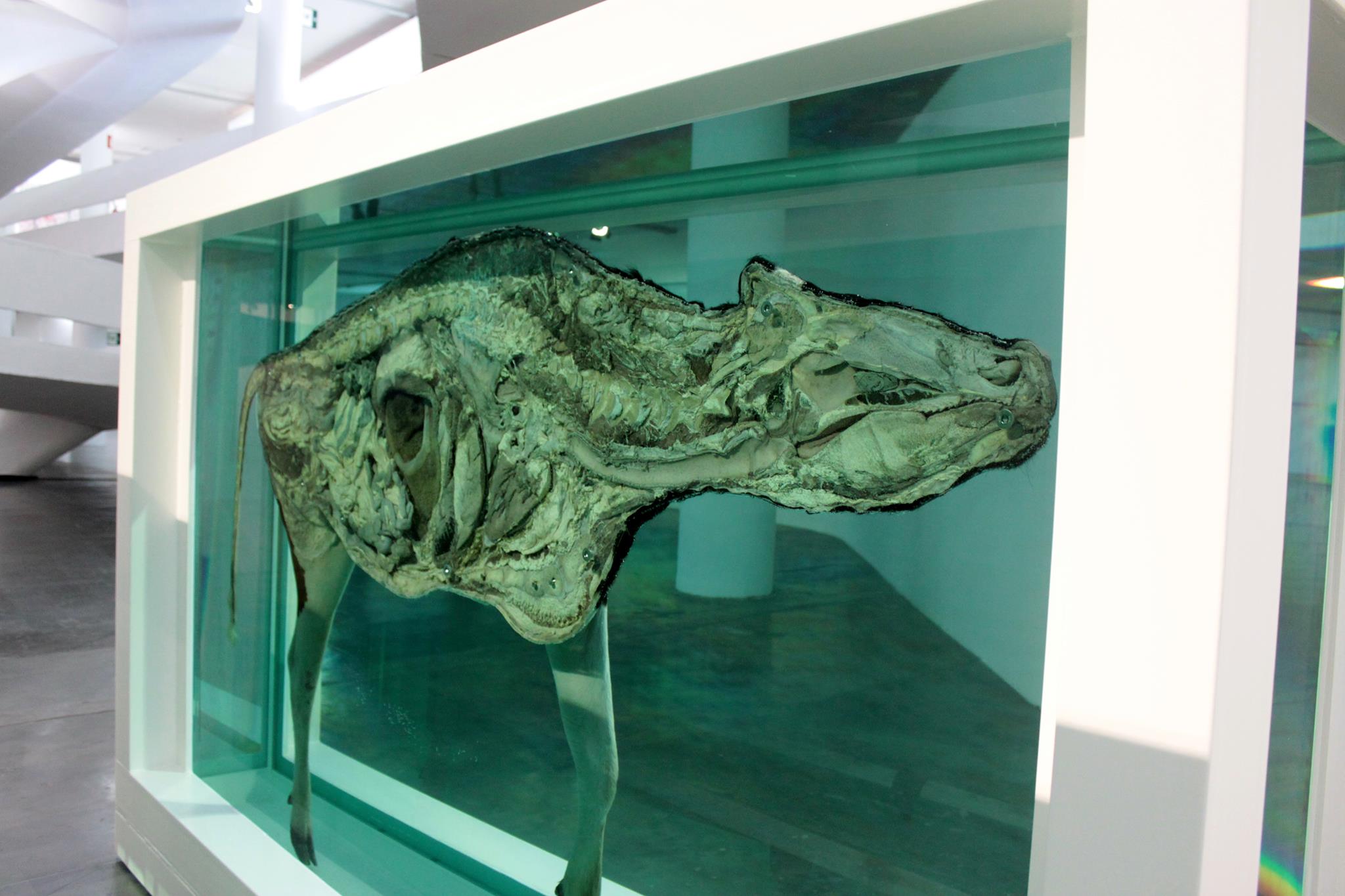
Damien Hurst’s Cow Cut in Half
Humans are “pack animals,” which means they must fight for the survival and triumph of their group, but, in the polygamous mating systems to which we are evolved, only the highest status males pass on their genes. Put simply, these males are better at fighting and at hunting. The females sexually select for these Alpha Males because they will have more resources to invest in the female and her offspring and the offspring will inherit the physical and psychological traits which lead to health, high status and the passing on of ones genes. As I have explored in my book Breeding the Human Herd: Eugenics, Dysgenics and the Future of the Species, among the hunter-gatherer Bushmen of southern Africa only 40% of males have any children at all, while in seventeenth century England the richer 50% of males had about double the number of surviving offspring compared to the poorer 50% of males. So, it is very important – and thus built into us – to want to attain social status.
Consequently, we balance different sets of what are known as “Moral Foundations.” The “binding” or “group-orientated” foundations are Obedience to Authority, In-group Loyalty and Sanctity/Disgust. The latter involves sacralising practices which are adaptive to the group and reacting with disgust to that which is maladaptive. Thus, people tend to react with disgust to foreigners because they may introduce novel pathogens into the group or disrupt its internal dynamics. Of course, high disgust can also be adaptive on the individual level, such as a strong revulsion to rotting food. But these three foundations correlate. Group-oriented people are higher in disgust, presumably due to its importance in policing group boundaries.
There are also the individually-oriented foundations of Equality and Harm Avoidance. A concern with equality means that you will get your fair – equal – share, while a concern with harm means that you personally are less likely to get harmed. People who are highly group-oriented have little concern with these, being happy to lay down their lives for the group, meaning they may pass on their genes only indirectly, by helping to save their group.
Liberals and Conservatives differ in the importance of these Moral Foundations. Conservatives score about the same in all of five of them. Liberals score very low in the binding foundations and they score very high in the individualistic foundations. As I explore in Breeding the Human Herd, liberals are also, on average, shorter, physically weaker, less physically attractive and more anxious and otherwise mentally unstable than conservatives. In a sense, they are bad, unsuccessful hunter gatherers. So, how do you gain status if you are such a person?
You can’t have a fair fight because you will be paranoid that you will lose, and you probably will. Accordingly, you “virtue signal”: You appeal to the conservative society – which is genuinely concerned about equality and harm – and attain status by seeming very kind. You also collaborate with outsiders. Being low in in-group loyalty and low in disgust, it has been found that the liberal moral circle – those with whom they identify – is further from self, in genetic terms. Conservatives are concerned with people in a series of concentric circles. In general, they prefer family to kin, kin to ethny, ethny to race and so forth. By contrast, liberals are more likely to identify with foreigners than with their own. This allows them to collaborate with foreigners and, so, take over their own in-group.
This will shake up everything but they don’t care. They are low in sanctity and they are low in obedience to traditional authority. What is the upper class socialist really doing? He is gaining power by collaborating with the working class against the interests of his own social class, in a context in which there is abundant evidence that social classes are substantially genetic castes. What are elite White people in Britain’s Labour Party doing? They are collaborating with working class Whites and foreigners in order to dominate the elite class of which they are a part.
How does this relate to Art and Architecture? I’m sure it’s clear by now. The traditional purpose of both was, in part, to create beauty. Beauty inspires people; beauty makes people feel good (feel transcendent, even). Beauty is symmetrical, it is about order, it aims to inspire the group with a sense of the sacred and the eternal. If you are low status, it is central to the system which caused you to be of low status. Thus, if you are physically and mentally weak, and cannot attain status within the system, it makes sense to attack the system, to attack “order,” so creating a vacuum in which you can take power.
Being low in sanctity (and low in disgust), you will be positively attracted to Art and Architecture which is revolting and repelled by Art and Architecture which is beautiful. Being concerned with “Equality,” you will horrified by the very idea that some things are more “beautiful” than other things. With your high Neuroticism, this will incur resentment. You will question the very notion of objective “beauty,” argue that there are “different kinds of beauty” and ultimately maintain that the ugly is beautiful so that everyone can feel equal. The very notion of “beauty” will hurt the feelings of –“harm” – those who are repugnant-looking, so it simply cannot be accepted. This destruction of tradition creates dysphoria, it confuses people, it creates a sense of instability; a lack of order. It is in this chaos that the Machiavellian — and liberals are individualistic and thus power-hungry — can take over.
As I have explored in my book The Past Is a Future Country: The Coming Conservative Demographic Revolution, due to asymmetrical empathy between conservatives and liberals, culture will tend to drift leftwards. Eventually, once a sufficient percentage of the elite accept these ideas, we very quickly tip over into being a liberal society, as people understand that things are changing and wish to be on the winning team. As the more intelligent better understand the benefits of socially conforming and are higher in what Kevin MacDonald has called the “effortful control” that allows them to do so, they will spearhead this change. Once this takes place the more intelligent start competitively signalling their conformity to the new moral dispensation.
The result is a kind of “runaway individualism” where Art and Architecture become uglier and uglier and uglier across time. This will continue until there is such dysphoria, until so many people are so unhappy, due to their group-oriented foundations being ignored, and due to a general sense of unnerving chaos, there is a right-wing backlash. This will often be provoked by a situation which strongly sets off disgust – such as an epidemic – or which sets off other binding foundations, such as war. We became more conservative in the 1980s about sexuality due to AIDs for example. So, beautiful Art and Architecture may well re-emerge . . .