Select date

American Pravda: The Nakba and the Holocaust, by Ron Unz


 Two weeks ago the Sunday New York Times Magazine published a long cover-story on thirty years of failed Middle East peace efforts between Israelis and Palestinians, a tragedy that resulted in the enormous bloodshed and destruction of the last couple of months. The discussion featured three Israeli and three Palestinian academics, moderated by staff writer Emily Bazelon, and the overall tone—for better or for worse—probably reflected the historical and ideological assumptions of the liberal Zionists who dominate the editorial leadership of the Times and most other major American media outlets.
Bazelon’s introduction ran a few paragraphs, summarizing the history of the conflict, which was portrayed as a struggle between right and right, with two unfortunate peoples battling over the same small piece of land. An early sentence stated that the Israelis saw the 1948 war as “an existential fight for survival, one that came just a few years after the Holocaust,” and that latter event, so endlessly covered in our media, obviously required no explanation for Times readers. But in the following sentence we were told that for three generations, Palestinians have similarly regarded 1948 as the year of their Nakba. That Arabic word was far less familiar to most Westerners, so Bazelon went on to explain that it meant “catastrophe,” the tragic circumstances under which 700,000 Palestinians fled or were forcibly expelled from their ancient homeland.
The following Wednesday, another Times article on the Israel/Gaza conflict similarly conjoined the Holocaust and the Nakba, this time in a single sentence, as had a different Times story a week earlier. These days there is even a Wikipedia entry running 3,300 words on those two interlinked historical traumas, so separately meaningful to Israeli Jews and Palestinian Arabs, and in 2018 an entire book was published with that title.
The increasing appearance of the term Nakba in elite mainstream publications such as the Times represents an important ideological victory for the Palestinian cause. Our media creates our reality, so concepts or historical events that lack an identifying name are far less likely to be considered important and remembered. Thus, the growing use of that one word may carry greater political weight than the actual historical fact that 700,000 pitiful refugees were expelled from their homes in Palestine.
There are now widespread suspicions that the current Israeli military attacks in Gaza are intended to drive all its Palestinians into the Sinai desert of Egypt, and will be followed by attempts to do the same to the Palestinians of the West Bank. Indeed, after decades of denying the reality of the 1948 Nakba, some top Israeli leaders are now proclaiming their plans for a new and far greater Nakba, finally ridding the Greater Israel they control of its unwanted Palestinian inhabitants.
I’m not sure when I first encountered the word Nakba in any of my publications. It might have been during the late 1980s when the first Intifada or “uprising” became a widely featured story regarding the Middle East, describing the Palestinian protests, violent and non-violent, in the West Bank and Gaza against what was then two decades of Israeli occupation. Or perhaps it was a few years later during the early 1990s, when the Oslo Peace negotiations between Israel and the PLO seemed set to finally resolve the conflict and move the region towards a reasonable peace agreement, one that included the establishment of an independent Palestinian state.
I had already often seen the phrase “Palestinian refugees” in many news stories, with the UN camps of the West Bank, Gaza, Lebanon, and elsewhere holding well over a million of those people, and I was vaguely aware that they’d fled from their former homes in Israel during the first Arab-Israeli war of 1948.
The media accounts that I casually absorbed over the years had been rather vague and sketchy, and they often presented severe distortions or outright falsehoods about those important events, being heavily shaped by the propaganda of Israel and its legion of partisans. We were often told that the flight of the Palestinians had been promoted by radio broadcasts of three or four neighboring Arab countries, which urged them to clear the ground for the invading armies that were expected to snuff out the newly-founded Jewish State. Those departures had been intended as very temporary, but after the professional Arab armies were unexpectedly defeated by the desperate, untrained Zionist militias, a Palestinian sojourn expected to last days or weeks ultimately stretched into years and decades. The unfortunate hardships of refugee life were worsened by the cruel refusal of the Arab states to integrate the Palestinians into their own societies, a failure that sharply contrasted with Israel’s rapid and successful assimilation of the many hundreds of thousands of Jews who had been expelled from Arab countries around the same time. Indeed, those neighboring Arab regimes sought to use the Palestinian refugees merely as political pawns against the newly established State of Israel, whose existence they viewed with such unremitting hostility. But little of this narrative was true, and crucial legal and historical facts were completely omitted.
As might be expected, the difficult existence of those many hundreds of thousands of Palestinians in refugee camps eventually fostered the rise of violent militant organizations such as the PLO, which sought to capture the world’s attention through high-profile terrorist attacks. By the early 1970s, their plane hijackings drew widespread attention and this was followed by the infamous seizure and killing of Israeli athletes at the 1972 Munich Olympic Games. Other terrorist groups such as Germany’s notorious Baader-Meinhof gang often cooperated with the PLO, and in 1976 their joint hijacking operation had been foiled by a bold Israeli commando raid at Entebbe airport in Uganda.

Prior to those incidents, the plight of the Palestinians had largely been ignored. But within a few years, the term “Palestinian terrorist” and “Palestinian refugee” both became widespread across our media, though the latter still included very little discussion of the circumstances that had originally created their predicament.
Far more typical was their villainous portrayal in Hollywood fare, such as the popular 1977 film Black Sunday, in which American FBI and Israeli Mossad agents together foiled a Palestinian terrorist plot to kill 80,000 Americans by blowing up the Goodyear Blimp over the Superbowl stadium, with our own President being one of the intended victims.
Although bombs and bullets have been weapons widely used during the 75 years of Israeli-Palestinian conflict, I think that the role of media coverage has been far more crucial to its trajectory, with the Israelis enjoying an enormous advantage in that regard given the massive pro-Israel bias of Western journalists and publications, let alone Hollywood productions. In evaluating both current and past events, thoughtful analysts should always account for that extreme bias—and the very sharply tilted playing field it creates—if they wish to correctly determine the reality of events.
I think that the first substantial wave of sympathetic media coverage the Palestinians ever received may have come in the wake of the 1982 Israeli invasion of Lebanon, culminating in the long, brutal siege of Beirut. Ariel Sharon, the hardline Defense Minister of Menachem Begin’s right-wing Israeli government, had been the mastermind of that project, which resulted in the deaths of perhaps 20,000 Palestinians and Lebansese civilians and his actions were roundly condemned by Times correspondent Thomas Friedman. The endless Israeli references to Palestinian “terrorists” were even ridiculed in Doonesbury:

Back then, invading an Arab country and the besieging its capital city was an almost unprecedented event, and with American and international diplomatic pressure mounting, the PLO military forces who were the purported targets of Israel’s assault were evacuated under UN auspices. But once those fighters were removed, Sharon soon afterwards orchestrated a grisly massacre of the defenseless Palestinian women and children left behind at the Sabra and Shatila refugee camps. That unfortunate event produced a major public relations debacle for the Israelis and a renewed international focus upon the Palestinians. There was growing global sympathy for their plight and some possibility that the American media would focus on the circumstances of their original expulsion, although I don’t recall the discussion of any specifics at that time, let alone the appearance of the term Nakba.
Given that serious crack in the previously overwhelming pro-Israel media tilt, it’s hardly surprising that Israel’s partisans would soon launch a sudden, concerted counter-attack, a bold attempt to permanently remove the Nakba from world history even before that term made any appearance on the political stage.
As a Stanford physics graduate student, I remember that in 1984 or 1985 the subject of the Middle East conflict once happened to come up and one of my fellow grad students—a pro-Israel Gentile—declared that the entire “Palestinian refugee problem” was largely a hoax. To my considerable surprise, he explained that most Palestinians were actually not native to the area, instead being relatively recent immigrants from neighboring Arab countries who had arrived during the decade or two preceding the 1948 war, drawn by the economic opportunities produced from the growing Jewish settlement.
I’d never devoted a great deal of time to the Middle East conflict, but that claim seemed very surprising to me, contrary to everything that I’d read, and although I was hardly convinced, I vaguely wondered whether it might be true to some extent. Obviously, if many or most of the so-called “Palestinians” weren’t actually natives of Palestine displaced by the Zionist Jewish settlers who had created Israel but were instead themselves recent immigrants who had arrived around the same time or later, the entire political landscape of the bitter regional conflict would be transformed.
Some years later, I discovered that those striking claims had been presented in a lengthy, extremely controversial 1984 book, glowingly praised in mainstream and pro-Israel circles but condemned as fraudulent by its critics, with the latter eventually gaining the upper hand and the arguments gradually disappearing from the media. But it was only about a decade ago that I finally looked into the matter, and discovered a fascinating story.

ORDER IT NOW
Joan Peters had been a college drop-out and free-lance writer, with interest in the Middle East but having little historical expertise. Then in 1984, her name suddenly appeared as the author of From Time Immemorial, a remarkably scholarly volume, running 600 pages with nearly 2,000 footnotes, a book that made the revolutionary claim that the Palestinians did not really exist as a people. According to her Introduction, she had begun the research project years earlier quite sympathetic to the plight of the Palestinian refugees and intending to focus on their miserable condition, but she gradually encountered more and more clues that they were largely a propaganda-concoction fabricated by Israel’s Arab enemies. So she then spent years digging in musty archives, carefully researching the underlying demographic data and finally producing her masterwork, which was eagerly released by a leading New York publisher.
A gigantic wave of almost uniformly glowing reviews praised her exhaustive scholarship, propelling her book onto all the bestseller lists. Even more importantly, she soon became the darling of the electronic media, reaching a vastly larger national audience through her 200 or 300 radio and television interviews, in which she exploded the widespread myth that the so-called “Palestinian refugees” had been longtime occupants of Palestine. Her monumental discovery was glowingly endorsed by top academic scholars, Pulitzer Prize-winning historians, and even the odd Nobel Laureate or two.
Back then, the media landscape was far more hierarchical and unified than today, with the Western prestige press lacking any significant global rivals or Internet critics. With such strong backing, her surprising conclusions seemed likely to become deeply embedded in the accepted narrative, permanently relegating any doubters to the conspiratorial fringes. And if the “Palestinians” did not actually exist as a people, any notion that they had a legitimate claim to the land obviously evaporated.
This might easily have happened except for the determination of a young Princeton graduate student named Norman Finkelstein, having a strong interest in Zionist history. He became curious about this widely-praised new book, which seemed to contradict everything he knew about the subject, so he began checking some of Peters’ scholarly references, and discovered that many of them were severely distorted or even falsified. Notwithstanding her legion of prestigious endorsements, he concluded that her book constituted “a spectacular fraud,” with important sections apparently even plagiarized from a Zionist propaganda tract published decades earlier that no one had ever taken seriously.
Unlike the political world, academia is largely run on the honor-system, and very few individuals bother critically checking the footnotes in a text released by a major press and strongly endorsed by many important figures. So absent Finkelstein’s personal efforts, it’s quite possible that the entire Palestinian people might have vanished from recognized existence without the need for the Israelis to fire a single shot. The gigantic, blatant hoax of “Nakba Denial” would have hardened into concrete, with no one in the political mainstream being willing to publicly challenge it.
As Finkelstein and others tell the story, uncovering that massive fraud in a very high-profile bestseller was easy enough, but bringing those facts to wider attention proved extremely difficult, especially since so many influential Jewish intellectuals had already invested their reputations in praising and endorsing the work, along with so many important publications. Finkelstein’s letters to journalists and editors were completely ignored, and of the many academics he contacted, only Noam Chomsky of MIT bothered responding. Chomsky, a strong critic of Israeli policies, encouraged Finkelstein’s efforts but warned that he might be severely damaging his own academic career, a concern that unfortunately proved correct.
Finkelstein wrote up his detailed critique as a long article, which he submitted everywhere but it was similarly ignored, until Chomsky helped him place a shortened version in a tiny Midwestern leftist magazine. Gradually word of Finkelstein’s analysis began circulating, with journalists and scholars realizing that it was probably only a matter of time until the intellectual scandal exploded, but no publication was willing to be the first to expose the plagiarized fraud. The prestigious New York Review of Books solicited an evaluation from a leading Israeli demographic historian, who ridiculed Peters’ book as “sheer forgery,” merely amounting to regurgitated Zionist propaganda that no one in Israel took seriously, but the editors refused to allow his devastating review to appear in print. However, in those days, British intellectuals were less beholden to Zionist influence and they were alerted by Chomsky to Finkelstein’s detailed criticism, so the appearance of the book’s British edition quickly unleashed a wave of ridicule in leading London publications, which finally forced most of their shamefaced American counterparts to acknowledge those same facts.
The book and the controversy it provoked were sufficiently important that it has become the subject of a lengthy Wikipedia article that effectively summarizes the story, helpfully providing numerous links and quotations. I’d also strongly recommend a 2002 essay by Chomsky that is available online, along with a 2015 article in Mondoweiss on the occasion of Peters’ death:
In his discussion, Chomsky even suggested that Peters’ pseudo-scholarly tome had probably been concocted by some intelligence agency or pro-Israel activist organization, with her name as author merely slapped upon that fraudulent work. This seems quite plausible to me, given that she’d never before nor afterwards published any serious writings in history nor other academic research. Indeed, I think the primary asset she contributed to the project may have been the Gentile last name of her first husband, along with her reasonably telegenic appearance.
So if not for the efforts of one determined grad student, a massive historical hoax likely would have carried the day and become established in the media. Probably after a few years, Hollywood would have eagerly clambered on board, soon releasing a wealth of films and documentaries telling the story of the forlorn, almost empty land of Palestine, eventually revived by an influx of idealistic Jewish immigrants, whose economic success naturally drew in Arabs from all the neighboring countries of the Middle East. Perhaps some of those screenplays would have centered upon the heroic efforts of Peters herself, a brilliant independent scholar who labored for years to reveal a truth long concealed by a biased and arrogant academic establishment. And the entire Palestinian people, now numbering in the many millions, would have been completely erased from the official Western record, with only a few dissenting voices on the fringes of today’s Internet still stubbornly claimed otherwise and being endlessly hectored by the ADL for espousing such “anti-Semitic” beliefs. As I’ve emphasized in the past, what we regard as the reality of the world is probably far less solid than most of use believe.
We naively tend to assume that our media accurately reflects the events of our world and its history, but instead what we all too often see are only the tremendously distorted images of a circus fun-house mirror, with small items sometimes transformed into large ones, and large ones into small. The contours of historical reality may be warped into almost unrecognizable shapes, with some important elements completely disappearing from the record and others appearing out of nowhere. I’ve often suggested that the media creates our reality, but given such glaring omissions and distortions, the reality produced is often largely fictional. Our standard histories have always criticized the ludicrous Soviet propaganda during the height of Stalin’s purges or the Ukrainian famine, but in its own way, our own media organs sometimes seem just as dishonest and absurd in their own reporting. And until the availability of the Internet, it was difficult for most of us to ever recognize the enormity of this problem.

ORDER IT NOW
I recently reread Finkelstein’s excellent 1995 book Image and Reality of the Israel-Palestine Conflict, which devoted a chapter to the Joan Peters case, and similarly deconstructed several other major examples of the massively biased scholarship and media coverage that have severely distorted American perceptions of the Middle East conflict. The Peters book itself has long been out of print and used copies available for sale quickly vanished following the outbreak of the recent Gaza violence, but fortunately a PDF version was temporarily available at Archive.org, which I downloaded and read. The contents seeming to confirm Finkelstein’s very harsh verdict, especially since none of his detailed charges were ever rebutted.
However, that hardly marked the end of the strange story. In the wake of the Second Intifada of the early 2000s, Israel’s public image in the West took another beating, so in 2003 Alan Dershowitz, a leading Harvard Law professor and fervent Zionist advocate, published The Case for Israel, which became a huge bestseller and repeated many of the same arguments about the non-existence of the Palestinians. Indeed, as Finkelstein soon demonstrated, that esteemed academic scholar—or more likely, his lazy ghostwriters—had extensively borrowed without credit large portions of Peters’ long-discredited book from two decades earlier. In a widely-discussed joint appearance on Democracy Now!, Dershowitz desperately tried to filibuster away Finkelstein’s devastating charges of academic fraud, and the resulting Dershowitz-Finkelstein affair even has a 4,500 word Wikipedia page of its own, as does the book itself.

ORDER IT NOW
Dershowitz was hardly pleased at the humiliating revelation that he had signed his name to the plagiarism of an already plagiarized fraud, thereby committing the sort of academic transgressions that would have gotten any freshman undergraduate expelled. Therefore, he launched a fierce campaign of retaliation, deploying his prestigious Harvard position and influential Jewish backers to drive his accuser from the academic world. Finkelstein had spent seven years as a faculty member at DePaul University, but although he was overwhelmingly recommended for tenure both by his own department and the entire College of Arts and Sciences, the backers mobilized by Dershowitz—and probably the wealthy donors they represented—exercised their veto, and he lost his appointment, leading to a bitter public lawsuit.
The story of Dershowitz’s fraudulent pro-Israel bestseller constitutes a major part of Finkelstein’s 2005 book Beyond Chutzpah, published by the University of California press, a prestigious academic imprint, and Dershowitz mobilized all his supporters to block its release, even recruiting Gov. Arnold Schwarzenegger to unsuccessfully lobby the UC Regents to ban the book. I had originally purchased that text more than a dozen years ago, but only now finally read its devastating critique of the dishonest propaganda so widely deployed on behalf of the history and activities of the Jewish State. His updated 2008 edition includes a very lengthy summary of the overwhelming evidence of Dershowitz’s plagiarism by a third party researcher who investigated the case, portions of which are also available online at Counterpunch.
So the academic plagiarist escaped any consequences, while the scholar who revealed that plagiarism was permanently exiled from the academic community.
Dershowitz had become a tenured Harvard professor at the age of 28, among the youngest in that university’s history, and Jeffrey Sachs was one of his former colleagues who shared that same distinction. Sachs, like Dershowitz, came from a Jewish background, but was quite different in his temperament and personality, and over the last year or two he has become one of our most prominent public intellectuals, first with regard to the origins of Covid and the Nord Stream pipeline attacks, and soon afterward with his analysis of the Ukraine war and its political roots.
His extremely rare combination of topmost credentials in elite establishment circles together with a remarkable candor in challenging official narratives has propelled him into the media stratosphere, and his numerous interviews have often accumulated hundreds of thousands of views on Youtube, sometimes reaching a million or more. Two of his very early appearances in that rising media arc were with the Gray Zone and Steve Hsu’s Manifold, and these have become the most popular videos in the history of those channels, with the former now approaching a half-million views. Indeed, last year ago I’d suggested that the Columbia University academic had probably become a “rogue elephant” in the minds of his establishmentarian opponents:
Different scholars have different fields of expertise, and Sachs is an international economist, whose regions of focus have been the former Soviet Bloc countries, Latin America, and China, but apparently without much emphasis upon the Middle East. However, during the long Covid lock-downs, he expanded his knowledge of the Israeli-Palestinian conflict by reading a recently published book by Prof. Rashid Khalidi, one of his Columbia University colleagues, then joined the author for a very interesting hour-long discussion available on Youtube.
By purest chance, I stumbled across that video several months ago, not long before the region suddenly erupted in unexpected violence, and found it an excellent presentation of the important historical facts, many of them previously unknown to me, while Sachs similarly emphasized that he was forced to “unlearn” much of the history that he had casually absorbed over the years. Although many of Sachs’ more recent videos have attracted hundreds of thousands of views or more, after two years this one hadn’t even reached 900, and despite the dramatic events of the last two months, it only finally broke 1,000 views a few days ago. Given the academic stature of the two participants and the current importance of the topic, I hope this may change once more of the world discovers it

ORDER IT NOW
This interesting discussion prompted me to read the author’s excellent book, which segmented the century-long struggle between Zionists and Palestinians into six separate conflicts. Although I found his detailed accounts of this history very helpful, I’d already been aware of the general outlines of most of the later portions of the history, so I gained the most from the first two in the list, especially his discussion of the earliest stages of the Zionist colonization project, which greatly accelerated during the two decades of Mandatory Palestine that followed the British conquest of the territory in the First World War.
The story the author tells is a simple one, but rather different from what has been presented in America’s mainstream media. The early Zionist leaders were mostly Central European Jews, and when they focused on Palestine, they explicitly envisioned the establishment of a Jewish nation-state, with most of them believing that the native Palestinians, living there for many centuries, must necessarily be induced to leave or forcibly expelled. Since the Zionist Jews were at first only a tiny minority, entirely consisting of newcomers to the country, such intentions were hardly broadcast, but instead planned for the future.
So in the early years of the twentieth century a small number of ideologically-zealous Central and Eastern Europeans plotted to seize a distant, already heavily-settled land and displace its many hundreds of thousands of longtime, existing inhabitants, a proposal of astonishing audacity, made more so by the fact that they ultimately succeeded. No obvious historical parallel comes to mind.
Although its origins have been disputed, Britain’s 1917 Balfour Declaration had somewhat ambiguously proclaimed that Palestine should become a national homeland for the Jewish people while also maintaining the rights of the existing inhabitants. So soon after Britain captured the country from the Ottoman Empire in 1918, conflicts naturally arose.
In 1921 a prominent American academic visited Palestine and he published his eyewitness account in a leading periodical, documenting the severe hostility between the fanatic Zionist settlers and the huge majority of native Palestinians, with large portions of his report subsequently reprinted in Henry Ford’s national newspaper. Back in those days, the mainstream American media was less totally one-sided than it eventually became, and the following year a long article appeared in a major newspaper syndicate describing those same facts, including the violence and extremism of the Zionists, with that fascinating time-capsule reprinted and discussed in one of our own recent articles.
These contemporaneous reports by American journalists and academics seemed to fully corroborate Khalidi’s historical narrative, but I also noticed a further, interesting detail.
For decades, Lord Northcliffe had reigned as Britain’s most powerful media mogul, the imperious owner of the Times of London and other publications, whose bombastic nationalist sentiments and political clout made him the William Hearst or Rupert Murdoch of his era. According to that 1922 news story, during his visit to Palestine, he became outraged over the violent Zionist attacks against both the local majority of non-Zionist Jews and the native Palestinians, and planned to orchestrate a media campaign against Zionism after his return to Britain. Instead, Northcliffe died soon afterwards, claiming to have been poisoned according to the later memoirs of Douglas Reed, his young personal assistant at the time, and the latter was convinced that the Zionists had used lethal means to protect their political project. We should note that in Ronen Bergman’s authoritative 2018 history of Zionist assassinations, one of the earliest victims was a prominent anti-Zionist Jewish leader, killed in 1924 for planning to lobby the British government against the Zionist enterprise.
Having successfully removed various political obstacles to their scheme, the Zionists focused during the 1920s and 1930s on Jewish immigration, seeking to raise their numbers to the point at which they could gain control of the country. The native Palestinians naturally suspected exactly this plan, and conflicts escalated, culminating in an Arab general strike and large scale revolt against foreign rule that began in 1936 and lasted until 1939, harshly suppressed by the British military assisted by Zionist militias. According to Khalidi, an estimated 14 to 17 percent of the entire adult male population of Palestinians was killed, wounded, imprisoned, or exiled during the conflict, severely weakening that community and especially its political leadership for the future military struggle against the Zionists that followed a decade later.
However, after quelling the Arab Revolt, the British sought to reduce future unrest by issuing a White Paper in 1939, sharply curtailing Jewish immigration and promising other restrictions. This provoked bitter Zionist resentment, culminating a few years later in their assassination of Lord Moyne, the British Minister for the Middle East. Indeed, although Khalidi is careful to avoid these very delicate subjects, once World War II broke out, one of the smaller right-wing Zionist factions led by a future prime minister of Israel unsuccessfully sought a military alliance with Hitler and Mussolini, just as the mainstream Zionist movement had heavily relied upon its crucial economic partnership with Nazi Germany throughout the 1930s.
Britain’s wartime leader Prime Minister Winston Churchill was very strongly pro-Zionist, and near the end of the war, he authorized the formation of a Jewish Brigade, allowing the militias of the nascent Zionist state to gain crucial military experience for the coming struggle over Palestine. Meanwhile, the Zionist forces strengthened their political ties to both of the newly emerging superpowers of the United States and the USSR, in the case of the former relying upon America’s influential Jewish community and in the latter upon Palestine’s local Communist Party, which was almost entirely Jewish.
By the end of the Second World War in 1945, Britain was bankrupt and exhausted, retreating from its imperial holdings across much of the world, and even about to lose control of India after more than a century. So the Zionists now sought to drive the British out of Palestine by unleashing a massive wave of violence against them, notably including the 1946 bombing of the King David Hotel, one of the greatest terrorist attacks in the history of the world to that date. Meanwhile, they also worked to bring in as much of Europe’s displaced Jewish population as possible, increasing their numbers for their looming struggle with the Arabs over Palestine.
Finally, in 1947 the British gave up and dumped their Palestine problem into the lap of the newly formed United Nations, which proposed resolving the Zionist-Arab dispute by partitioning the land into two new states. Jews then constituted one-third of the Palestinian population, with most of them having only arrived in the previous three years, while they only owned about 6% of the land. Nonetheless, effective Zionist lobbying persuaded the UN to allocate 55% of Palestine to the majority-Jewish state, with only 45% going to the native Arabs, a decision that the latter naturally regarded as outrageous and an obvious violation of the democratic principles supposedly enshrined in the UN Charter. Meanwhile, the Zionists viewed the glass as half-empty, and intended to gain control of most or all of Palestine while clearing out the existing Arab inhabitants. Therefore, violence soon escalated on both sides.
Backed by both the US and the USSR, the Zionists declared their new State of Israel on May 14, 1948, while the armies of Egypt, Transjordan, Syria, and various other nearby Arab states quickly intervened in support of the beleaguered and outgunned Palestinians. But with the exception of Transjordan’s British-officered Arab Legion, those militaries were puny and had little training, so the far larger and better-organized Zionist forces gained the upper hand, especially after they illegally received a huge shipment of Czech arms from Stalin’s Soviet Bloc during a temporary UN truce in the fighting. Count Folke Bernadotte, the head of the Swedish Red Cross, was appointed UN Peace Negotiator, but some of his proposals were viewed unfavorably by the Zionists, who expressed their displeasure by assassinating him, after which his American successor proved much less disagreeable.
Fighting eventually resumed and the Zionists won a sweeping victory, seizing almost 80% of Palestine and expelling a similar percentage of the Palestinians, who became refugees in the remainder of their territory or in neighboring Arab states.
ORDER IT NOW
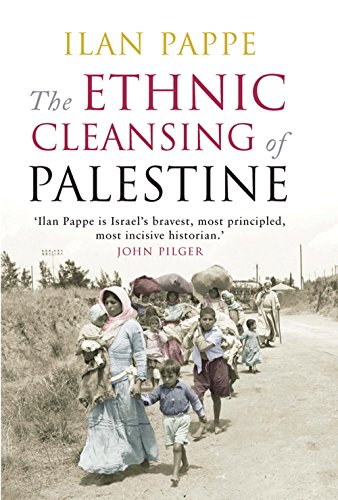
One of the major sources on the expulsion of the Palestinians from their homeland was the ground-breaking research by Ilan Pappe, an Israeli historian, and over the years I’d sometimes seen favorable mention of his 2006 book The Ethnic Cleansing of Palestine. So prompted by Khalidi’s much briefer account, I finally read it, finishing the last page just a few days before the unexpected attack by Hamas suddenly propelled the Israel-Palestine conflict back to the center of world attention. Pappe’s work seemed to warrant all the critical praise it had received, with the scholar relying upon exhaustive archival research to reconstruct and document the plans of the Zionist leadership to remove all the Palestinians and create the purely Jewish state that they had always desired.
The term “ethnic cleansing” became widespread in the Western media during the bitter Balkan Wars of the 1990s. The blatant war crimes represented by that term were used to justify NATO bombing attacks against the perpetrators, and some of the leading architects were later brought to trial in the Hague, ending their lives in prison cells. So one very effective framing technique employed by Pappe is to open most of his chapters by quoting a short passage describing some of those Balkan outrages, followed by pages of text demonstrating that the same crimes or far worse ones had also been committed by the Zionist forces a few decades earlier. In those 1990s conflicts, Gen. Wesley Clark, a Supreme NATO commander of Jewish ancestry, had famously declared “There is no place in modern Europe for ethnically pure states.” But a certain Middle Eastern country had earlier received strong American support in its military efforts to achieve exactly that same objective.
One important point emphasized by the author was that from the beginning the Zionist leadership was quite confident of their comfortable military superiority over the forces they might face, not merely the almost unarmed Palestinian civilians whose towns and villages they planned to destroy, but even the armies of the neighboring Arab states that might eventually intervene. According to the myth of later Israeli propaganda, the local Palestinians only began fleeing after the State of Israel was declared and Arab armies invaded, but in actuality by that date some 200 Palestinian villages had already been attacked, with their inhabitants killed or expelled, and this brutal ethnic cleansing was what provoked the Arab military intervention.
Whether or not a local Palestinian village had amicable relations with nearby Zionist settlers was irrelevant and all were targeted for destruction. According to Pappe, the circumstances surrounding the notorious Deir Yassin massacre were particularly disreputable. That village had concluded a formal non-aggression pact with the main Zionist movement, so the leaders of the latter legalistically arranged for the Irgun and Stern Gang forces to launch the attack, which resulted in a brutal massacre of the inhabitants, with word of the horrific atrocities putting many other Palestinians to flight. Ultimately, more than 500 villages were attacked, usually with some of their men summarily executed and the remainder of the population expelled, while the buildings were destroyed and the entire village razed to the ground.
The population of all the Palestinian towns and cities were treated in similar fashion, with one subsection of the book entitled “The Urbicide of Palestine.” Sometimes the inhabitants of nearby villages were deliberately massacred in order to terrorize the urban population and precipitate their flight, which was further encouraged by a bombardment of mortar shells or other high explosives. Any Palestinian property was casually looted, while rapes and gang-rapes also occurred, sometimes culminating with murder, although the true numbers of those incidents cannot be determined.
The year 1948 had begun with only 6% of Palestine’s land under Jewish ownership, but the UN assigned 55% of the territory to the new Jewish state and its victorious military forces soon seized half of the proposed Palestinian state as well, only disappointed because they failed to seize the other half as they had hoped. Their original intent had been to expel all non-Jews from the territory under their control, and although they were ultimately 80% successful in this effort, their failure to dislodge the last 20% before the war ended led to later recriminations. But as Pappe explains, since 1948 Israel’s remaining Palestinian minority has been legally confined to just 2% of the land compared to the 94% they had owned prior to the Zionist seizures and expulsions of that year.
One important point that Pappe makes is that the British had spent nearly three decades maintaining law and order in Palestine, and their military and police forces were still present in very large numbers even after the disposition of the territory had been put into the hands of the UN. As a result, Palestinian civilians had naively assumed that they would be protected from unprovoked attacks by the Zionist militias, and they were therefore shocked and unprepared when the British forces instead stood by and did nothing, placing them at the complete mercy of violent groups who stole their property or killed them with complete impunity.
Although I have never paid much attention to fashion or celebrity magazines, sisters Gigi and Bella Hadid are American supermodels whose images have graced the covers of many of those publications. Their paternal ancestry is Palestinian, and their elderly father recently told the painful story of how his parents had willingly taken in a family of pitiful Jewish refugees who arrived in their country from Europe. But then his mother traveled to a neighboring town for a few days to be with relatives during the birth of her child and when she returned, that Jewish family had seized their home and dispossessed them, refusing to allow them entrance to take any of their family photographs or even a blanket for their new-born baby.
Mohamed Hadid, father of supermodels Bella and Gigi Hadid, talks about how the Jewish refugees his family took in, eventually betrayed his family:
"We were locked out — they wouldn't even let her enter the house to take a single photo of her children".
pic.twitter.com/ebAFC1e2Lb
— Dr. Anastasia Maria Loupis (@DrLoupis) December 7, 2023
The United Nations had legally created the State of Israel and in late 1948 after the end of the fighting, UN General Assembly Resolution 194 required the unconditional return of the Palestinian refugees, something that typically happened after the end of every military conflict. But although many of the families had fled their homes only days or weeks earlier, the Israeli government refused to comply, leading to the threat of American sanctions, though these were never imposed. Meanwhile, the Israelis sought to forestall any such possibility by accelerating their destruction of the emptied Palestinian villages and quickly resettling Jews in the abandoned homes of the towns and cities they had seized. For years afterward, the Israelis would regularly shoot as “infiltrators” any Palestinians who tried to return to their homes and land, incidents that gradually set the stage for future wars.
Although I’d strongly recommend reading Pappe’s heavily documented book, those who prefer to absorb his important information in a different format can watch a long 2018 interview of the author, viewed nearly 300,000 times on Youtube, followed by Part Two of that interview or a shorter discussion of the book by a British blogger a few weeks ago.
As demonstrated in his interviews, Pappe is a deeply humanitarian individual of progressive sympathies and an outstanding scholar focused intensely upon the Middle East. So on other matters outside his area of professional expertise, he naturally shares views that are widespread in his ideological circles. For example, although his central theme is the appalling dispossession of the native Palestinians by Zionist settlers, he freely admits that the process was not so very different from what had previously happened in the United States, as European settlers dispossessed and ethnically cleansed the native Amerindians,