Select date

Moon Landing 2023 – Science or Science Fiction?


All Global Research articles can be read in 51 languages by activating the Translate Website button below the author’s name.
To receive Global Research’s Daily Newsletter (selected articles), click here.
Click the share button above to email/forward this article to your friends and colleagues. Follow us on Instagram and Twitter and subscribe to our Telegram Channel. Feel free to repost and share widely Global Research articles.
***
This article is largely based on my book entitled Moon Landing 2023 – Science or Science-fiction?
Given that a 2019 poll, conducted by YouGov, found that 29 percent of respondents 50 years old or younger expressed some belief that the U.S. government “faked the 1969 Apollo moon landing,”, [1] this article will examine the evidence for the claimed ISRO moon landing in 2023; and the ongoing controversy surrounding NASA’s Apollo moon landings. Then we will dive a little deeper into the matrix of deception and illusion; and what may lie behind it.
The India Space Research Organisation (ISRO) Claim to Have Landed on the Moon
The India Space Research Organisation (ISRO) informed the world that their Chandrayaan Mission-3 spacecraft landed on the moon on August 23rd 2023, as detailed on the organisation’s website. We can view the video footage that ISRO has released as purported evidence of this historical ‘moon landing’. The following is a video posted by the UK’s Guardian newspaper:
According to Jim Bridenstine, who led NASA as administrator from 2018 to 2021, “They should feel very proud of this accomplishment”[2]. It is also remarkable that this incredible achievement appears to have been achieved on a shoestring budget. According to CNBC:
“In 2020, the Indian Space Research Organization (ISRO) estimated the Chandrayaan-3 mission would cost about $75 million…But that rivals the lowest-cost lunar lander missions in development in the U.S. NASA in recent years turned to having companies compete for fixed-price contracts to build moon landers, under a program it calls Commercial Lunar Payload Services. The CLPS program has a maximum budget of $2.6 billion over 10 years, with 14 companies vying for mission contracts typically worth upwards of $70 million each. Overall, NASA’s annual budget dwarfs that of its Indian counterpart. In 2023, the U.S. agency received $25.4 billion in funding, compared to the ISRO’s budget of about $1.6 billion.”[3]
Considering that a Hollywood movie could cost twice that to produce it certainly sounds like an impresssive achievement for just $75 million. Here in Ireland, $75 million would build about 10 Km of motorway,[4]; and I note the 2016 movie Star Trek Beyond had a budget of $185 million – so to go to the moon and back for just $75 million odd is ‘beyond’ impressive. It seems to be cheaper to go to the moon that to build 10 km of motorway!
Let us consider what ISRO had to achieve with just $75 million. It is claimed by space agencies and modern science that the moon is around 240,000 miles away from the Earth. So, the ISRO spacecraft had to travel 240,000 miles to the moon and then achieve lunar orbit. The spacecraft then had to ‘descend’ from orbit onto the moon surface (apparently a distance of around 60 miles or more). Upon landing, we are told, the spacecraft opened up and a rover vehicle called ‘Pragyan’ (CGI picture released by ISRO below) rolled out onto the moon, in a purported vacuum at 1/6 Earth gravity. We are told the vehicle and rover stayed on the moon for two weeks to conduct various scientific experiments. All this sounds truly incredible or, perhaps… it is too incredible to be true.
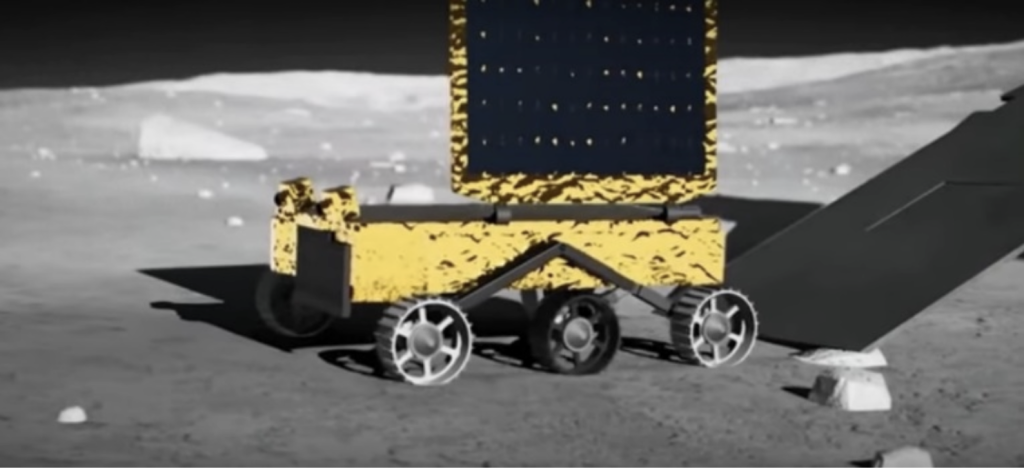
ISRO sources said:
“Chandrayaan-3 will perform a raft of experiments, including a spectrometer analysis of the mineral and chemical composition of the Moon’s surface, returning valuable data on the properties of lunar soil and rocks. It hopes to confirm the presence of water ice in the region, which could supply oxygen, fuel, and drinking water for future space exploration.”[5]
Meanwhile, we were told, ISRO ground control on Earth attempted to communicate with the vehicle. We are told the rover is powered by solar energy – which seems an odd decision given the speculations of space agencies that the moon has a south pole with regions permanently in shadow. Furthermore, according to ISRO the vehicles are subjected to temperatures between minus 156 degrees Celsius at night to plus 121 degrees Celsius during the day, but have been equipped with systems to deal with this massive thermal stress. This is also interesting, considering electronic devices usually have a temperature limit something along the lines of -10 °C to 75 °C while in use.
Video Footage Taken by the Spacecraft While Orbiting the Moon – but this Looks Like CGI
The ISRO website even provides video footage of the spacecraft traveling over the moon’s surface[6]. This should be amazing to watch! Let us take a look here.
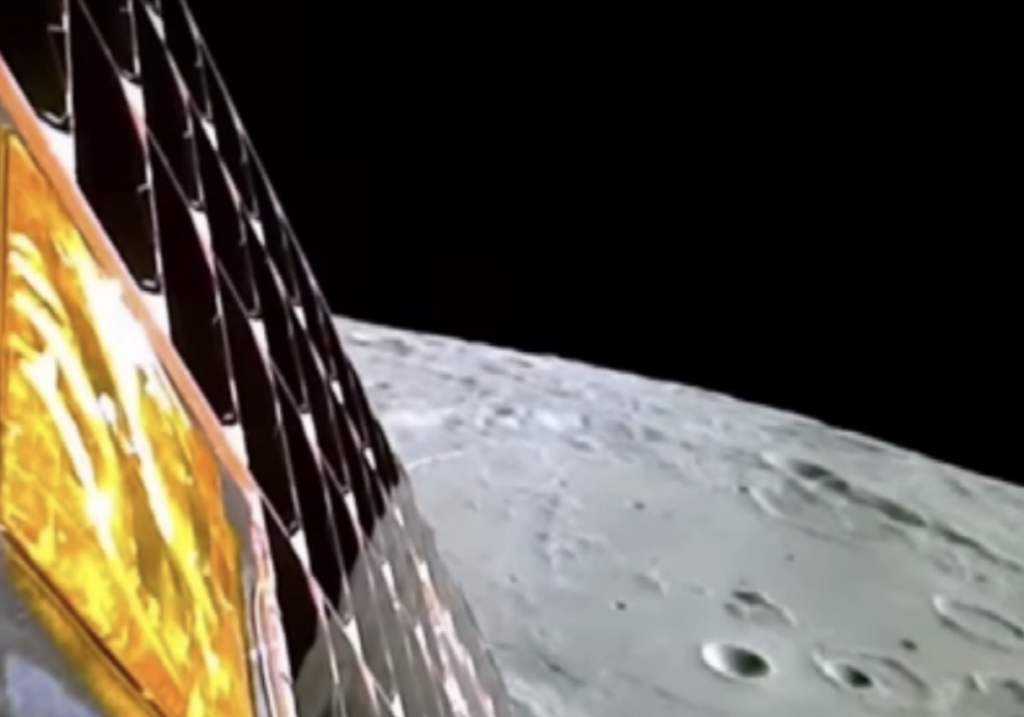
Wait! What is this I am watching? This footage looks like computer video game animation from the 1980s! What ‘on Earth’ is going here? The picture below is a screenshot from the ISRO video footage taken from the spacecraft supposedly orbiting the moon – does this image look real to you or does it look like CGI (computer generated imagery)?
Bizarre Simulation Video of the Moon Landing, While ISRO Employees Look On and Cheer Wildly
The two images below are of the yellow ISRO vehicle as displayed on ISRO-released video footage. These images were displayed to the ISRO employees at ground control as the spacecraft ‘descended’ toward the moon surface. The video ISRO provide is clearly CGI animation. Clearly, these videos of ISRO’s yellow-coloured spacecraft were not intended as real actual footage of the spacecraft landing, but as a simulation of what was supposed to be taking place.

Then, as the yellow-coloured spacecraft touched down in the real-time simulation, the ISRO employees watching this simulation in the ISRO command centre on Earth are seen to cheer and clap wildly in the belief that the actual ISRO space vehicle is actually touching down on the surface of the moon.
We are told the lander weighs 1749.86 Kg, including a 26 Kg Rover vehicle, 14 payloads, and the rover consisting of scientific instrumentation designed to measure various aspects of the moon’s surface and subsurface. For example, instruments to measure the thermal properties and the seismic activity of the surface; and an alpha-particle x-ray spectromoter to measure the chemical composition of the surface.
ISRO Video Footage of the Rover Purportedly Leaving the Spacecraft and Rolling onto the Moon Surface – Sceptical Comments on YouTube
ISRO provided the following video posted here,[7], by the UK’s Guardian newspaper. We are told this is actual real footage of the rover leaving the lander vehicle and travelling on the moon surface. It is little more professional looking, but, in my opinion, it is hazy, and does not look real – it looks like CGI animation or film production. Furthermore, there is nothing in the footage that enables anyone to verify it as being filmed on the moon – there is no point of reference, no view of space, and no view of the Earth from the moon that would indicate it is real.
Below is a picture of the ISRO Moon Rover claimed to be rolling onto the moon surface. The picture is a screengrab from the above video footage posted by the Guardian newspaper. A question has also been raised as to why, upon close examination, there appears to be no wheel imprints left by the front left wheel on the lunar soil (for example at 0.13 seconds in the above video).
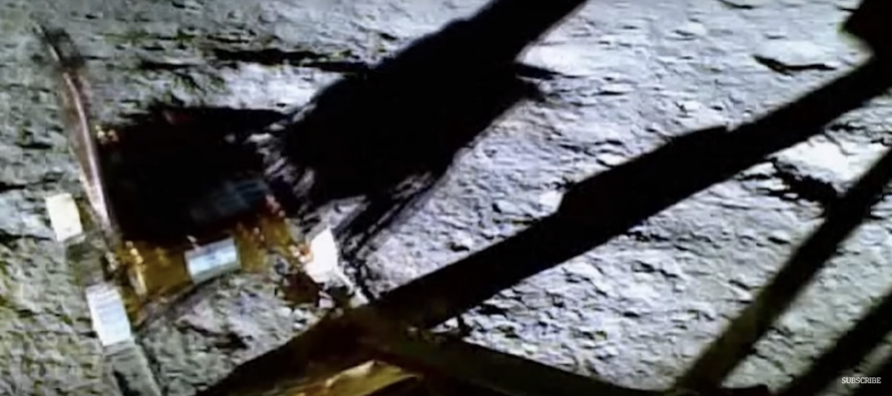
After landing, ISRO claim the ‘rover’ took the following ‘real’ image of the landing craft.
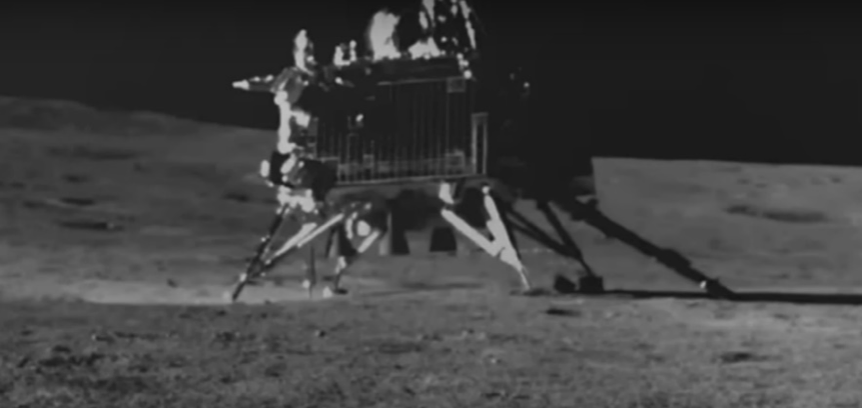
It appears to me that the above hazy video and the above black and white picture are not proof of anything. Actual real video of the moon planet, or of any foreign planet, would surely be magnificent with detailed views stretching to a distant horizon. Just as there are detailed views of landscapes here on Earth. Instead, we are presented with CGI images, and a black and white picture that looks more like a few yards of barren desert that could just as easily be Nevada or a Hollywood film set.
Additionally, there are no stars in the background. On platforms, such as YouTube, people are leaving sceptical comments such as the following:
“So far only CGI computer generated images Where are the real images of the Moon? If you compare Indias moon coverage to a football game, 99% of footage released was of spectators, Godi media, ISRO cheering instead of the actual Moon Footage. I want to believe India went to the moon but they are making it very difficult. Looks like another Hollywood