Select date

The 1995 Assassination of Prime Minister Yitzhak Rabin: Yigal Amir Is Israel’s Oswald. “Most Israelis Believe that He was not The Lone Assassin but Part of a Wider Plot”


All Global Research articles can be read in 51 languages by activating the Translate Website button below the author’s name.
To receive Global Research’s Daily Newsletter (selected articles), click here.
Click the share button above to email/forward this article to your friends and colleagues. Follow us on Instagram and Twitter and subscribe to our Telegram Channel. Feel free to repost and share widely Global Research articles.
***
Twenty-eight years ago, the Israeli nation went into mourning after the assassination of Labor Party Prime Minister Yitzhak Rabin on November 4, 1995, allegedly by a right-wing West Bank settler named Yigal Amir.
A law student at Bar Ilan University, Amir was an activist of an anti-peace process organization who, according to the official story, shot Rabin at the end of a Tel Aviv rally in support of the Oslo Accords.
Formally signed in Washington, D.C., in 1993, the Oslo Accords resulted in Israel’s transferring control of the Occupied Territories to the Palestinian Authority (PA) and withdrawal of Israeli troops from Gaza and Jericho in return for the Palestine Liberation Organization (PLO) renouncing the use of terrorism and violence.
The Oslo II Accords, signed in September 1995, just two months before Rabin’s assassination, envisioned greater Palestinian autonomy from Israel and interim self-government in the Palestinian territories.
Many Palestinians viewed the Oslo Accords as an act of capitulation since Arafat abandoned Palestinian demands for their own state, and did not press for Palestinians’ right of return (of those expelled in the 1948 Nakba) and the release of Palestinian political prisoners.[1]
The majority of the Jews in Israel opposed Oslo II. It was ratified by the Knesset on October 6, 1995 by one vote, with the support of the Arab parties. Rabin would be murdered one month later. Hundreds of thousands of Israelis demonstrated against the Accords while Arab terror attacks continued unabated.
Some historians believe that “if Rabin had lived, he surely would have won the 1996 election and the peace process would have been advanced.”[2] Rabin’s daughter Dalia, however, has suggested that Rabin was close to calling off the Oslo process prior to his death and was considering “doing a U-turn, a reverse on our side. After all, he was someone for whom the national security of the state was sacrosanct and above all.”[3]
Rabin had a background as more of a warmonger than peacemaker, having been the chief of staff of the Israeli Defense Forces (IDF) during the 6-day war and Defense Minister during the first Intifada in the late 1980s when he ordered Israeli soldiers to “break the bones ”of Palestinian protesters.”[4] When a U.S. State Department official tried to get Rabin to meet with the Syrian Foreign Minister at the UN to withdraw from the Golan Heights two weeks before his assassination, Rabin called him a “motherfucker.”
With Rabin’s growing apprehension and opposition to the more left-wing policies of Foreign Minister Shimon Peres regarding the future of the West Bank, Gaza and the Golan Heights, Peres had to act fast. A choreographed “attempted assassination” was, literally at the last moment, converted to a vile hit-job, according to sources inside Israel.[5]
Convicted for the assassination in March 1996, Amir was branded by Israeli authorities as a “lone nut” like Lee Harvey Oswald, and spent more than 15 years in solitary confinement.
Most Israelis believe, however, that he was not the lone assassin but part of a wider plot. Just as Oswald denied doing anything in the Dallas Sheriff’s interrogation, and also said, you’ll soon see who i am, so too Amir in his first police interrogation claimed he didn’t do anything and soon he’ll blow the whole system up with his court testimony.
There is considerable evidence that has emerged to indicate that Amir was indeed set up as a patsy—just like Lee Harvey Oswald and Sirhan Sirhan in the case of the assassination of Robert F. Kennedy.
Covert Operation
The anti-peace process group to which Amir belonged, Eyal (acronym for the Organization of Jewish Warriors) was a front created by the General Security Services, Shabak (sometimes Shin Bet), or Israel’s internal security services or FBI. Headed by Avishai Raviv, a Shabak agent since 1987 known as “champagne,” Eyal was created as part of a covert operation designed to attract anti-peace process radicals and set them up for arrest.[6]
At one protest prior to Rabin’s murder, Raviv was filmed with a picture of Rabin in a Nazi SS uniform, which had the purpose of inflaming the right-wing settlers while making them look crazy.
On the night of the shooting, Amir was provided a gun loaded with blanks and was instructed to shoot him, setting himself up to be caught.
Remarkably, Rabin himself knew about the plot and thought it was a set-up to make him look like a hero for surviving an assassination attempt, which would justify a nationwide crackdown on opponents of the peace process. Sitting on the dais at the Peace Rally, Rabin asked the person sitting by his side “Has it already started” when a motorcycle backfired.
After the blanks were fired and Amir was captured by police, Rabin was whisked into his limousine where he was actually still very much alive.
But Rabin was double-crossed as the real assassin sat down next to him in the rear of the limousine and shot him as the limousine made its way to the hospital through the streets of Tel Aviv.
Clues of a Conspiracy
According to investigator Barry Chamish, the conspiracy was sloppy and there were key clues that the conspirators left behind. The official narrative of Amir as the lone assassin who shot Rabin in the back is undercut by a vast array of facts that include:
- National television broadcast a supposed amateur video made by Roni Kempler which convinced the Israeli public Amir shot Rabin. For 30 minutes the tripod and cameraman stood on the roof above the sterile area; a security no-no. The film was doctored, stretching Amir’s arm by two feet and blanking out at the moment of “impact.” An IDF intelligence course taught soldiers how the filming was planned, executed, edited and photoshopped to deceive the public.
- The Kempler film interestingly documents that Rabin’s bodyguards allowed Amir to take a clear shot at Rabin and that Rabin survived it.
- Witnesses a few feet from Rabin, including his wife, said they saw him continue walking briskly after supposedly being shot. Ten minutes after the shooting, one witness, Miriam Oren, told a national television audience: “Rabin wasn’t hurt. I saw him walk into the car.”[7]
- Security officers at the scene did not believe Rabin was shot at the rally because he did not fall, cry out in pain, or bleed. Three police officers who had been present testified that “when Yitzhak Rabin was placed in the car, he showed no visible wounds,” according to wikipedia.
- Rabin suspiciously was not put in the ambulance which was parked next to his car.
- Just as the Zapruder film’s frames were reversed in Life Magazine to prove Oswald’s guilt so Israel’s largest daily extended Amir’s arm to make him close to Rabin to prove his guilt.
- Police laboratory tests concluded that Rabin was shot point blank, though the government’s Commission of Inquiry concluded that Amir shot at Rabin from a distance of a half meter. One of the shots had actual contact of the gun on Rabin’s jacket.
- The Israeli police conducted Feroprints tests on Yigal Amir fifteen minutes after the shooting. The results were negative. Feroprint, a device used by Interpol and most police labs, measures the metal discharge when a bullet is fired from a revolver. It is impossible to test negative for 24 hours if you’ve fired a gun. There was also no gunpowder residue found on Amir’s hands, clothes or hair, which would have been impossible unless he fired blanks. Police ballistics tests on shell casings found at the scene also did not match Amir’s gun.[8]
- The death certificate, signed by Dr. Mordecai Gutman, one of the surgeons’ who operated on Rabin—stated that Rabin was shot through the chest from the front and that his spine was shattered, claims backed up by an operating room nurse, the Health Minister, the Director of Ichilov Hospital, a patient, and even then-Foreign Minister Shimon Peres. The official version of events has Amir shooting Rabin in the back with no spinal damage.[9]
- One of the pieces of evidence found with Rabin’s belongings was a bloodied song sheet, which gives weight to the theory that Rabin was shot in the chest and not in the back by Amir.[10]

Rabin’s bloody songbook. [Source: wikipedia.org]
- Like in the JFK assassination where the military supervision was removed, Rabin’s IDF security detail, required by law, was removed. The next week, the disheartened commanding officer moved to Canada. When he decided to return to Israel to go public, he was killed.
- The Shamgar Commission set up by the Israeli government (led at the time by Shimon Peres) to investigate the assassination concluded that two policemen had held Amir down after he attempted two shots and yet somehow Amir is alleged to have shot Rabin after he was pinned in a downward slope (meaning he got up over top of him). The medical reports determined that Rabin had been paralyzed after a bullet entered his spine but he was seen walking into the limo at the rally so could not have been shot there, and this injury disappeared from the Shamgar Commission Records.[11]
- An operating room technician at the Ichilov Hospital, thought to be Eli Lipstein, reported that there was another dead body in the hospital that night, of another bodyguard, who was unaccounted for and never reported about.[12]
According to an investigation carried out by Natan Gefen, author of The Deadly Sting, Rabin was killed by a single bullet in the front of the chest on the right, which hit the spine and destroyed his spinal vertebra.
About 45 minutes after being treated in the trauma room, Rabin died of his wounds and his body was left in the hands of the Shabak (Shin Bet) who were all over the hospital. Some time later, the doctors were called back to the trauma room and found two more bullets in Rabin’s back. They were tasked with moving the body to the operating room and performing an operation to remove the original bullet and to change the medical records, much like with John F. Kennedy.
Since Amir was behind Rabin at the rally, the entrance wound in the chest disappeared in the forged medical documents and was replaced with two bullets that were fired into a dead Rabin in the hospital. The bogus medical report identified the entrance wounds in his back, while ignoring the fatal entrance wound in the chest.[13]

Source: slideplayer.com
The Shabak agents on the scene threatened the doctors and hospital staff to lie to the public. A Tel Aviv magazine reported that everyone on duty at Ichilov involved in trying to save Rabin received anonymous mailed death threats.[14]
Three witness doctors were in the end killed, Dr. Kluger and Dr. Gutman along with Dr. Dalia Eyal and her husband Nimrod and son Eyal.[15] Dr. Eyal’s family was poisoned with cyanide. The morning after the assassination, she placed in all of Ichilov’s doctors’ mailboxes copies of the authentic medical records.
Advance Warning
Yitzhak Shamir, Israel’s Prime Minister from 1986 to 1992 and the former head of Mossad’s European desk, told Benny Elon, a territorial leader, two weeks before the assassination that “They’re planning to do another Arlosorov.”
This was a reference to the 1933 assassination of the leader of the Mapai left-wing Socialist party. The murder is believed to be a black flag op by the left to discredit their rival, right-wing Jabotinski and his Revisionist party, at the ongoing Zionist Congress in Basal. The left wanted to make a deal with Hitler, which the right opposed vehemently. The arrested Revisionists were acquitted at trial. The murder remains unsolved.[16]
Agent Provocateur
Within an hour of the assassination, Amir was brought before a Tel Aviv magistrate judge for a 30-day detention order in the hands of the Shabak. He claimed innocence to the court, protesting that he only did what he was told to do [shoot blanks].”
This is similar to Lee Harvey Oswald’s protest “I am a patsy.”
With his intelligence background, Amir’s very public and radical activities, especially his anti-Rabin threats, leading up to the assassination, were a mirror image of Lee Harvey Oswald’s radical and public actions before the JFK’s assassination with the Fair Play For Cuba Committee.
In both cases, attention was drawn upon themselves, evidence was strewn in plain sight, only to be cited later as proof of their guilt. Every covert operation requires a cover story. And that cover story can be long in the making.
In the summer of 1992, following his IDF service in a high-end infantry unit, the Prime Minister’s Office sent Amir to Riga, Latvia, for three months where he worked as a security guard. The Shabak trained him in the use of handguns.
In the fall of 1993, Amir began studying law and computer science, and Jewish law at Bar-Ilan University. There he made known his strong opposition to the Oslo Accords, participating in protest rallies on campus. He organized weekend bus trips to support West Bank settlers, and helped found an illegal settlement outpost. Amir was especially active in Hebron, where he led marches through the streets. He also attempted to form an anti-Arab militia.
Amir made public his view that Rabin was a “rodef,” meaning a “pursuer” who endangered Jewish lives. Amir repeatedly told people he would be justified under Jewish law to kill Rabin since he endangered the lives of Jews. Pamphlets suddenly appeared in West Bank settlement synagogues advocating the validity of applying the law of pursuer, punishable by death.
Shabak agent Avishai Raviv publically encouraged Amir to murder Rabin. More than a dozen people testified to seeing Raviv prod Amir into killing Rabin. Good citizens reported Amir to the authorities. The Shabak dismissed Amir’s threats as “non-credible.”[17]
Strange Behavior of Rabin’s Driver
The limo driver, Menachem Damti, was a last-minute replacement for Rabin’s regular driver. He was Foreign Minister Shimon Peres’s driver.[18]
Damti lied to police investigators when he claimed he went right to the driver’s seat after hearing that Rabin was shot; the Kempler film showed him staying outside the limo and helping Rabin into the car.
The drive to Ichilov Hospital from the site of the rally should have been less than a one-minute drive at a speed of 60 miles per hour and at most four minutes but took twenty-two minutes. The route is a residential street with no traffic lights or traffic.
Damti was the most experienced driver in the country who had driven every prime minister since 1974 but on the way to Ichilov somehow “became confused,” and took wrong turns though he knew the correct route to Ichilov by rote.[19]
Also, Damti did not notify Ichilov by radio that he was coming and, thus, the hospital staff was totally unprepared for Rabin’s arrival.[20]

Source: Photo Courtesy of google maps
A Prime Suspect: Peres’ Bodyguard
Peres changed Rabin’s four-man security detail at the last moment. He replaced the driver with his own, Mohammed Damti, and replaced one of the bodyguards with his own: Yoram Rubin. In the later “investigation” proceedings, Rubin kept altering his testimony and lied to the Shamgar Commission when he claimed to have jumped on Rabin after he was shot.
Rubin testified under oath that a bullet entered his arm “like an electrical charge” while he was trying to save Rabin, though the clinical hospital report revealed that he was treated for only a superficial wound and that no bullet ever penetrated his skin.[21]
Rubin was sitting next to Rabin in the limo on the drive to the hospital in the back seat and so was the main person who could have shot him in the chest (medical reports specified that Rabin came into the Ichilov hospital with a chest wound). A large blood stain was recorded on both the front and back seats of the limo, corroborating this theory.
Researcher Barry Chamish considers Rubin to be the prime murder suspect.[22] Right after Rabin’s death, he became Shimon Peres’s bodyguard—when he should not have been trusted since he had not adequately protected Rabin.[23] He also served in the highest levels of the Shabak.
While in the army reserves and serving as Rabin’s personal bodyguard, Rubin took frequent unexplained trips abroad, which indicate involvement in covert operations. An informant noted that his travel expenses “rivaled the wealthiest businessmen in the country.”
These trips started before Rabin was killed and resumed in January 1996. The informant said his people thought that Rubin was then “receiving and depositing money for services rendered and keeping quiet. And that’s why we think Peres took him on as his personal bodyguard without hesitation. That’s what we think.”[24]
The Missing Bodyguard
As Yoram Rubin almost certainly shot Rabin dead in the back seat, Damti shot dead Yoav Kuriel—Rabin’s personal bodyguard—in the front seat. Yoav, an orthodox Bar Ilan University grad and rumored Shabak (Shin Bet) agent, was shot seven times in the chest. Deposing his body accounted for the 22 minute delay in getting to the hospital.
The chief of security at Ichilov hospital signed an affidavit that he had inspected Rabin’s car and saw pools of blood in the front and back seats. The Israel police claimed Yoav committed suicide in his upscale North Tel Aviv apartment the following day because he failed in his duty. No weapon, though, was recovered at the scene. That night, downtown Tel Aviv was blocked to traffic during his funeral in the Yarkon Cemetery. One of the rabbis who prepared Yoav’s body for burial reported he saw seven holes in his chest. An official document stated “Cause of death: work accident.” The rabbi was threatened with death if he said anything.
The Shamgar Commission of Inquiry made a supreme effort to hide Yoav’s name, that is, the fourth bodyguard of Rabin’s detail, from the report. This effort to obscure the details of the fourth bodyguard, which was defined by the Shabak as the key to understanding Rabin’s murder, explains the absence of Yoav Kuriel’s name from the list of those buried in the Yarkon cemetery. The official postponement of Yoav Kuriel’s date of death by 10 days—November 15—also obscured the connection between his and Rabin’s deaths.[25]

Yoav Kuriel accompanying Rabin as they approached the ambush car. [Source: rotter.net]
Police Cover-up and a Kangaroo Court
No independent examination of Rabin’s body was undertaken. There was no autopsy. The only proof of what happened to the body is found in the muddled, contradictory reports which emanated from the Ichilov Hospital on the night of the murder.[26] The pathologists’ report written by Dr. Yehuda Hiss was altered so as to change Rabin’s wounds—after Hiss had been threatened and forced to sign a confidentiality agreement by Shabak agents in the Ichilov Hospital.
Prior to Amir’s trial, all the police files against Raviv—more than 15 of them—disappeared and the one document revealing Raviv’s criminal past that was presented to the court was done so in a secret session. Raviv was never called to testify.
Gabi Shahar, one of Amir’s lawyers, described a trial—like the Shamgar Commission before it—in which no evidence contrary to the established version of events could be presented, no counter scenarios vocalized, and no confusing testimony discussed.
The court found no money or desire to arrange the most basic pathological and ballistic tests and judges ignored evidence that contradicted the official story.[27] In violation of the law, the prosecution hid the negative Feroprints. When Amir’s attorney demanded to call Yoram Rubin as a witness, the judge mocked him, denying his request.
Barry Chamish wrote that “the kangaroo court denied Amir any chance of a fair trial and prevented the Israeli public from hearing the truth about the murder of their prime minister.”[28]
Shutting People Up Permanently
As in the Kennedy murder, numerous witnesses with insider knowledge about the culprits in the plot to kill Rabin were murdered, with their deaths declared to be “suicides.”
Not long after the release of the Shamgar Commission’s findings, one of the members of the commission, Ariel Rosen-Zvi, a Tel Aviv University law professor, died of cancer.
An informant told researcher Barry Chamish that he had seen Ariel the week before he died and that Ariel told him “he was keeping deep secrets in his heart about Rabin and could never reveal them.” Chamish wrote that “a few days later he was dead. Cancer isn’t a heart attack. You are bedridden in the final stages. He couldn’t have died overnight from it.”[29]
Rabin’s murder may have also been connected with the murder of his deputy defense minister Mordechai “Motta” Gur, a hero of the 1967 Six-Day War like Rabin, a few months earlier. Gur supposedly died by suicide because of a terminal illness but his cancer was reported to be in remission and he was found shot through the neck.
An accompanying suicide note also looked to be forged, and the gunshot wound could not have been self-inflicted. The night before his death he had made an appointment to be interviewed by a TV reporter. Initially he had supported Rabin’s peace initiative but came to believe the Palestinians used the Oslo accords as a ruse, and was planning to run for Prime Minister.
Who Was at the Top of the Conspiracy?
If Rubin emerges as a key suspect in the killing who may have fired the fatal bullets, the people who ordered the killing remain unidentified. However, a number of key suspects emerge, including:
- Carmi Gillon, the head of Shabak who was in Paris at the killing on undisclosed business and may have communicated with the conspirators in the course of the killing via telephone. Gillon had earlier used Raviv as an agent provocateur and was found by the Shamgar Commission to have not sufficiently investigated threats against Rabin that had accumulated before the assassination or pass on relevant information to Rabin’s bodyguards and the police. Gillon was later appointed to a prestigious position as head of the Shimon Peres Peace Institute.[30]
and
- Shimon Peres: He was a main beneficiary of the assassination who rewarded Rubin by making him his top bodyguard after the assassination. Peres was with Rabin at the time of his assassination and his behavior on the night of the assassination appears suspicious. Peres also made sure that Carmi Gillon did not resign as head of Shabak, repeatedly praised him, and subsequently appointed him to a prestigious position. As Prime Minister in 1986, Peres had previously led the government’s refusal to allow an investigation of the Shabak in a case (known as the Bus 300 case) where its agents had executed two Gazans, who were allegedly terrorists, after they were taken into police custody.[31]
Role of French Intelligence
Peres was connected to the Vatican and France. Barry Chamish argues that the General Directorate for External Security, France’s foreign intelligence agency, equivalent to the CIA, played a role in Rabin’s assassination.
For this reason, in 1988 Prime Minister Netanyahu appointed his trusted colleague Eliyahu Ben-Elissar PhD, as ambassador to France.
Two years later, Ben-Elissar was murdered in Paris. Israel’s Foreign Ministry refused to explain his death. Barry Chamish investigated and wrote about the swirling rumors surrounding his death from a heart attack when he was previously in good health.
According to Chamish, word had reached then Israeli Prime Minister Ehud Barak that Ben-Elissar had been apprised of the truth by a French intelligence official that his government helped murder Yitzhak Rabin in order to place their agent, Shimon Peres in the Israeli Prime Minister’s office, leading to his recall.
To avert suspicion, Barak recalled six other diplomats at the same time. But in his last days in Paris, Ben-Elissar continued gathering the facts. He was in turn lured to the hotel where he died with the promise of additional proof and told that he must arrive without any security. Once there, the “informant” spiked his coffee or utilized another means to initiate a mortal cardiac arrest. One more influential individual, who knew too much about Rabin’s assassination, then bit the dust.[32]
Watershed in History
Barry Chamish sees the plot against Rabin as having been designed to fortify the peace process because Rabin’s death was blamed on religious right-wing settlers and used to justify a police crackdown on those rabbis and right-wing groups that opposed the peace process, with many innocent people being caught up in the net.
The foreign powers which pull Israel’s strings directed Shimon Peres to murder his life-long friend. Peres carried out a palace coup much like the LBJ and the CIA/Pentagon in November 1963, with Yigal Amir being used for the same purpose as Lee Harvey Oswald. For Peres the task at hand was simple to execute. In his youth Peres invented and founded Shabak and he controlled it and used it as his own personal instrument.
Rabin was murdered for precisely the opposite reason we believed. The cover story indicted the Torah and observant Jews, blaming the rabbis “whose incitement caused Amir to act.” In fact, Rabin, who dedicated his life to the Jewish people, died a martyr in Kiddush Hashem—the sacrifice of one’s life for the sake of the Jewish people. Peres and his “deep state” apparatus murdered Rabin because he was too much a patriot.
*
Note to readers: Please click the share button above. Follow us on Instagram and Twitter and subscribe to our Telegram Channel. Feel free to repost and share widely Global Research articles.
The author wishes to thank his friend from Israel for assisting in writing this piece.
Jeremy Kuzmarov is Managing Editor of CovertAction Magazine. He is the author of five books on U.S. foreign policy, including Obama’s Unending Wars (Clarity Press, 2019), The Russians Are Coming, Again, with John Marciano (Monthly Review Press, 2018), and Warmonger. How Clinton’s Malign Foreign Policy Launched the U.S. Trajectory From Bush II to Biden (Clarity Press, 2023). He can be reached at: [email protected].
Notes
See Edward Said, “The Morning After,” London Review of Books, October 21, 1993, https://www.lrb.co.uk/the-paper/v15/n20/edward-said/the-morning-after; Avi Shlaim, “The Oslo Accord,” Journal of Palestine Studies, 23, 3 (Spring 1994), 24-40; Norman G. Finkelstein, Image and Reality of the Israel-Palestine Conflict, 2nd ed. (Brooklyn, NY: Verso, 2003), xix. Finkelstein wrote that the real meaning of the Oslo Accord was to create a “Palestinian Bantustan by dangling before Arafat and the PLO the perquisites of power and privilege, much like how the British controlled Palestine during the Mandate years through the mufti of Jerusalem, Amin al-Husayni, and the Supreme Muslim Council.” The occupation continued after Oslo, “albeit by remote control and with the consent of the Palestinian people, represented by their sole representative, the PLO.”
- David Morrison, Lies: Israel’s Secret Service and the Rabin Murder (Jerusalem: Gefen, 2000), 11, 14. Eliot Abrams told the Council of Foreign Relations that Secretary of State Kerry said of Rabin: “Actually, it is quite uncertain whether Rabin would have pushed forward to the two-state solution under the conditions that existed when he was assassinated, or would today.”
- David M. Weinberg, “Yitzhak Rabin Was Close to Stopping the Oslo Process: Former PM’s true legacy is Israel’s struggle for secure and defensible borders, and great wariness of Palestinian statehood,” The Jerusalem Post, October 17, 2013, https://www.jpost.com/Opinion/Columnists/Yitzhak-Rabin-was-close-to-stopping-the-Oslo-process-329064
- See Max Blumenthal, “‘I would like to see Gaza drown in the sea’: Remembering the Real Yitzhak Rabin, 20 years after his assassination,” The Grayzone Project, November 5, 2015, https://thegrayzone.com/2015/11/05/gaza-yitzhak-rabin-assassination/amp/. Rabin and Shimon Peres meanwhile oversaw the privatization of state-owned industries and limitations on the power of the country’s trade union federation.
- Though succeeding in killing Rabin and replacing him as Prime-Minister, Peres’ calculations did not play out fully as he lost 1996 elections to Benjamin Netanyahu of the right-wing Likud Party by less than 1% of the vote, and the Oslo agreements eventually broke down. Barry Chamish maintains that Netanyahu blackmailed Peres: either Peres would lose the election, or the Likud would expose the coup d’etat. Peres manipulated his natural allies, the 210,000 Arab voters, not to vote for him.
- Barry Chamish, Who Murdered Yitzhak Rabin? (Cambridge, MA: Brookline Books, 2000), xii, xiii; Morrison, Lies, 91-128.
- According to wikipedia, a Shin Bet (secret service) agent testified that “I heard a policeman shout to people to calm down. The shot is a blank.” Policeman Moshe Ephron stated: “The shots didn’t sound natural. If they were real shots, they should have sounded much louder.” Leah Rabin stated that a security guard told her immediately after the incident that the bullets shot at her husband were “blanks”. She further stated that she was told by an Israeli security chief that she “should not worry as the whole thing had been staged.
- Amazingly, a revised police result was circulated 5 days after the original and an additional evaluation kit resurfaced in which many particles were apparently found on Amir’s hands.
- Chamish, Who Murdered Yitzhak Rabin? xiii, xiv.
- Chamish, Who Murdered Yitzhak Rabin? 167.
- A doctor and two paramedics reported that, after shots rang out and they ran toward Rabin, they were physically prevented by Rabin’s bodyguards from reaching him and the doctor was forced to the ground.
- Ibid.; see also Morrison, Lies, 47.
- Natan Gefen, The Deadly Sting: The Research of the Assassination of Prime Minister Yitzhak Rabin (Create Psace Independent Publishing, 2014). The false impression was created that Rabin had come into the ER with two gunshot wounds in his back. For comparison with JFK, see Jacob Hornberger, The Kennedy Autopsy (The Future of Freedom Foundation, 2014).
- Chamish, Who Murdered Yitzhak Rabin? 127, 128.
- Barry Chamish, Save Israel (Modlin House, 2002), 216.
- Chamish, Who Murdered Yitzhak Rabin? 1, 2.
- Chamish, Who Murdered Yitzhak Rabin? 9, 10.
- Chamish, Who Murdered Yitzhak Rabin? 132.
- Chamish, Who Murdered Yitzhak Rabin? 58.
- Chamish, Who Murdered Yitzhak Rabin? 60.
- Chamish, Who Murdered Yitzhak Rabin? 80, 81, 85, 86, 146. A witness saw Rubin standing alone at a distance from Rabin after Amir’s blanks were fired. He never covered Rabin to protect him.
- Chamish, Who Murdered Yitzhak Rabin? 83.
- Chamish, Who Murdered Yitzhak Rabin? 85.
- Chamish, Who Murdered Yitzhak Rabin? 85.
- https://rotter.net/forum/gil/23192.shtml
- Chamish, Who Murdered Yitzhak Rabin? 68.
- Chamish, Who Murdered Yitzhak Rabin? 74.
- Chamish, Who Murdered Yitzhak Rabin? 74. Amir commented at a court hearing, “If I were to tell the whole truth, the entire system would collapse. I know enough to destroy this country.”
- Chamish, Who Murdered Yitzhak Rabin? 104.
- Chamish, Who Murdered Yitzhak Rabin?; Morrison, Lies, 132, 134.
- Chamish, Who Murdered Yitzhak Rabin?; Morrison, Lies, 132, 136.
On May 23, 2002, when Ariel Sharon was Prime Minister, the five-story Israeli Embassy in Paris was taken out, no doubt to cover up what ugly secrets it contained. CNN reported “The elegant building, with a wood-paneled interior, had served as the headquarters of Israel’s diplomatic mission to France for four decades. The fire was so intense that only the walls were left standing.” An electrical short was the cover story.
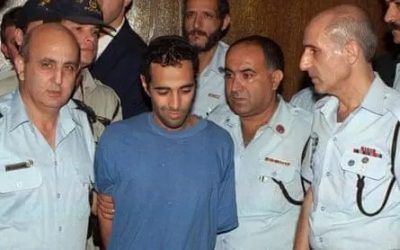
Featured image: Yigal Amir being taken to court after Rabin’s killing. [Source: theguardian.com]


.jpg)