Select date

Sustainable Development Goal 16: Part 2 — Enforcing Digital Identity


In Part 1 of our investigation into the United Nations’ (UN’s) Sustainable Development Goal 16 (SDG16) we revealed how the UN proclaims itself a “global governance regime.” We investigated the UN’s exploitation of so-called “human rights” as an authoritarian system of behavioural control permits, as opposed to any form of recognisable “rights.”
We examined how the UN uses what is calls the “policy tool” of human rights to place citizens (us) at the centre of international crises. This enables the UN and its “stakeholder partners” to seize crises as “opportunities” to limit and control our behaviour. The global public-private partnership (G3P), with the UN at its heart, redefines and even discards our supposed “human rights” entirely, claiming “crisis” as justification.
The overall objective of SDG16 is to strengthen the UN regime. The UN acknowledges that SDG16.9 is the most crucial of all its goals. It is, the regime claims, essential for the attainment of numerous other SDGs.
At first, SDG16.9 seems relatively innocuous:
By 2030, provide legal identity for all, including birth registration
But, as ever, when it comes to UN sustainable development, all is not as it initially appears.
SDG16.9 is designed to introduce a centrally controlled, global system of digital identification (digital ID). In combination with other global systems, such as interoperable Central Bank Digital Currencies (CBDCs), this can then be used to monitor our whereabouts, limit our freedom of movement and control our access to money, goods and services.
Universal adoption of SDG16.9 digital ID will enable the G3P global governance regime’s to establish a worldwide system of reward and punishment. If we accept the planned model of digital ID, it will ultimately enslave us in the name of sustainable development.
Digital ID As A Human Right
As we previously discussed, The UN underwent a “quiet revolution” in the 1990s. In 1998, then UN Secretary General Kofi Annan stated that “the business of the United Nations involves the businesses of the world.”
Government’s reduced role was to create the regulatory “enabling environment” for private investors, alongside taxpayers, to finance what would become SDGs. Using the highly questionable “climate crisis” as an alleged justification, in 2015, the UN’s Millennium Development Goals gave way to the 2030 Agenda for Sustainable Development.
On the 25th September 2015, UN General Assembly Resolution 70.1 (A/Res/70.1) formally established the SDGs by adopting the binding resolution to work towards “Transforming our world: the 2030 Agenda for Sustainable Development.”
As soon as the ink was dry on the resolution, the UN set about creating the enabling environment to encourage public-private partnerships to develop a system of global, digital ID. In May 2016, in response to SDG16.9, the United Nations Office for Partnerships convened the “ID2020 Summit – Harnessing Digital Identity for the Global Community.” This established the ID2020 Alliance.
The ID2020 Alliance is a global public-private partnership that has been setting the future course of digital identity since its founding. The global accountancy and corporate branding giant PwC was selected by the UN as the “lead sponsor” of the inaugural ID2020 summit in 2016. Excited about the opportunities digital ID would present, PwC described the ID2020 sustainable development objective:
[. . . .] to create technology-driven public-private partnerships to achieve the United Nations 2030 Sustainable Development Goal of providing legal identity for everyone on the planet. [. . .] Specifically, ID2020’s mission aligns with development target 16.9, “Legal identity for all, including birth registration”. Thirty percent of the world’s population, approximately 1.5 billion people, lack a legal identity, leaving them vulnerable to legal, political, social and economic exclusion.
Offering us digital ID to address so-called “economic exclusion,”—more on this shortly—the ID2020 Alliance duly launched in 2017 and set its Agenda2030 goal:
Enabling access to digital identity for every person on the planet.
You will note that the UN’s SDG16.9 makes no mention of global “digital ID.” Sustainable development, as it is presented to us, is nothing if not deceptive.
The ID2020 Alliance announced a “strategic, global initiative” for digital ID that presented humanity with a quite astonishing idea. The regime stated that the lack of “legal identity”—digital ID—prevented people from accessing “healthcare, schools, shelter, justice, and other government services,” thereby allegedly creating what it called “the identity gap.”
Empowered by the “global governance regime,” the ID2020 Alliance expanded on the idea that we are only permitted to live in “its” society if we can prove who we are, using its digital ID, to the satisfaction of the G3P regime.
The ID2020 manifesto states:
The ability to prove one’s identity is a fundamental and universal human right. [. . .] We live in a digital era. Individuals need a trusted, verifiable way to prove who they are, both in the physical world and online. [. . .] ID2020 Alliance partners jointly define functional requirements, influencing the course of technical innovation and providing a route to technical interoperability, and therefore trust and recognition.
SDG16.9 “sustainable development” means we must use digital ID that meets the functional requirements of the ID2020 Alliance partnership. Otherwise we will not be protected in law, service access will be denied, our right to transact in the modern economy will be removed, we will be barred from participating as “citizens” and excluded from so-called “democracy.”
This past August, ID2020 joined with the Digital Impact Alliance (DIA) to “push for digital transformation.” That said, ID2020 “joining” DIA is a bit of a misnomer, considering that both of these public-private partnerships are essentially run by the same organisations.
Speaking about the launch of its “partnership” with DIA, ID2020 founder John Edge, said:
[W]e established ID2020 to be a time-bound exploration of alternative systems for individuals to prove they exist.
In accordance with SDG16.9 “transformation,” if you don’t have the properly authorised digital ID then, as far as the regime is concerned, you don’t exist. As DIA explains, everyone must have “the trusted digital tools they need to fully participate in society.” If you don’t submit, you are literally nobody and thereby excluded from “society.”
The DIA calls its methodology “do[ing] digital right.” Its backers, such as the UN, the Bill and Melinda Gates Foundation, USAID (widely believed to be a front for the CIA) and the UK and Norwegian governments, are all behind the DIA mission:
We use our expertise to influence the influential, encouraging the world’s largest investors and most effective policymakers to “do digital right”, emphasizing the importance of design, implementation, and governance.
Establishing global governance “with teeth” is the primary objective of the G3P regime, and “sustainable development” is its chosen mechanism to achieve its ambitions. As a regime partner, the DIA has been entrusted as the steward of the regime’s associated Principles for Digital Development.
Among these “principles” is the commitment to harvest as much human data as possible and to provide “the right people” with access to that data:
When an initiative is data driven, quality information is available to the right people when they need it, and they are using those data to take action.
The “world’s largest investors” are particularly encouraged to use their money tackle the alleged “identity gap” in least developed countries (LDCs) first. This will be achieved by prioritising investment in “cross-sectoral digital public goods and architecture.”
Very graciously, the G3P will “allow LDCs to be the stewards of their national digital agendas”—providing, of course, that they fully comply with the right “agenda.”
Given the cross-cutting nature of digital and its role in reaching all of the SDG targets, we believe that the current moment in time is ideally suited for such a “push” in LDCs.
The objective is to marshal “the necessary resources to fund and achieve national and global targets.” That is to say, LDC national governments are “allowed” to adopt “digital transformation” policies aligned to “global targets.”
There is no doubt that the ID2020 Alliance fully appreciates the implications of what it is doing. In a now quite infamous 2018 article, one of the founding partners of ID2020, Microsoft, published the following:
As more and more transactions become digital in nature and are built around a single global identification standard, supported by Microsoft, the question of who will govern this evolving global community and economy becomes relevant. Especially since non-participants in this system would be unable to buy or sell goods or services.
While the regime talks about “inclusion,” it is building a global digital ID system that is inherently exclusionary and can punish regime critics or silence dissident voices by cutting them off from its “society.” Being forced to use digital ID against your will is not a “right,” but it can be called a “human right” because, as defined by the UN, those are not rights, they are policy tools.
A global system of biometric digital ID can only become “essential” for all if it is made “essential.” There is no current necessity for it. The need has to be manufactured first. Hence the proclaimed “identity gap.”
Interoperability Is The Key
Biometric data records our “unique biological characteristics.” Fingerprints, iris-scans, DNA, facial recognition and voice-identification are all forms of biometric identifiers that can be stored digitally. Thales, the European defence and security contractor, explains how biometric data can be used for “biometric authentication”:
Biometric authentication compares data for the person’s characteristics to that person’s biometric “template” to determine resemblance. The reference model is first stored. The data stored is then compared to the person’s biometric data to be authenticated. [. . .] [I]ncreased public acceptance, massive accuracy gains, a rich offer, and falling prices of sensors, I.P. cameras, and software make installing biometric systems easier. Today, many applications make use of this technology.
Biometric digital ID is “mapped” to your physical ID. Thus, once we are coerced, forced or deceived into using it, we will always be identifiable on the planned surveillance grid.
Biometric ID is already commonly used around the world. In the UK for example, all driving licenses require machine readable photo ID; the Chinese government requires photo ID to purchase a SIM card or use the internet and has more recently moved toward issuing a national biometric digital ID card. So you may wonder why the G3P regime is developing new forms of biometric digital ID to meet SDG16.9.
Hitherto, all these disparate biometric ID systems have been managed by various national governments, their agencies and corporate partners, etc. Different forms of biometric digital ID are required for everything from license application and welfare claims, to accessing service or opening a bank account.
There is currently no unified, coherent international system of digital ID. This is a problem if you want to use it to exert centralised global governance control over “every person on the planet.”
The ID2020 Alliance was established to rectify the regime’s centralised authority problem. SDG16.9 enables ID2020 to claim legitimacy. For the people who think sustainable development has something to do with “saving the planet” or tackling the “climate emergency,” SDG16.9 is another untouchable “goal” and, therefore, must be implemented for the good of humanity.
ID2020 does not intend to stipulate the precise form of each national, regional or corporate ID card, nor every biometric data solution. Instead, by defining the “functional requirements” of all, the intention is to make every single one of these various digital ID products and services “interoperable.”
While each digital ID “solution” may have different design specifications, the biometric data they harvest will be machine readable in accordance with ID2020 technical standards. Thus, regardless of where or when the data is gathered, or by whom, it will be possible to create and maintain a single global biometric digital ID database.
As ID2020 states in its manifesto:
[. . .] widespread agreement on principles, technical design patterns, and interoperability standards is needed for decentralized digital identities to be trusted and recognized. [. . .] As such, ID2020 Alliance-supported pilots are designed around a common monitoring and evaluation framework.
Digital ID won’t necessarily be offered to all as a single “ID card”—or even as anything that appears to resemble a regime-controlled digital ID. Our SDG16.9 digital ID will instead be a composition of the data we share every day.
Private “vendors” of digital ID-based “solutions” will offer a “decentralised” range of products and services that people may adopt, perhaps without even realizing they are effectively committing to enter the regime’s digital ID network.
It will all depend upon the national government’s assessment of what their respective populations are willing to accept or are likely to reject. For example, people in China, familiar with concepts like “datong,” may be more amenable to accepting an official, government-issued digital ID compared to Westerners schooled in more libertarian traditions.
It should be noted that there is nothing “libertarian” about SDG16.9 digital ID. For populations that are stiffly opposed to government control, deception appears to be the preferred SDG16.9 “solution.” We will discuss that subject shortly.
ID2020 certification encourages the interoperability of the various digital ID products and services. It enables the “vendors” of digital IDs to “share a commitment to key principles for digital ID, but remain technology- and vendor-agnostic.”
The ID2020 Alliance recounts:
In January 2019, the Alliance launched the ID2020 Certification Mark at the World Economic Forum in Davos. ID2020’s Technical Advisory Committee (TAC), made up of leading experts on digital ID and its underlying technologies, established a set of functional, outcomes-based technical requirements for user-managed, privacy-protecting and portable digital ID.
With the net effect:
Through our Certification Mark, we shape the technical landscape to ensure that the digital ID solutions which are developed and adopted are user-managed, privacy-protecting and interoperable.
Interoperability is achieved through a digital ID platform’s compliance with the ID2020 Technical Requirements. Key Requirement 6.2 demands that all digital ID products and services:
Must support open APIs [application programming interfaces] for access to data and integration with components / vendors.
6.4 adds that digital ID systems:
Must be able to export the data in a machine-readable form. Data when exported, [. . .] should itself be provided in an open standard machine-readable format enabling ease of import into a new system/component.
The Founding “partners” of the ID2020 “Alliance” are Accenture, GAVI, IDEO, Microsoft and the Rockefeller Foundation. Their role is to establish the technical requirements for all digital ID “solutions” to enable the supposedly necessary, global “interoperability.”
Digital ID is not being implemented by “civil authorities” as the UN’s SDG indicator 16.9.1 deceptively suggests. Governments are merely the enabling and enforcement “partners” in the ID2020 – G3P. The design and functionality of global digital ID system is, and always was, led by the private sector.
The UN Digital Solutions Centre (UN DSC) has already established the digital ID framework for UN personnel. The regime has constructed “a suite of digital solutions that can be shared among UN Agencies.” This interoperability between all components of the “suite” enables the “personal, Human Resources, medical, travel, security, payroll and pension data” of UN workers to be centralised.
A modular “suite” of digital solutions that are “interoperable” is an important concept to grasp, as it effectively creates a single system of digital identity while giving the public the impression that there are instead many “decentralised” systems of digital identity. The ID2020 aim is not to create a single global digital ID system, but rather to construct a global network of interoperable digital ID “solutions” to feed the so-called “decentralised” data into a centralised global database.
The regime can then collate, analyse and exploit the harvested biometric data from a centralised, global command point. This will facilitate the global governance regime’s intention to surveil the Earth’s population. As yet, the universal biometric database hasn’t been officially announced, but the World Bank’s ID4D has emerged as a strong potential candidate.
The Global Interoperable Digital ID Database?
As a founding “partner” of GAVI, the World Bank has been a key ID2020 partner from the outset. The ID2020 Alliance is among the endorsing organisations behind the World Bank’s ID4D “dataset” project.
In turn, the World Bank has produced the Catalogue of Technical Standards for Digital Identification Systems. This outlines the ID4D mission:
The mission of ID4D is to enable all people to access services and exercise their rights, by increasing the number of people who have an official form of identification. [. . .] Trusted and inclusive identification (ID) systems are crucial for development, as enshrined in Sustainable Development Goal (SDG) Target 16.9.
Recognising that many “vendors” are already developing digital ID “solutions,” the World Bank explains why it considers interoperability to be crucial:
Novel approaches, including decentralized and federated ID systems, are emerging rapidly along with new types of virtual and digital credentials. [. . .] The need for trusted and interoperable identification system has also intensified. Adherence to technical standards – henceforth “standards” – is one of the core building blocks of optimizing a system’s operations. [. . .] Standards are critical for identification systems to be trusted, interoperable and sustainable. The objective of this report is to identify the existing international technical standards and frameworks applicable across the identity lifecycle for technical interoperability.
The world “sustainable” is strewn throughout the regime’s written statements. By association, the intention appears to be to signal moral justification. In reality, “sustainable” here simply means “durable.”
The World Bank specifies the “standards” that it and its ID2020 partners expect digital ID products and services to comply with. It has divided these into five related categories.
Major standards to facilitate the technical quality and interoperability of the ID system related to: (1) biometrics, (2) cards, (3) 2D barcodes, (4) digital signatures, and (5) federation protocols.
Providing that developers comply with the stipulated standards, their digital ID solutions will be interoperable. For example India’s Aadhaar unique digital ID number uses “the ISO/IEC 19794 Series and ISO/IEC 19785 for biometric data interchange formats.” These are approved World Bank ID4D standards. In this case, Indian people’s biometric data can be exported in a “machine-readable format enabling ease of import into” the SDG16.9 compliant ID4D database.
Like ID2020, ID4D has formulated 10 principles for addressing the newly manufactured issue of the “identification gap,” a digital ID “gap” which ID4D claims to be an “obstacle for full participation in formal economic, social, and political life.”
The ID4D group states:
Growing awareness of the need for more inclusive, robust identification systems has led to a global call to action, embodied in Target 16.9 of the Sustainable Development Goals (SDGs). [. . . ] [T]here is no universally applicable ‘model’ for the provision and management of identity. [. . .] With this objective in mind, more than 15 global organizations have jointly developed a set of shared Principles that are fundamental to maximizing the benefits of identification systems for sustainable development[.] [. . .] These organizations have taken an important step towards developing a broad consensus on the appropriate design of identification systems and how they should—and should not—be used to support development and the achievement of multiple SDGs.
The ID4D and ID2020 organisations are supposedly distinct. Nonetheless, not only are their broad objectives practically identical, they are both supported by many of the same organisations:
ID4D is guided by the 10 Principles on Identification for Sustainable Development. [. . .] The work of ID4D is made possible through support from the Bill & Melinda Gates Foundation, the UK Government, The French Government, The Norwegian Agency for Development Cooperation (Norad), and the Omidyar Network.
The ID4D Global Dataset produces “a global estimate of the ID gap.” The dataset currently incorporates “self-reported data from ID-issuing authorities.” For example, it gathers data from “UNICEF birth registration and voter registration rates.” Covering 151 countries so far, the intended scope of the dataset, at the “global level,” is to eventually “include all people aged 0 and above.”
In July 2022, the ID2020 Alliance appointed Clive Smith as its new executive director. Clive was the former Director of Global Operations at the United Nations Foundation Mobile Health Alliance. Speaking about his new role, Clive said:
ID2020 can play a pivotal role, helping ensure that the appropriately interoperable solutions – and related financial, legal, and regulatory guardrails – are in place, and become the foundation of digital ID in the decades ahead.
While significant SDG16.9 progress has been made in developing and emerging economies, digital ID interoperability needs to be firmly established before enforcing digital ID upon the rest of the world’s population.
To aid developers to achieve interoperability, the ID4D partnership has launched the Modular Open Source Identity Platform (MOSIP). MOSIP is a modular software development environment based upon ID2020/ID4D “standards.” It was developed by the International Institute of Information Technology, Bangalore (IIIT-B) in Karnataka, India.
MOSIP enables other protocols to be converted into interoperable standards for data sharing. For example it uses OpenCRVS as a “global solution for civil registration.” This transcribes HL7 FHIR compliant birth registration records into a MOSIP compatible “registration.”
MOSIP-based digital ID products can thereby be assured that they are interoperable:
A fully interoperable digital civil registration system is key to enabling inclusive and equitable government service delivery.
Both public and private “vendors” can use MOSIP software modules to construct their own digital ID system while ensuring compatibility with ID2020 and ID4D “Key Requirements.” This will facilitate the “interoperability” which is crucial for ID2020 to provide digital ID to “every person on the planet” and for ID4D to “include all people aged 0 and above” in its database.
Thus, seemingly “decentralised” digital ID data can be centralised and SDG16.9 can succeed as intended.

SDG16.9: Key To “Sustainable” Stewardship Global Digital Goods
In 2021, the UN announced an initiative deceptively named “Our Common Agenda.” The planned future of humanity, as laid out by this initiative, includes a new “social contract anchored in human rights” and the regime’s claim that it has somehow managed to acquire the authority to better manage “global public goods.” From where they obtained such authority, no one knows.
The UN contends that “global public goods” are “those issues that benefit humanity as a whole and that cannot be managed by any one State or actor alone.” In ‘Our Common Agenda’ the UN asserts:
One of the strongest calls emanating from the consultations on the seventy-fifth anniversary and Our Common Agenda was to strengthen the governance of our [. . .] global public goods.
OpenG2P, which provides “government-to-person (G2P) solutions,” enables governments to provide digital “onboarding into schemes, identity verification, and cash transfers to their [the public’s] bank accounts.” According to the UN, OpenG2P is a digital public good.
Any organisation that professes to have the alleged right to exercise “stewardship” over something is claiming to define “the way in which they control or take care of it.”
Needless to say OpenG2P is World Bank ID4D and ID2020 standard compliant. This is just one “global public good” over which the regime intends to “strengthen” its global governance.
The WEF and the Rockefeller Foundation have partnered on the Commons Project. The claimed objective is:
Unlocking the full potential of technology and data for the common good.
Their stated mission is to “improve lives by empowering people to access, manage and share their data” by “supporting open data standards that promote interoperability”, “developing global ecosystems to convene public and private partners”; and “building technology platforms and services that empower individuals with their own data.” The Commons Project was notably behind CommonPass, a WEF-backed vaccine passport framework, as well as the Vaccine Credential Initiative (VCI), which sought to create the standards for interoperability among vaccine passports globally.
As reported by Unlimited Hangout in 2021:
[The Commons Project co-founders] Paul Meyer and Bradley Perkins, have long-standing ties to the RAND Corporation, the US Centers for Disease Control and Prevention, and the International Rescue Committee, as noted in this article published last year by MintPress News. The IRC, currently run by Tony Blair protégé David Milliband, is developing a biometric ID and vaccination-record system for refugees in Myanmar in cooperation with the ID2020 Alliance, which is partnered with CommonPass backer, the Rockefeller Foundation. In addition, the ID2020 Alliance funds the Commons Project Foundation and is also backed by Microsoft, one of the key companies behind the VCI.
Having established the concept of exercising its governance over “global public goods,” the regime has moved on to flesh out the necessary policy platforms to convert its claimed authority into national government policy, regulation and legislation.
Everything related to global health care, including all of our health data, all information [on any subject] both online and off, all global economic activity, all trade and finance; the internet and all digital infrastructure, digital services, all data and “more.” The regime and its G3P regime claims both the authority and the ability to govern it all.
The regime states that 41 of the 92 SDG indicators cannot be met unless a system of “interoperable data and standardised reporting” is introduced. Therefore, they must fabricate the alleged geopolitical demand for said interoperable data and digital ID to meet the also fabricated “Identity gap.” Interoperable data solutions, especially digital ID, are essential if the regime is going to successfully exploit sustainable development to seize all global public goods and cement its claimed authority over it all.
As reported by Dr Jacob Nordangård, the commitment to “Our Common Agenda” gave rise to a number of policy briefs which governments around the world will “enable” and translate into hard national policy that controls all of us. Among the policy briefs sits the regime’s Policy brief No 5: A Global Digital Compact.
This blankly states, without any apparent justification or even identifiable rationale:
Digital technologies today are similar to natural resources such as air and water. Our well-being and development depend on their global availability.
Highlighting global inequality in the distribution and relative access costs of digital technology, the Digital Compact’s stated objective is “to overcome digital, data and innovation divides and to achieve the governance required for a sustainable digital future.” The deceptive moral “sustainable” case is made, ensuring most accept the proffered justification. The associated policy implications portend something far less edifying.
In A Global Digital Compact, the UN claims:
Urgent investments are needed in “data commons”, which pool data and digital infrastructure across borders, build flagship data sets and standards for interoperability and bring together data and AI expertise from public and private institutions to build insights and applications for the Sustainable Development Goals.
The regime and its partners have created the commensurate “mutlistakeholder” initiatives, the Digital Public Goods Alliance (DPGA) “where all recognised digital public goods can be discovered.” The DPGA brings together the usual foundations, such as the BMGF, the Rockefellers and the Omidyar Network, and other public and private “stakeholders.”
The DPGA has already registered a number of digital products which are, it says, essential for sustainable development. Apparently, 73 such products are necessary for SDG3 to transform global public health and health care; 25 digital public goods are needed in order for SDG2 to eradicate global hunger, 37 interoperable digital applications are allegedly essential for SDG4 to transform education and so on.
The DPGA claims that all registered Digital Public Goods (DPGs) must adhere to the DPG standards it decrees, along with its own set of “indicators.” This supposedly means that digital products that “store and distribute personally identifiable data, must demonstrate how they ensure the privacy, security and integrity of this data.”
The vendor must show, to the DPGA’s satisfaction, how it removes PII (personally identifiable information). How the DPGA can make this claim is a mystery as the global governance regime clearly intends to collect PII as outlined in A Global Digital Compact:
Personal data should only be collected for specified, explicit and legitimate purposes, and their processing must be relevant and limited to what is necessary for those purposes.
The regime will specify the “legitimate purposes” for the “collected” PII. We already know that some of those purposes include ensuring our health data is “bound to an individual identity.” ID2020 founders Accenture are among the digital ID vendors whose blockchains and biometrics will support their corporate clients to “map physical IDs to digital IDs.” Presumably, this too is “legitimate.”
Other legitimate purposes include the surveillance of every transaction we make. It is clear that the intention is to link our digital IDs to our finances. The Global Digital Compact adds:
Digital IDs linked with bank or mobile money accounts can improve the delivery of social protection coverage and serve to better reach eligible beneficiaries. [. . .] Digital public goods and applications such as mobile money are enabling access to financial and other services for all members of societies.
The regime maintains that this is “legitimate” because it establishes the framework for another of its deceptively named ideas: financial inclusion.
Digital ID and “Financial Inclusion“
The regime’s concept of “financial inclusion,” as highlighted in its Global Digital Compact, will see our digital IDs linked to our “bank or mobile money accounts.”
This will not only enable the regime to take our money whenever it likes, for whatever purpose it wishes, but also to surveil and control all of our transactions and effectively operate a global system of economic punishment and reward. SDG16.9 is thus the keystone for a global dictatorship.
The UN Secretary-General’s Special Advocate for Inclusive Finance for Development (UNSGSA), in partnership with the G20, has identified fixing the lack of financial inclusion as “imperative” for meeting SDGs:
G20 leaders recognized financial inclusion as a cross-cutting issue for development and economic system stability and included it in work plans. Additionally, financial inclusion is referenced in the targets of eight of the 17 UN Sustainable Development Goals (SDGs). [. . .] An important step on the global level was to convene financial standard-setting bodies (SSBs) at the Bank of International Settlements (BIS) in Basel to include financial inclusion in their work.
UNSGSA is led by Queen Máxima of the Netherlands who, as a former economist for Deutsche Bank and institutional sales director for HSBC—among her numerous roles with other global financial institutions—is working with the WEF, the World Bank and the BIS to unlock the estimated $2 trillion in investment required to achieve said “financial inclusion.”
India—and China—are of particular interest in this regard. In its most recent (financial inclusion index) Findex Report, speaking about the need to create the $2 trillion “enabling environment,” the President of the World Bank, David Malpas, said:
The lack of verifiable identity is one of the main reasons why adults remain excluded from financial services. India has pioneered a successful model for universal identity[.] [. . .] The interoperability of systems and the availability of a low-cost switch for financial transactions are equally important.
The UN offers an explanation, suggesting why its focus upon “financial inclusion” supposedly matters:
According to the 2021 World Bank Global Findex. [. . .] Financial inclusion [. . .] has a critical role in the efforts to help people prepare for, respond to and recover from crises, such as the COVID-19 pandemic, inflation, or economic and climate shocks. [. . .] An inclusive financial system is essential infrastructure in every country.
Once again we see that crises provide opportunities. As stated here, a variety of crises, new and old, will be used to push for “financial inclusion.”
The UN Task Force for the digital financing of SDGs explored how to “catalyse and recommend ways to harness digital financing to accelerate the financing of the Sustainable Development Goals.” It published a “call to action” with the objective of exploiting “digitalization in creating a citizen-centric financial system aligned to the SDGs.”
The UN Task Force’s “action agenda” recommended “a new generation of global digital financing platforms with significant cross-border, spillover impacts.” According to the regime, this would, of course, require the strengthening of “inclusive international governance.”
Cross-border spillovers, or “externalities,” are the actions and events occurring in one country that have intended or unintended consequences in others. An article published by the private World Privacy Forum, the BMGF and the Rockefeller-backed Centre for Global Development, after noting that COVID-19 accelerated the path towards digitalisation, claimed that governments are “still in the early stages of deciding how they want to govern digital spaces.” Apparently, the only possible solution is, as the UN Task Force claims, tighter global governance.
It is claimed that cross-border spillover could be managed by including “digital ID and data markets” in a system of “SDG-aligned digital financing.” Supposedly, this will enable people to exercise their [human] “rights” while protecting national economies and data markets from spillover impacts.
Such [human] “rights” include the “right” to have a digital ID attached to an individual from birth in order to ensure that any “money” allocated to any individual can be used by the G3P to finance whatever it wants to finance.
The Task Force concluded that the “catalytic opportunities” to finance SDGs would necessitate “accelerating the use of domestic savings” and controlling “SDG-aligned consumer spending.” The proposed “citizen-centric financial system” provides the G3P regime access to domestic savings and the power to supervise consumer spending.
To this end, in 2020, the UN Task Force published a document it deceptively titled “Peoples’ Money – Harnessing Digitilisation to Finance A Sustainable Future. The most striking thing about “Peoples’ Money” is that the global governance regime assumes that all of the peoples’ money belongs to it:
The aggregate global pool of domestic savings has grown over the last 20 years from US$7.5 trillion to US$23.3 trillion. Domestic savings in least developed countries alone has grown from US$13 to US$218 billion over the same period. Digitalization allows micro-savings from the informal sector to become part of the formal financial system and gives those already using the financial system more options. This raises the possibility of increasing the proportion of long-term development financing needs being met from domestic resources.
The Financial Times offers a reasonable definition of “domestic savings”:
Gross Domestic Saving consists of savings of household sector, private corporate sector and public sector.
As we will discuss in a moment, none of us have the right to not to be included in this digital ID based financial system. It is assumed that all of us agree that “our” money should be used to finance the UN regime’s SDGs.
The long-term development of financing for SDGs can come directly from “our” bank accounts in the digitalized “ecosystem.” This is another notable aspect of the UN regime’s “citizen-centric financial system.”
“Peoples’ Money” recommended that the UN and its partners should use “the forces of digitalization” to accelerate SDG-aligned, citizen-centric financing:
Digital identity systems are particularly important for people to be able to operate in this world. [. . .] Robust, accessible, affordable and secure digital foundations are a pre-requisite to citizen-centric, SDG-aligned finance. This includes the core digital connectivity and payments infrastructure, digital IDs, and data markets that enable financial innovation and low-cost service delivery. [. . .] Universally-available, reliable, secure, private, unique digital IDs are critical to enabling people to access digital finance.
“Financial inclusion” renders our access to money and finance subject to conditions set at the global governance level. It converts us all into “cash cows” on a global financial farm.
While we may still be able to access funds—if we have an approved digital ID—we won’t control our own money. The money we can “access” can be expropriated for SDG investment and keeping our money elsewhere will become more difficult as “the informal sector” becomes “part of the formal financial system” through the imposition of these systems globally. Digital ID “linked with bank or mobile money accounts” is the key to unlock the “informal sector” vault.
SDG16.9 digital ID is essential for the new SDG-aligned financial system to thrive. Imposing a global system of of digital identity for all eight billion of us is a mammoth task. The Task Force reiterated the only practical, technological solution:
Open source projects and shared standards allow interoperability and open innovation rather than tying companies into proprietary technology and locking data into incompatible formats.
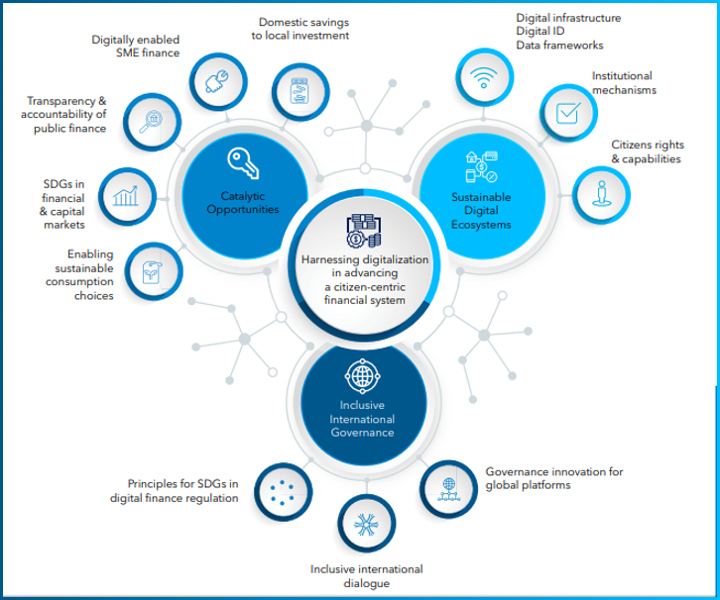
UN Task Force action plan to create a citizen-centric, SDG-aligned financial system. Source
Controlling All Business Through Digital ID
Financial inclusion extends beyond the individual to all of our businesses. The regime claims the “right” to “steward” all of those assets too.
In 2021, Manjeet Kripalani, the Executive Director of Gateway House (Indian Council on Global Relations), the Indian policy think-tank arm of the US Council on Foreign Relations,