Select date

The Extreme Center: How the Neocons Went Woke, by Oliver Williams


No lessens, no consequences
The Iraq war was spearheaded by a remarkably small group of people. It has become politically untenable to justify that overt disaster and some of the key architects of that war have, much belatedly, come to acknowledge as much. As late as 2013 Max Boot was still arguing there was No Need to Repent for the Iraq War. He had changed his tune by 2018, writing in his book The Corrosion of Conservatism: Why I Left the Right, “I regret advocating the invasion and feel guilty about all the lives lost.” Boot claims, “It was a chastening lesson in the limits of American power,” yet in the same book complains that the modern conservative movement is “permeated with” racism, extremism and isolationism.
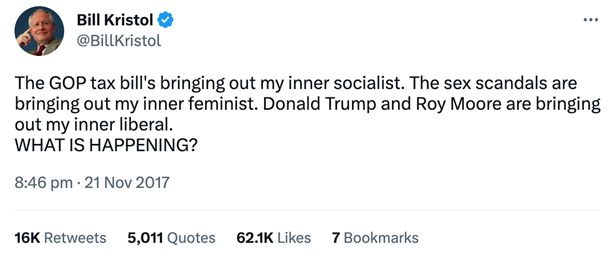
David Frum now describes the invasion as “a grave and costly error” and gives a thoroughly equivocal mea culpa. Robert Kagan says that the war “didn’t go exactly the way we wanted it to” and that “many aspects of the war” were “unfortunate.” Bill Kristol acknowledges that Iraq was “very difficult” and that “many things were done badly,” but concludes, “I’m inclined not to think it was [a mistake].” Since the inauguration of Trump, Kristol has changed his mind on trans rights, on gays, on abortion — but not on the catastrophe that led to over a hundred thousand civilian deaths. He told Jewish Insider: “Ironically, I’d say I’ve changed or rethought my views more on domestic policy issues… Foreign policy, I haven’t really changed my views. And I’ve been critical of Biden for the withdrawal from Afghanistan.”
Despite the repeated disasters in Iraq, Afghanistan, Libya and elsewhere, these figures remain as combative as ever. In 2018 Kristol told Vox, “the fact that the public is, quote, “war-weary”… those instincts have be challenged.” He told the Al Franken podcast that the Iraq intervention “didn’t destabilize the entire Middle East, I wish it had destabilized some of those places more.”
The neocons have been consistently wrong about foreign policy, and not just wrong, but wrong in the loudest, most doctrinaire and most uncompromising way possible. You’d think they might face some career blowback…
What actually happened?
Liberal adulation
On his MSNBC show, Ari Melber referred to 2018 as the year when “many people began referring to ‘woke Bill Kristol’.” According to Melber, this was “A tribute to the idea that people do evolve and that Trumpism can create strange bedfellows.”
Joy Reid, perhaps the most noxious personality on MSNBC, was positively glowing with praise:
One of the most amazing outcomes of the Trump administration is the number of neo-conservatives that are now my friends and I am aligned with. I found myself agreeing on a panel with Bill Kristol. I agree more with Jennifer Rubin, David Frum, and Max Boot than I do with some people on the far left. I am shocked at the way that Donald Trump has brought people together.
It turned out that in the throes of Trump Derangement Syndrome, being vehemently against Trump was enough to garner liberal adulation. During Donald Trump’s four years in office we saw the wholesale rehabilitation of the most discredited propagandists of the war on terror. After Trump called the Iraq war a “big fat mistake” in the 2016 Republican presidential debate ,the neocons rebranded themselves as the ‘moderate’ voice against the danger of a Trump presidency. They went on to find lucrative positions in the liberal messaging apparatus. Frum became a senior editor for The Atlantic. Boot is now a senior fellow at the Council on Foreign Relations, a CNN analyst, a columnist at The Washington Post, and a contributor to the New York Times op-ed pages. Robert Kagan is a senior fellow at the Brookings Institution and an editor at large for The Washington Post. Kristol is a frequent commentator on CNN and MSNBC.
In the liberal imagination, the Neocons shifted from being war criminals to sensible moderate centrists, and, after the 2020 election and January 6th, brave and principled defenders of democracy.
How did this happen?
Hawks for Hillary
In 2014 Jacob Heilbrunn, author of They Knew They Were Right: The Rise of the Neocons, predicted “the neocons may be preparing a more brazen feat: aligning themselves with Hillary Rodham Clinton and her nascent presidential campaign, in a bid to return to the driver’s seat of American foreign policy.” Attending a Foreign-Policy-Professionals-for-Hillary fundraiser, Robert Kagan was quoted as saying, “I would say all Republican foreign policy professionals are anti-Trump. I would say that a majority of people in my circle will vote for Hillary.” Hillary won the endorsement of almost every high-profile Neoconservative you could name . Eliot Cohen, co-founder of the Project for the New American Century; John McCain speechwriter Mark Salter; think tank goon James Kirchick. Boot said he would “sooner vote for Josef Stalin than[he] would vote for Donald Trump.” The Wall Street Journal’s most hawkish columnist, neocon Bret Stephens, penned an op-ed titled Hillary: The Conservative Hope. But no one else went as far as Bill Kristol, who, when, after running a rival candidate in 2016 proved a fool’s errand, tweeted that he would “prefer the deep state to the Trump state.”
This wholesale coalition between Bush-era neocons and hawkish Democrats started before Trump and it continued after he left the White House. In 2008 The Weekly Standard celebrated Hillary Clinton as “the great right hope” of foreign policy, hailing her transformation from “First Feminist” to “Warrior Queen.” In 2013 John McCain described Hillary Clinton as a foreign policy “rock star.” In a 2014 profile of Robert Kagan in The New York Times, Kagan mentions that he served on Hillary’s “bipartisan group of foreign-policy heavy hitters at the State Department, where his wife worked as her spokeswoman.” He said of Clinton’s foreign policy, “it’s something that might have been called neocon, but clearly her supporters are not going to call it that.”
This was more than a temporary marriage of convenience to stop Donald Trump. This is more than a pragmatic alliance. It’s an ideological convergence. The Neocons have cast off any pretence to conservatism while the Democrat Party has become uniformly pro-war. David Frum explained the realignment:
Trump pushed Never Trump Republicans into partnership with moderate Democrats — and prodded even formerly conservative minded people — to see power in ideas like Me Too and Black Lives Matter. … Old patterns are dissolving into something new.
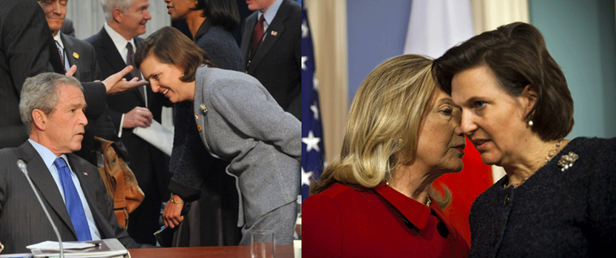
The neocons had lost access to power in the GOP and needed to find a new constituency. Robert Kagan co-authored an article in 2019 attacking “America First” foreign policy with Antony Blinken, who is now Joe Biden’s Secretary of State. Kagan’s wife is Victoria Nuland. The two fell in love “talking about democracy and the role of America in the world.” Nuland is the ultimate example of the continuity (only interrupted briefly by Donald Trump) of personnel regardless of the administration. Nuland was a foreign policy adviser to Vice President Dick Cheney, a State Department spokesperson under Obama, and Under Secretary of State for Political Affairs in the Biden administration. Her worldview is identical to that of her husband.
The Alliance for Securing Democracy, the national security advocacy group responsible for the Hamilton 68 scam of Russian pro-Trump influence, is governed by a board that includes Michael Chertoff, former secretary of homeland security under George W. Bush; Michael McFaul, former ambassador to Russia under Barack Obama; Bill Kristol; John Podesta; and, at one time, Jake Sullivan, now national-security adviser to President Biden. If there were ever a meaningful distinction between the liberal interventionists and the Neoconservatives, the two are now fully merged.
Invade the world, invite the world: Imperialism + Immigration
High-profile neoconservative figures have radically changed their positions on a whole range of issues to appeal to their new liberal followers but they’ve always been remarkably consistent on two policies: never ending war and unrestrained immigration. Preventing the migration of Muslims from such terror-prone countries as Afghanistan is beyond the pale, bombing those same people is seen as just fine.
Bill Kristol wants “new Americans” to replace a population he brands “lazy” and “spoilt” — “luckily you have these waves of people coming in.” Kristol has mourned the “insanity and cruelty” of ICE raids. “I’d take in a heartbeat a group of newly naturalized American citizens over the spoiled native-born know-nothings of CPAC” he tweeted in 2018. Kristol made open borders a litmus test of respectability. Asked about his previous endorsement of the brain-dead Sarah Palin he said: “I regret that. … To be fair, if you look at what she said in 2008, apart from some of the silliness, she was not anti-immigration. She was not xenophobic. She was not isolationist. … So, in a funny way, if we could have co-opted some of the populism and given them a place in a McCain-nominated Republican Party, maybe that would have been a good outcome.”
He told Vox: “I will say, you know, the Weekly Standard was pretty unapologetically anti-Buchanan. … Pretty liberal on immigration.”
As documented by the repentant former neocon Scott McConnell in a 2003 article in the American Conservative, and more extensively in the book The Great Purge: The Deformation of the Conservative Movement, the neocons were instrumental in the cancellation of any Conservative that expressed reservations about immigration.
Boot expressed the ultimate synthesis of imperialism abroad and multicultural colonisation at home . Bemoaning the size of the America’s fighting force, he noted, “there is a pretty big pool of manpower that’s not being tapped: everyone on the planet who is not a U.S. citizen.” He floated the idea of simply paying Afghans to occupy their own country: “The most efficient way to expand the government’s corps of Pashto or Arabic speakers isn’t to send native-born Americans to language schools; it’s to recruit native speakers of those languages.”
Historically the imperial project enabled the successful militarily power to attain new territory for its people to settle. Under the new imperialist framework, America invades countries only to welcome the waves of refugees that war inevitably creates. So the return on the blood and treasure expended in Iraq and Afghanistan and Libya is ever more Iraqi’s, Afghan’s and Libyan’s finding living space in the USA. According to the New York Times, in 2005, just a few years after 9/11, “more people from Muslim countries became legal permanent United States residents—nearly 96,000—than in any year in the previous two decades.”
Invade/invite are both formed by a similar panglossian view of diversity. For all the celebration of diversity, there’s a blindness to it, a belief that that deep down we’re all basically Americans, yearning for secular democracy and ‘freedom’ (in the form of unrestrained liberal hedonism and free markets). If diversity is a strength, there’s no reason to think that forcing democracy on a deeply sectarian country like Iraq might not work out. Here’s Kristol on Iraq: “I think there’s been a certain amount of, frankly, a kind of pop sociology in America that, you know, somehow the Shia can’t get along with the Sunni.”
In reality the Shia didn’t get along with the Sunni and horrific bloodshed between the two groups followed Saddam’s ouster.
In 2016 Robert Kagan wrote an article about Trump titled This is how Fascism comes to America:
His public discourse consists of attacking or ridiculing a wide range of “others” — Muslims, Hispanics, women, Chinese, Mexicans, Europeans, Arabs, immigrants, refugees — whom he depicts either as threats or as objects of derision. His program, such as it is, consists chiefly of promises to get tough with foreigners and people of nonwhite complexion. He will deport them, bar them, get them to knuckle under, make them pay up or make them shut up.
But he won’t bomb them. Therein lies the problem.
Anarchy at home, military occupation abroad
In 2020 over 130 senior Republican national security officials signed a statement that condemned Donald Trump because he “stokes fears that ‘angry mobs’ and ‘anarchists’ are destroying our country” and violated America’s “legacy as a nation of immigrants.” America’s foreign policy elite would like to wage non-stop war to “keep America safe,” yet when America’s urban centers themselves resemble war zones, the establishment either shrugs or cheers on the rioters (at least 25 people died during the BLM riots, including a Trump supporter assassinated in the middle of the street in Portland).
Man Ukraine is looking bad!
Just kidding. This is what BLM did in the United States