Select date

Jules Cambon, the Sykes-Picot Agreement, and the Balfour Declaration: Exposing Jewish Machinations in World War I, by Francis Goumain


The Balfour declaration consists of 129 words, including the date and the polite formula, so why has it not fallen into oblivion, being little more than similar agreements between General Custer and Sitting Bull to define a reservation limit?
Take it easy, this short article is not meant to set the records straight for the sake of fairness, nor is it a matter of French willing to take credit for a Balfour-like declaration. There is nothing to be proud of there. But, the thing is, should the declaration of the unfortunate Jules Cambon have not fallen into oblivion — that is, if people were aware that a very similar declaration was made in two different countries in the same year within a five-month time period, perhaps the international wheeling and dealing of the Jews would become obvious to everyone.
Besides, the two declarations may have a common origin. The secret Sykes-Picot agreement signed on May 16, 1916 — in the same context of the First World war as the Balfour Declaration. From a French point of view, the link is crystal clear: while it was Jules Cambon who made a declaration similar to the Balfour Declaraion, it was his younger brother, Paul Cambon, who assisted Picot during the negotiations with Sykes, and their project was colonial in nature, not Zionist.
I. We know the English version of the Balfour declaration:
It was meant to thank the chemist Chaim Weizmann – who would later be the first president of Israel for a crucial discovery he made for the Royal Navy; according to Wikipedia:
While serving as a lecturer in Manchester Weizmann became known for discovering how to use bacterial fermentation to produce large quantities of acetone. Acetone was used in the manufacture of cordite explosive propellants critical to the Allied war effort. Winston Churchill became aware of the possible use of Weizmann’s discovery in early 1915, and David Lloyd George, as Minister of Munitions, joined Churchill in encouraging Weizmann’s development of the process. The importance of Weizmann’s work gave him favour in the eyes of the British Government; this allowed Weizmann to have access to senior Cabinet members and utilise this time to represent Zionist aspirations.
One of these senior members was none other than Sir Arthur Balfour, who took over Churchill as First Lord (i.e. The head of the Royal Navy), and as such, equally aware of the importance of the Weizmann contribution to the fleet.
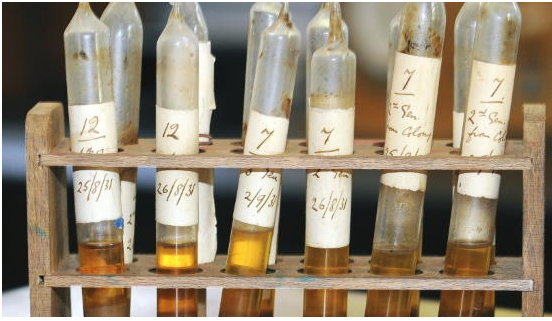
Dr. Chaim Weizmann invented a fermentation process that converted starch — a poly-sugar readily available from corn and potatoes — into acetone and butyl alcohol, facilitated by a bacteria, Clostridium acetobutylicum, that Dr. Weizmann had previously isolated.
But why should the United Kingdom care about the fate of Palestine whilst engaged in a struggle with its survival at stake?
II. We also know the Benjamin Freedman theory:
The Balfour declaration was the result of bargaining between Great Britain and American Jews, the latter pledging to make use of their influence on the US government and public to push them into war in exchange for Palestine, we refer to the speech by Freedman to the Marine cadets in 1974:
…when Germany was winning the war, the Jews were very happy, because they didn’t want Russia to come out the winner, with France and England, because they thought it would be tougher for the Jews in Russia. So, they were all pro-German. What happened? When the Germans trotted out the submarines, … General Haig, in London, warned the English, “We have less than two week’s food supply for the whole nation of 55,000,000 people.”… So, England was offered a Peace Treaty by Germany. … It was on the desk of the British War Cabinet, ready to be signed. … What happened? The Khazar Jews in New York, Washington, led by Brandeis, made this promise through Fleischman & Sockloff in London. They went to the British War Cabinet and they said, “You don’t have to make peace—which is tantamount to surrender. We can show you how you can win the war, if, when you defeat Germany, and carve up the Ottoman Empire (or Turkey) you will give us Palestine.
This version is not flawless since it doesn’t fit the chronology of events; the Balfour declaration is dated November 2, 1917. However, by this date, the transfer of American troops to Europe was already well underway, the declaration of war by the United States on Germany itself dating back to April 6, 1917.
Of course, we could just say that we shouldn’t worry about getting an exact chronology. It is enough to say that by the end of 1917, England had other fish to fry and that this Balfour declaration doesn’t make sense except for the bargain Freedman was hinting at.
III – But we have better than that now: the French Jewish version:
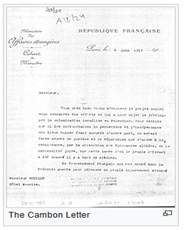
On June 4, 1917, Jules Cambon, General Secretary at the Quai d’Orsay, published an open letter to Nahum Sokolov, representative of the World Zionist Organization in France:
You were good enough to present the project to which you are devoting your efforts, which has for its object the development of Jewish colonization in Palestine.You consider that, circumstances permitting, and the independence of the Holy Places being safeguarded on the other hand, it would be a deed of justice and of reparation to assist, by the protection of the Allied Powers, in the renaissance of the Jewish nationality in that Land from which the people of Israel were exiled so many centuries ago.
The French Government, which entered this present war to defend a people wrongfully attacked, and which continues the struggle to assure the victory of right over might, can but feel sympathy for your cause, the triumph of which is bound up with that of the Allies.
I am happy to give you herewith such assurance
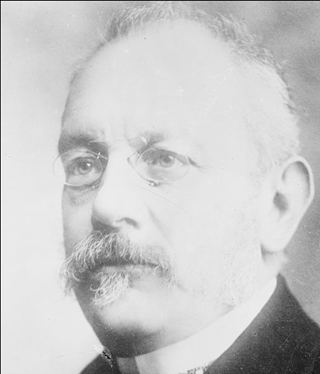
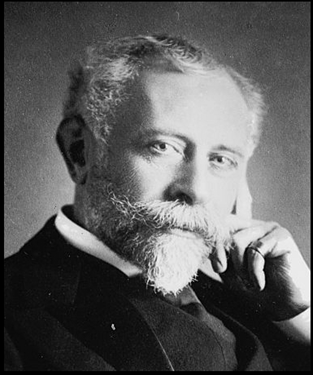
Two top French diplomat: left, Paul Cambon who took part in the Sykes-Picot negotiations signed on May 16, 1916, and right, his elder brother, Jules Cambon, who made a declaration favouring the creation of Israel on June 4, 1917.
With this letter, the timing and the rationale are perfect. Here are two entries from the Raymond Poincaré diary, the French President during the war:
June 13, 1917 Pershing arrival in Paris:
American General Pershing arrived in Paris at the end of the afternoon. Colonel Renoult, my military attache, went to meet him at the station. He tells me that the welcome was very warm.
July 4 1917, review of a first American battalion on the American national holiday:
In the morning, courtyard of the Invalides, review of an American battalion, which has just arrived in Paris. Painlevé picks me up at the Élysée and we both leave in a «Victoria». General Duparge, Colonel de Rieux and Commander Helbronner follow us in a landau. On the Alexandre III bridge and on the esplanade, a very dense and unanimously enthusiastic crowd.
We arrive in front of the Hôtel des Invalides and we dismount. We are received by General Pershing and General Dubail. We enter the courtyard, around which are ranged the American soldiers and a French company.
Under the arcades and on the first floor, in the galleries, many spectators applauding. We pass the troops who look very good in their khaki uniforms.
In other words, Pershing and the first American detachment arrive after Jules Cambon’s declaration of June 4, 1917. Note how Combon points out in his statement that “your cause, the triumph of which is bound up with that of the Allies” — and how one wants to add “and vice versa”.
Strangely enough since Poincaré also served as a noted minister of Foreign Affairs before the war, a critical period, we found nothing in his memoirs about the Cambon letter, whether it be because, as many politicians of that time (including former president William Howard Taft in America) believed, he didn’t realise the importance of the rise of the Jewish power, or whether it be, on the contrary, as with President Wilson, that he didn’t dare speak about it openly. The fact is that the immediate situation was very bad for France on the frontline with the ongoing mutiny and the arrival of German reinforcements from the East. From Poincaré’s diary:
June 3, 1917:
[…] In a secret committee, Augagneur, so firm and so optimistic at the start of the war, gave a speech of discouragement and immediate peace, repeating that there was no longer anything to count on with Russia and that America would arrive too late, that all was lost. However, he was applauded by a good fifth of the House.
[…] New painful incidents on the front. Colonel Fournier informs me that a division of the 21st Corps has deliberated on the point whether it would consent to go up to the trenches and resume the offensive. She decided to go to the trenches, but to stand on the defensive; another division, that of the 7th Corps, refused to go to the trenches. General Pétain is looking for the ringleaders, whom he believes to be connected with the General Confederation of Labour, and he will not regain his command unless action is taken against pacifist propaganda.
It was therefore about time for the Americans to arrive, fortunately, the negotiations had started even earlier, here is again the chronology found in Poincaré’s memoirs:
May 15, 1916:
Victor Basch, whom I asked to come to my office, gives me his impressions of America. He found the Israelites there very hostile to Russia but favorable to France; he succeeded in penetrating among them; he lectured to them; he acquired the assurance that the house of Jacob Schiff would agree to place a loan of 250 million dollars for the Allies, if Russia granted some advantages to the Israelites.
1. Poincaré does not specify it, but Victor Basch is himself a Jew, on June 4, 1898. In the wake of the Dreyfus affair, he was one of the founders of the League of Human Rights and he would become its fourth president. Take note: League of Human Rights, not League of French Rights, there is a nuance.
2. What are these advantages that Russia should grant to the Israelites? The right to emigrate to Palestine, maybe?
3. It is plausible, since on May 15, we are precisely on the eve of the signing of the Sykes/Picot agreement. Poincaré, with his relative frankness, especially when it comes to the Israelites, does not breathe a word about it, yet this secret agreement is undoubtedly at the origin of the two declarations, that of Cambon and that of Balfour.
On the map that draws the dividing line between the French zone of influence and the English one, we notice a small but ominous yellow spot on the bottom left where before there was nothing special, nothing else that a small part of the Ottoman Empire had not even identified; it seems almost obvious that the two subjects — Sykes-Picot and Cambon-Balfour – one year apart, between the same two countries, in the same context of the First World War, are not entirely disconnected. Besides here is a very interesting entry in this regard, again from Poincaré ,three weeks after these Sykes-Picot agreements:
June 8, 1916
Edmond de Rothschild talks to me about the Jews of Russia. He tells me that before taking an interest in them, he wants to safeguard the alliance, but he noticed that Mr. Protopopoff was quite ready to improve their lot and he would like the French government, with all the necessary prudence, to intervene in their favor.I insist on the delicate nature of this intervention. I tell him, however, that I will bring the conversation to this subject when I see Mr. Protopopoff again, but he is not a minister yet; he can only become one.
1 . Note how the Jews have easy access to the President of the Republic. Moreover, they are ablve to intervene directly in foreign policy in wartime, while at the same time, a finicky secularism prevents him from meeting so easily the Catholic hierarchy; see 1917 : le Rond-point Poincaré.
2. The question remains, was “the Jews of Russia” the sole purpose of Edmond de Rothschild? Was it not rather “the Jews of Russia being transferred to Palestine”? As if by chance, Balfour handed out his declaration to a Rothschild in London.
Let’s end with these few entries during the rushing hours, still from Poincaré’s diaries:
February 4, 1917:
Jules Cambon telephones the Élysée that Mr. Sevastopoulo has received from the Russian ambassador in Washington notice that President Wilson has assembled a commission made up of a few friends and that he has examined three points there:
1 – negotiations between the United States and Germany
2 – waiting for a new torpedo before any decision
3 – immediate severance of diplomatic relations.
Wilson would have chosen the latter course. Press cables say that he sent a new message to the Senate and declared that he was going to hand over his papers to the German ambassador and make an appeal to the neutrals.If this news is correct, the assistance of the United States will be an invaluable moral support for us.
What a pity, Poincaré does not give us the names of the “friends” in question, but we are starting to get a little idea for ourself …
March 31, 1917, meeting with the Prince Sixtus who, with a view to possible peace negotiations, delivered a message from the Emperor Charles of Austria to Poincaré and Cambon (general secretary of the Quai d’Orsay), Sixtus of Bourbon-Parma leaves them also a personal note alluding to regime change in Petrograd:
Until the change of regime which has just taken place in Petrograd, Russian opinion seemed, in fact, unanimous in demanding the possession of Constantinople as an essential condition for the development of the Muscovite Empire. But the feelings of the current Russian government already show differences in this regard. If the Foreign Minister, Mr. Milioukov, maintains the previous point of view, which was that of an annexation of Constantinople to Russia, his colleague, Mr. Kerensky, reflects the new opinion that Russia must renounce any enlargement: in this case, Turkey could keep its capital, the regime of which would simply have to be combined with a European international status.
April 5, 1917, exchange of telegrams between Poincaré and Wilson:
The Chamber of Deputies adopted a resolution similar to that of the Senate. To protect the Americans against the attacks with which they remain threatened, Wilson had torpedo boats armed which were directed towards American waters. One of them has just been sunk in the English Channel by a German submarine.
Ribot delivers a highly acclaimed speech in the Chamber on American determination.
I telegraph, for my part, to President Wilson. Mr. William Martin communicates the telegram that I wrote to Ribot, who gives his full support:
At the moment, when under the generous inspiration of your Excellency, the great American Republic, faithful to its ideal and its traditions, is preparing to defend by arms the cause of justice and freedom, the French people quivered with brotherly emotion. Allow me to renew to you, Mr. President, at this grave and solemn hour, the assurance of the feelings of which I recently addressed the testimony to you and which finds in the present circumstances an increase in strength and ardor. I am sure to express the thoughts of all of France by telling you, to you and to the American nation, the joy and the pride that we feel to feel our hearts beating, once again, in unison with yours. This war would not have had its full meaning if the United States had not been induced by the enemy himself to take part in it. From now on, it appears more than ever to any impartial mind that German imperialism, which wanted, prepared and declared war, had conceived the insane dream of establishing its hegemony over the world. He succeeded only in revolting the conscience of humanity. You have made yourself before the universe, in an unforgettable language, the eloquent interpreter of outraged law and threatened civilization. Honor to you, Mr. President, and to your noble country.
Please believe in my devoted friendship.
Raymond Poincaré
Wilson’s response:
«His Excellence Raymond Poincaré, President of the Republic, Paris.
In this trying hour when the destinies of civilized mankind are in the balance, it has been a source of gratification and joy to me to receive your congratulations upon the step which my country has been constrained to take, in opposition to the relentless policy and course of imperialistic Germany. It is very delightful to us that France who stood shoulder to shoulder with us of the western world in our struggle for independence, should now give us such a welcome into the lists of battle as upholders of the freedom ant the rights of humanity. We stand as partners of the noble democraties whose aims and acts make for the perpetuation of the rights and freedom of man and for the saveguarding of the true principales of human liberties in the name of the american people. I salute you and your illustrious countrymen.
Woodrow Wilson»
Conclusion
The common point of the three versions of the Balfour declaration, the English, the American and the French, is, of course, the international Jew, the three versions already push aside the Sykes – Picot agreement and its colonial prospect, and anyway, only one version will prevail before history. On February 10, 1918, through its own Foreign Minister, Stephen Pichon, France associated itself with the declaration before Parliament by Lord Arthur Balfour, British Foreign Minister, which is officially consecrated by the Treaty of Sèvres , in August 10, 1920.
On that day, Raymond Poincaré still thought that the Jews were only pawns in his war against Germany and, with the extension of the French colonial empire in the Middle East, he could not imagine that it would turn out to be the other round: France, Germany, UK and the USA as being pawns in the history of Israel.
And so it was, after two world wars, that the state of Israel came to light. Think of the consequences:
1 – No First World war, no Balfour declaration and no fall of the Ottoman empire (a prerequisite for the setting of a Jewish state in Palestine).
2 – No Second World war, no Israel.
* * *
Appendix, the Balfour Declaration
November 2nd, 1917
Dear Lord Rothschild,
I have much pleasure in conveying to you, on behalf of His Majesty’s Government, the following declaration of sympathy with Jewish Zionist aspirations which has been submitted to, and approved by, the Cabinet.
“His Majesty’s Government view with favour the establishment in Palestine of a national home for the Jewish people, and will use their best endeavours to facilitate the achievement of this object, it being clearly understood that nothing shall be done which may prejudice the civil and religious rights of existing non-Jewish communities in Palestine, or the rights and political status enjoyed by Jews in any other country.”
I should be grateful if you would bring this declaration to the knowledge of the Zionist Federation.
Yours sincerely,
Arthur James Balfour