Select date

How NATO states sponsored ICC prosecutor’s Putin arrest warrant


All Global Research articles can be read in 51 languages by activating the Translate Website button below the author’s name.
To receive Global Research’s Daily Newsletter (selected articles), click here.
Click the share button above to email/forward this article to your friends and colleagues. Follow us on Instagram and Twitter and subscribe to our Telegram Channel. Feel free to repost and share widely Global Research articles.
***
ICC prosecutor general Karim Khan raised millions from NATO states by crafting an arrest warrant for Vladimir Putin while freezing investigations into well-documented US and Israeli war crimes. Along the way, he won powerful friends in Washington, London, Kiev — and Hollywood.
Karim Khan, the chief prosecutor of the International Criminal Court, stood before a podium on March 3, 2023, and issued an unusual qualifier:
“Of course the prosecutor of the ICC does not, whatever affection and regard I may have for my dear friends in Ukraine – has no special affinity to any particular country. We’re not a party to any hostilities.”
“We have an affinity to legality,” Khan insisted in British-accented English. “We have an affinity and commitment to the rule of law.”
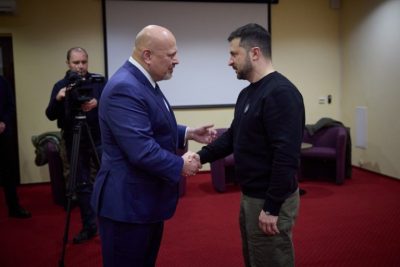
Khan made his declaration of legal independence while headlining the “United for Justice” conference, an event personally organized in Lviv, Ukraine, by President Volodymyr Zelensky. There, he pressed the flesh with Ukraine’s president and conferred with US Attorney General Merrick Garland, who had stopped in to advance the Biden administration’s effort to haul Russian President Vladimir Putin before an international war crimes tribunal.
It was Khan’s fourth visit to Ukraine since the Russian military invaded the country in February 2022.
On March 17, 2023, Khan introduced a formal ICC warrant for Putin’s arrest, accusing the Russian president of the “unlawful deportation” of Ukrainian children to a “network of camps” throughout Russia. The warrant arrived days before the 20th anniversary of the NATO invasion of Iraq, a crime directed by US and UK officials whom the ICC has refused to prosecute to this day.
As The Grayzone has reported, the ICC’s warrant was inspired by a State Department-funded report that contained no field reporting, no concrete evidence of war crimes, and no proof that Russia was actually targeting Ukrainian youth with a massive deportation campaign.
In fact, the investigators acknowledged finding “no documentation of child mistreatment, including sexual or physical violence, among the camps referenced in this report.” What’s more, the inquiry’s lead author told The Grayzone’s Jeremy Loffredo that “a large amount” of the Russian youth camps his team researched were “primarily cultural education – like, I would say, teddy bear.”
Though Khan pledged his absolute independence in his hunt for Putin, he is closely aligned with the same Western governments that are currently engaged in a proxy battle with Russia on the Ukrainian battlefield. Meanwhile, he has stalled the ICC’s case against Israel, frustrating human rights lawyers who represent the victims of grisly violence in the besieged Gaza Strip. Additionally, Khan formally dropped the international court’s case against the US military for its actions in Afghanistan.
Through his focus on Ukraine, Khan has presided over a massive surge in Western financial support for his office, with much of the money earmarked for his investigation into Russian officials. The ICC’s issuance of Putin’s arrest warrant happened to coincide with a major donor’s conference for the court in London, England.
The ICC prosecutor’s political entanglements do not stop there. Celebrity lawyer Amal Clooney has worked as a special advisor to Khan’s office while simultaneously counseling the Ukrainian government on its initiative to target Russian officials with prosecution, either by the ICC or another international body. Clooney has also served as a special liaison to the British Foreign Secretary.
It is perhaps no surprise, then, that after two decades of unremitting hostile relations with the ICC, official Washington is suddenly warming up to the court, and is endeared by its top prosecutor.

Karim Khan (left) with US Attorney General Merrick Garland in Lviv, Ukraine on February 28, 2023
ICC’s Khan inspires “sighs of relief in Jerusalem,” support from the US
US President Joe Biden helped set the tone in Washington with a full-throated endorsement of the ICC prosecutor Khan’s warrant against Putin, declaring it “justified.” On the Republican side of the aisle, the US Senate’s most enthusiastic cheerleader of the Ukraine proxy war, Lindsey Graham, was even more fulsome in his support for the court’s campaign, celebrating the ICC’s prosecutor as a modern-day Nazi hunter.
Washington’s sudden embrace of the ICC represented a sudden and clearly opportunistic break from two decades of antagonism.
Almost as soon as US President George W. Bush entered the White House in 2001, his administration introduced the Servicemembers Protection Act, a measure that authorized a future US military invasion of the Hague in the event the ICC indicted any US personnel for war crimes. When the bill passed the Senate the following year, not one member of the Republican Party opposed it.
The US intensified its campaign against the ICC in 2019, after then-Chief Prosecutor Fatou Bensouda announced an investigation into war crimes committed by Israel in the Occupied Palestinian Territories. While Secretary of State Mike Pompeo personally denounced Bensouda, the Senate introduced a bipartisan resolution calling on him to escalate its attacks on the “politicized” ICC. Graham was among the signatories to the resolution. (The Biden administration also opposes the ICC investigation into Israeli war crimes).
When Bensouda declared her intention to investigate both the US and Taliban for crimes against humanity in Afghanistan the following year, Washington placed the prosecutor under sanctions and revoked her US visa.
Since replacing Bensouda in 2021, Khan has worked to soothe the nerves of the US and its most violence-prone allies. The Jerusalem Post reported in June 2022 that “there have been some sighs of relief in Jerusalem,” as Khan had “not issued a single public statement nor taken any single public action regarding Israel-Palestine” in his first year as prosecutor.
“There has been no significant progress or measures taken, the investigation [into Israeli atrocities] is not a priority for the office of the prosecutor, and no cases have been brought yet,” a member of the legal team representing victims of Israeli violence in the occupied Gaza Strip told The Grayzone. “Every time the issue is raised before Khan, he never takes a position, and there’s never been a statement.”
The lawyer noted the irony of Khan’s obsession with the transfer of civilians from Ukraine to Russia, considering he has ignored the forced deportation of hundreds of thousands of Palestinians from the territory now known as “Israel” to occupied territories and refugee camps across the Middle East. “In Palestine civilians have been transferred for decades, it’s the most over documented situation of war crimes in history,” they said. “Palestine should be the final benchmark for the credibility of the court.”
Khan also narrowed the scope of the ICC’s Afghanistan investigation, protecting US forces from prosecution by focusing solely crimes committed by the Taliban. “This decision reinforces the perception that these institutions set up in the West and by the West are just instruments for the West’s political agenda,” Shaharzad Akbar, the former chair of Afghanistan’s Independent Human Rights Commission, complained to The Intercept
“This was clearly a political decision – there’s really no other way it can be interpreted,” Jennifer Gibson, a US lawyer who heads an investigation into US abuses in Afghanistan, said of Khan’s action. “It gave the US and their allies a get out of jail free card.”
With its two most contentious investigations out of the way, a clearly pliant figure in the prosecutor’s office, and Russian troops inside Ukraine, the previously battered ICC suddenly experienced a deluge of Western financial support.
“In the weeks after 24 February [2022, when Russia invaded Ukraine], the [International Criminal] court has been flooded with cash and secondments,” reported JusticeInfo.net.
Much of the money flowed directly to Khan’s office, with special earmarks for efforts targeting Russian officials. As Maria Elena Vignoli of Human Rights Watch told JusticeInfo.net, “In the messaging around the various pledges that were made, states were not always that careful, and they often made the link between their contribution and Ukraine, thus creating this perception of politicization or selectivity in the court’s work.”
Washington, London pave the path for the ICC’s Khan
It was February 28, 2022 when Khan announced his intention to “proceed with opening an investigation into the Situation in Ukraine, as rapidly as possible.” Russia’s military operation inside Ukraine was only four days old at that point.
Days later, on March 2, 2022, the British Embassy in the Hague delivered Khan a referral co-signed by over 40 US and UK diplomats that urged him to investigate Russia for violations of the Rome Statute of the ICC.
That same day, Sen. Graham introduced a resolution in the US Senate calling for “Vladimir Putin and members of the Russian regime to be held accountable for the numerous acts of war, aggression, and human rights abuses that have been conducted under his watch.” Even as hawks like John Bolton warned that support for the ICC’s warrant could validate future legal actions against the US citizens, the resolution passed unanimously.
Just hours after issuing his resolution condemning alleged violations of international law, Graham took to Twitter to call for Putin’s assassination. “Is there a Brutus in Russia? Is there a more successful Colonel Stauffenberg in the Russian military?” the senator pleaded on March 3, 2022. “The only way this ends is for somebody in Russia to take this guy out.”
Is there a Brutus in Russia? Is there a more successful Colonel Stauffenberg in the Russian military?
The only way this ends is for somebody in Russia to take this guy out.
You would be doing your country – and the world – a great service.
— Lindsey Graham (@LindseyGrahamSC) March 4, 2022
On April 3, 2022, Biden injected further momentum into the ICC’s campaign against Russia, branding Putin a “war criminal” and demanding he be hauled before “a war crimes trial.”
To further Biden’s objective, and by extension, that of the ICC, the US Department of State announced in May 2022 the establishment of a Conflict Observatory to gather open source evidence of alleged Russian war crimes and disseminate the findings “so that prosecutors can potentially even build criminal cases based on the material that is published.”
With American political winds at his back, Khan embarked on his first officially-curated tour of Ukraine.

ICC prosecutor Karim Khan on a government-guided tour of Kharkiv, Ukraine
Four government-guided junkets to Ukraine
Khan made his inaugural visit to Ukraine on March 16, 2022, arriving first in Poland, where he met with Ukrainian migrants at a refugee reception center. He then crossed the Ukrainian border to confer in Lviv with Irina Venediktova, the Ukrainian Prosecutor-General, before holding a virtual meeting with Zelensky.
“We conduct our work with independence, impartiality and integrity. I have underlined that I wish to engage with all parties to the conflict,” Khan insisted.