Select date

Tristan Tzara and the Jewish Roots of Dada, by Brenton Sanderson


The twentieth century saw a proliferation of art inspired by the Jewish culture of critique. The exposure and promotion of this art grew alongside the Jewish penetration and eventual capture of the Western art establishment. Jewish artists sought to rewrite the rules of artistic expression — to accommodate their own technical limitations and facilitate the creation (and elite acceptance) of works intended as a rebuke to Western civilizational norms.
The Jewish intellectual substructure of many of these twentieth-century art movements was manifest in their unfailing hostility toward the political, cultural and religious traditions of Europe and European-derived societies. I have examined how the rise of Abstract Expressionism exemplified this tendency in the United States and coincided with the usurping of the American art establishment by a group of radical Jewish intellectuals. In Europe, Jewish influence on Western art reached a peak during the interwar years. This era, when the work of many artists reflected their radical politics, was the heyday of the Jewish avant-garde.
A prominent example of a cultural movement from this time with important Jewish involvement was Dada. The Dadaists challenged the very foundations of Western civilization which they regarded, in the context of the destruction of World War One, and continuing anti-Semitism throughout Europe, as pathological. The artists and intellectuals of Dada responded to this socio-political diagnosis with assorted acts of cultural subversion. Dada was a movement that was destructive and nihilistic, irrational and absurdist, and which preached the overturning of every cultural tradition of the European past, including rationality itself. The Dadaists “aimed to wipe the philosophical slate clean” and lead “the way to a new world order.” While there were many non-Jews involved in Dada, the Jewish contribution was fundamental to shaping its intellectual tenor as a movement, for Dada was as much an attitude and way of thinking as a mode of artistic output.
Writing for The Forward, Bill Holdsworth observed that Dada “was one of the most radical of the art movements to attack bourgeois society,” and that at “the epicenter of what would become a distinctive movement… were Romanian Jews — notably Marcel and Georges Janco and Tristan Tzara — who were essential to the development of the Dada spirit.” For Menachem Wecker, the works of the Jewish Dadaists represented “not only the aesthetic responses of individuals opposed to the absurdity of war and fascism” but, invoking the well-worn light-unto-the-nations theme, insists they brought a “particularly Jewish perspective to the insistence on justice and what is now called tikkun olam.” Accordingly, for Wecker, “it hardly seems a coincidence that so many of the Dada artists were Jewish.”
It does seem hardly coincidental when we learn that Dada was a genuinely international event, not just because it operated across political frontiers, but because it consciously attacked patriotic nationalism. Dada sought to transcend national boundaries and deride European nationalist ideologies, and within this community of artists in exile (a “double Diaspora” in the case of the Jewish Dadaists) what mattered most was the collective effort to articulate an attitude of revolt against European cultural conventions and institutional frameworks.
First and foremost, Dada wanted to accomplish “a great negative work of destruction.” Presaging the poststructuralists and deconstructionists of the sixties and seventies, they believed the only hope for society “was to destroy those systems based on reason and logic and replace them with ones based on anarchy, the primitive and the irrational.” Robert Short notes that Dada stood for “exacerbated individualism, universal doubt and [an] aggressive iconoclasm” that sought to debunk the traditional Western “canons of reason, taste and hierarchy, of order and discipline in society, of rationally controlled inspiration in imaginative expression.”
Tristan Tzara and Zurich Dada
The man who effectively founded Dada was the Romanian Jewish poet Tristan Tzara (born Samuel Rosenstock in 1896). “Tristan Tzara” was the pseudonym he adopted in 1915 meaning “sad in my country” in French, German and Romanian, and which, according to Gale, was “a disguised protest at the discrimination against Jews in Romania.” It was Tzara who, through his writings, most notably The First Heavenly Adventure of Mr. Antipyrine (1916) and the Seven Dada Manifestos (1924), laid the intellectual foundations of Dada. Tzara’s Dadaist Manifesto of 1918, was the most widely distributed of all Dada texts, and “played a key role in articulating a Dadaist ethos around which a movement could cohere.”
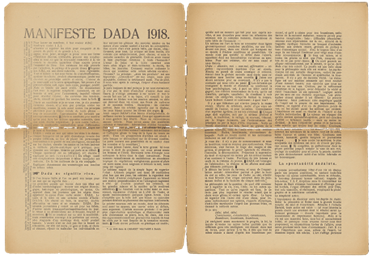
Tzara’s Dada Manifesto of 1918
In his book Dada East: The Romanians of Cabaret Voltaire, Tom Sandqvist notes that Tzara’s intellectual and spiritual background was infused with the Yiddish and Hassidic subcultures of his early twentieth-century Moldavian homeland, and how these were of seminal importance in determining the artistic innovations he would institute as the leader of Dada. He links Tzara’s revolt against European social constraints directly to his Jewish identity, and his perception of the Jewish population of Romania (and particularly of his native Moldavia) was cruelly oppressed by anti-Semitism. Under Romanian law, the Rosenstocks, a family of prosperous timber merchants, were not fully emancipated. Many Russian Jews settled in Romanian Moldova after being driven out of other countries and lived there as guests of the local Jews who only became Romanian citizens after the First World War (as a condition for peace set by the Western powers). For Sandqvist, the treatment of Jews in Romania fueled an attitude of revolt against the socio-political status quo in Tzara, and this was fully consistent with the anarchist impulses he exhibited at the Cabaret Voltaire in Zurich and later in Paris.
Agreeing with this thesis, the ethnocentric Jewish poet and Dada historian, Andrei Codrescu, claims the supposedly ubiquitous anti-Semitism suffered by Romanian Jews like Tzara extends into the present day, insisting: “The Rosenstocks were Jews in an anti-Semitic town that to this day does not list on its website the founder of Dada among the notables born there.” This is considered all the more egregious given that, despite its marginality, Tzara’s hometown Moineşti is, in Codrescu’s opinion, “the center of the modern world, not only because of Tristan Tzara’s invention of Dada, but because its Jews were among the first Zionists, and Moineşti itself was the starting point of a famous exodus of its people on foot from here to the land of dreams, Eretz-Israel.” For Codrescu, Tzara’s Jewish heritage was of profound importance in shaping his contribution to Dada.
The daddy of dada was welcomed at his bar mitzvah in 1910 into the Hassidic community of Moineşti-Bacau by the renowned rabbi Bezalel Zeev Safran, the father of the great Chief Rabbi Alexandre Safran, who saw the Jews of Romania through their darkest hour during the fascist regime and the Second World War. Sammy Rosenstock’s grandfather was the rabbi of Chernowitz, the birthplace of many brilliant Jewish writers, including Paul Celan and Elie Weisel [both of whom wrote about the Holocaust]. … Sammy’s father owned a saw-mill, and his grandfather lived on a large wooded estate, but his family roots were sunk deeply into the mud of the shtetl, a Jewish world turned deeply inward.
For Codrescu, Tzara was one of the many “shtetl escapees” who was “quick to see the possibility of revolution,” and he became a leader within “the revolutionary avant-garde of the 20th century which was in large measure the work of provincial East European Jews.” Crucially, for shaping the intellectual tenor of Dada, Tzara and the other Jewish exiles from Bucharest like the Janco brothers “brought along, wrapped in refugee bundles, an inheritance of centuries of ‘otherness.’” This sense of “otherness” was rendered all the more politically and culturally potent given the “messianic streak [that] drove many Jews from within.” Codrescu notes that: “By the time of Samuel’s birth in 1896, powerful currents of unrest were felt within the traditional Jewish community of Moineşti. The questions of identity, place and belonging, which had been asked innumerable times in Jewish history, needed answers again, 20thcentury answers.” In this need for answers lay the seeds of Dada as a post-Enlightenment (proto-postmodern) manifestation of Jewish ethno-politics.
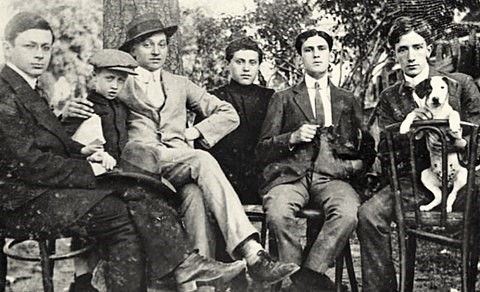
Tristan Tzara in Romania in 1912 (far left) with Marcel and Jules Janco (third and fourth from left)
While there is some controversy over who exactly invented the name “Dada,” most sources accept that Tzara hit upon the word (which means hobbyhorse in French) by opening a French-German dictionary at random. “Da-da” also means “yes, yes” in Romanian and Russian, and the early Dadaists reveled in the primal quality of its infantile sound, and its appropriateness as a symbol for “beginning Western civilization again at zero.” Crepaldi notes how the choice of the group’s name was “emblematic of their disillusionment and their attitude, deliberately shorn of values and logical references.” Tzara seems to have recognized its propaganda value early with the German Dadaist poet Richard Huelsenbeck recalling that Tzara “had been one of the first to grasp the suggestive power of the word Dada,” and developed it as a kind of brand identity.
Tzara’s own “Dadaist” poetry was marked by “extreme semantic and syntactic incoherence.” When he composed a Dada poem he would cut up newspaper articles into tiny fragments, shake them up in a bag, and scatter them across the table. As they fell, they made the poem; little further work was called for. With regard to such practices, the Jewish Dadaist painter and film-maker Hans Richter commented that “Chance appeared to us as a magical procedure by which we could transcend the barriers of causality and conscious volition, and by which the inner ear and eye became more acute. … For us chance was the ‘unconscious mind,’ which Freud had discovered in 1900.” Codrescu speculates that Tzara’s aleatoric poetry had its likely intellectual and aesthetic wellspring in the mystical knowledge of his Hassidic heritage, where Tzara was inspired by:
the commentaries of other famous Kabbalists, like Rabbi Eliahu Cohen Itamari of Smyrna, who believed that the Bible was composed of an “incoherent mix of letters” on which order was imposed gradually by divine will according to various material phenomena, without any direct influence by the scribe or the copier. Any terrestrial phenomenon was capable of rearranging the cosmic alphabet toward cosmic harmony. A disciple of the Smyrna rabbi wrote, “If the believer keeps repeating daily, even one verse, he may obtain salvation because each day the order of the letters changes according to the state and importance of each moment … .”
An old midrashic commentary holds that repeating everyday even the most seemingly insignificant verse of the Torah has the effect of spreading the light of divinity (consciousness) as much as any other verse, even the ones held as “most important,” because each word of the Law participates in the creation of a “sound world,” superior to the material one, which it directs and organizes. This “sound world” is higher on the Sephiroth (the tree of life that connects the worlds of humans with God), closer to the unnamable, being illuminated by the divine. One doesn’t need to reach far to see that the belief in an autonomous antiworld made out of words is pure Dada. In Tzara’s words, “the light of a magic hard to seize and to address.”
That Tzara returned to study of the Kabbalah towards the end of his life certainly lends weight to Codrescu’s thesis. Finkelstein notes how Tzara’s poetry “sounds eerily like a Kabbalistic ritual rewritten as a Dadaist café performance,” and links Tzara’s Dadaist spirit to the influence of the seventeenth- and eighteenth-century Jewish heresies that were centered on the notion of “redemption through sin” which involved “the violation of Jewish law (sometimes to the point of apostasy) in the name of messianic transformation.” The Jewish-American poet Jerome Rothenberg calls these heresies “libertarian movements” within Judaism and connects them to Jewish receptivity to the forces of secularization and modernity, leading in turn to the “critical role of Jews and ex-Jews in revolutionary politics (Marx, Trotsky etc.) and avant-garde poetics (Tzara, Kafka, Stein etc.).” Rothenberg sees “definite historical linkages between the transgressions of messianism and the transgressions of the avant-garde.” Heyd endorses this thesis, observing that: “Tzara uses terminology that is part and parcel of Judaic thinking and yet subjects these very concepts to his nihilistic attack.” Perhaps not surprisingly, the Kabbalist and Surrealist author Marcel Avramescu, who wrote during the 1930s, was directly inspired by Tzara.
Nicholas Zarbrugg has written detailed studies of the ways that Dada fed into the sound and visual poetry of the first phase of postmodernism. Tzara’s poetry was, for instance, to strongly influence the Absurdist drama of Samuel Beckett, and the poetry of Andrei Codrescu, Jerome Rothenberg, Isidore Isue, and William S. Burroughs. Allen Ginsberg, who encountered Tzara in Paris in 1961, was strongly influenced by Tzara. Codrescu relates that: “A young Allen Ginsberg, seated in a Parisian café in 1961, saw a sober-looking, suited Tzara hurrying by, carrying a briefcase. Ginsburg called to him “Hey Tzara!” but Tzara didn’t so much as look at him, unsympathetic to the unkempt young Americans invading Paris again for cultural nourishment.” For Codrescu, it was a minor tragedy that “the daddy of Dada failed to connect with the daddy of the vast youth movement that would revive, refine and renew Dada in the New World.”
The Cabaret Voltaire
The Cabaret Voltaire was created by the German anarchist poet and pianist Hugo Ball in Zurich in 1916. Rented from its Jewish owner, Jan Ephraim, and with start-up funds provided by a Jewish patroness, Käthe Brodnitz, the Cabaret was established in a seedy part of the city and intended as a place for entertainment and avant-garde culture, where music was played, artwork was exhibited, and poetry was recited. Some of this poetry was later published in the Cabaret’s periodical entitled Dada, which soon became Tristan Tzara’s responsibility. In it he propagated the principles of Dadaist derision, declaring that: “Dada is using all its strength to establish the idiotic everywhere. Doing it deliberately. And is constantly tending towards idiocy itself. … The new artist protests; he no longer paints (this is only a symbolic and illusory reproduction).”
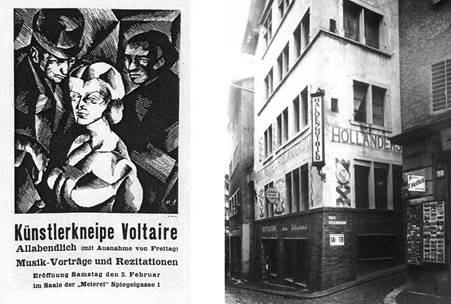
_Right_ Spiegelgasse 1, Zurich, Location of the Cabaret Voltaire
Evenings at the Cabaret Voltaire were eclectic affairs where “new music by Arnold Schoenberg and Alban Berg took its turn with readings from Jules Laforgue and Guillaume Apollinaire, demonstrations of ‘Negro dancing’ and a new play by Expressionist painter and playwright Oskar Kokoschka.” The inclusion of dance and music extended Dada activities into areas that allowed a total expression approaching the pre-war (originally Wagnerian) ideal of the Gesamtkunstwerk (combined art work). In time the tone of the acts “became more aggressive and violent, and a polemic against bourgeois drabness began to be heard.” Performances sought to shock bourgeois attitudes and openly undermine spectator’s templates for understanding culture. Thus, a June 1917 lecture “on modern art” was delivered by a lecturer who stripped off his clothes in front of the audience before being arrested and jailed for performing obscene acts in public. Godfrey notes that: “This was carnival at its most grotesque and extreme: all the taste and decorum that maintains polite society was overturned.” Robert Wicks:
The Dada scenes conveyed a feeling of chaos, fragmentation, assault on the senses, absurdity, frustration of ordinary norms, pastiche, spontaneity, and posed robotic mechanism. They were scenes from a madhouse, performed by a group of sane and reflective people who were expressing their decided anger and disgust at the world surrounding them.
The outrages committed by Dadaists attacking the traditions and preconceptions of Western art, literature and morality were deliberately extreme and designed to shock, and this tactic extended beyond the Cabaret Voltaire to everyday gestures. For instance, Tzara, “the most demonic activist” of Dada, regularly appalled the dowagers of Zurich by asking them the way to the brothel. For Godfrey, such gestures are redolent of the “propaganda of the deed” of the violent anarchists who, through their random bombings and assassinations of authority figures, sought to “show the rottenness of the system and to shock that system into crisis.” Arnason likewise underscores the serious ideological intent behind such gestures, noting that: “From the very beginning, the Dadaists showed a seriousness of purpose and a search for a new vision and content that went beyond any frivolous desire to outrage the bourgeoisie. … The Zurich Dadaists were making a critical re-examination of the traditions, premises, rules, logical bases, even the concepts of order, coherence, and beauty that had guided the creation of the arts throughout history.” Jewish Frankfurt School intellectual Walter Benjamin, spoke admiringly of Dada’s moral shock effects as anticipating the technical effects of film in the way they “assail the spectator.”
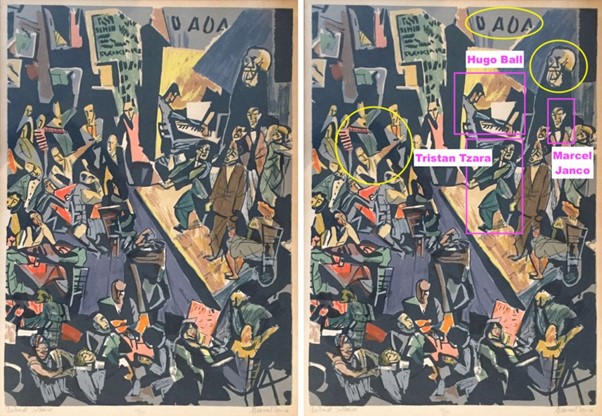
Color lithograph of a painting by Marcel Janco from 1916, “Cabaret Voltaire”
The leadership of Zurich Dada soon passed from Ball to Tzara, who, in the process, “impressed upon it his negativity, his anti-artistic spirit and his profound nihilism.” Soon Ball could no longer identify with the movement and left, remarking: “I examined my conscience scrupulously, I could never welcome chaos.” He moved to a small Swiss village and, from 1920, became removed from social and political life, returning to a devout Catholicism and plunging into a study of fifth- and sixth-century saints. Ball later embraced German nationalism and was to label the Jews “a secret diabolical force in German history,” and when analyzing the potential influence of the Bolshevik Revolution on Germany, concluded that, “Marxism has little prospect of popularity in Germany as it is a ‘Jewish movement.’” Noting the makeup of the new Bolshevik Executive Committee, Ball observed that:
there are at least four Jews among the six men on the Executive Committee. There is certainly no objection to that; on the contrary, the Jews were oppressed in Russia too long and too cruelly. But apart from the honestly indifferent ideology they share and their programmatically material way of thinking, it would be strange if these men, who make decisions about expropriation and terror, did not feel old racial resentments against the Orthodox and pogrommatic Russia.
Tzara, as Ball’s successor, quickly converted Ball’s persona as cabaret master of ceremonies into a role as a savvy media spokesman with grand ambitions. Tzara was “the romantic internationalist” of the movement according to Richard Huelsenbeck in his 1920 history of Dada, “whose propagandistic zeal we have to thank for the enormous growth of Dada.”
In addition to the Jewish mysticism of his Hassidic roots, Tzara was strongly influenced by the Italian Futurists, though, not surprisingly, he rejected the proto-Fascist stance of their leader Marinetti. By 1916, Dada had replaced Futurism as the vanguard of modernism, and according to Jewish Dadaist Hans Richter, “we had swallowed Futurism — bones, feathers and all. It is true that in the process of digestion all sorts of bones and feathers had been regurgitated.”
Nevertheless, the Dadaists’ intent was contrary to that of the Futurists, who extolled the machine world and saw in mechanization, revolution and war the logical means, however brutal, to solving human problems. Dada was never widely popular in the birthplace of Futurism, although quite a few Italian poets became Dadaists, including the poet, painter and future racial theorist Julius Evola, who became a personal friend of Tzara and initially took to Dada with unbridled enthusiasm. He eventually became disillusioned by Dada’s total rejection of European tradition, however, and began the search for an alternative, pursuing a path of philosophical speculation which later led him to esotericism and fascism.
The entry of Romania into the war on the side of Britain, France, and Russia in August 1916 immediately transformed Tzara into a potential conscript. Gale relates that: “In November Tzara was called for examination by a panel ascertaining fitness to fight. He successfully feigned mental instability and received a certificate to that effect.” At this time, living across the street from the Cabaret Voltaire in Zurich were Lenin, Karl Radek and Gregory Zinoviev who were preparing for the Bolshevik Revolution.
After the November 1918 Armistice, Tzara and his colleagues began publishing a Dadaist journal called Der Zeltweg aimed at popularizing Dada at time when Europe was reeling from the impact of the war, the Bolshevik Revolution, the Spartacist uprising in Berlin, the communist insurrection in Bavaria, and, later, the proclaiming of the Hungarian Soviet Republic under Bela Kun. These events, observed Hans Richter, “had stirred men’s minds, divided men’s interests and diverted energies in the direction of political change.” According to historian Robert Levy, Tzara around this time associated with a group of Romanian communist students, almost certainly including Ana Pauker, who later became the Romanian Communist Party’s Foreign Minister and one of its most prominent and ruthless Jewish functionaries. Tzara’s poems from the period are stridently communist in orientation and, influenced by Freud and Wilhelm Reich, depict extreme revolutionary violence as a healthy means of human expression.
Among the other Jewish artists and intellectuals who joined Tzara in neutral Switzerland to escape involvement in the war were the painter and sculptor Marcel Janco (1895–1984), his brothers Jules and George, the painter and experimental film-maker Hans Richter (1888–1976), the essayist Walter Serner (1889–1942), and the painter and writer Arthur Segal (1875–1944). After Zurich, Dada was to take root in Berlin, Cologne, Hanover, New York and Paris, and each time it was Tzara who forged the links between these groups by organizing (despite the disruption of the war and its aftermath) exchanges of pictures, books and journals. In each of these cities, Dadaists “gathered to vent their rage and agitate for the annihilation of the old to make way for the new.”
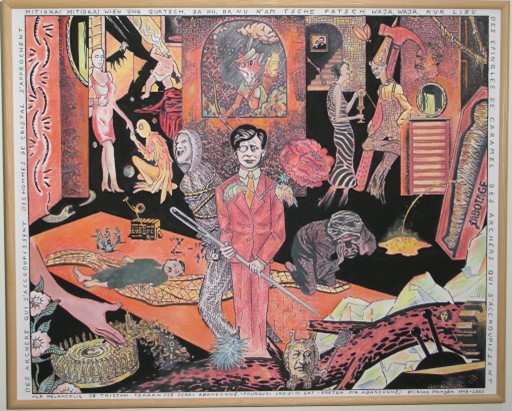
Tristan Tzara depicted in a contemporary painting
Dada in Paris
By 1919, when Tzara left Switzerland to join the poet André Breton in Paris, he was, according to Richter, regarded as an “Anti-Messiah” and a “prophet”. His 1918 Dada Manifesto had appeared in Paris, and, according to Breton, had “lit the touch paper. Tzara’s 1918 Manifesto was violently explosive. It proclaimed a rupture between art and logic, the necessity of the great negative task to accomplish; it praised spontaneity to the skies.” The editors of the avant-garde literary review Littérature felt that Tzara could fill the gap left by the deaths of Guillaume Apollinaire and Jacques Vaché. Gale notes that “Tzara immediately became the most extreme contributor to Littérature,” and by the end of 1919, “the Littérature editors had to defend his work from nationalistic attacks in the Nouvelle Revue Française.” A coordinated Dada insurgency was not, however, achieved until Tzara’s arrival in Paris in 1920.
In addition to his messianic zeal, Tzara brought to Paris Dada a skill in managing events and audiences, which transformed literary gatherings into public performances that generated enormous publicity. In the five months from January 1920 he helped organize six group performances, two art exhibitions and more than a dozen publications. Dempsey notes how “the popularity of these events with the public soon turned these revolutionary ‘anti-artists’ into celebrities. The cumulative effect of this first ‘Dada season’ as it became known, was to mark the movement as a nihilistic collective force leveled at the noblest ideals of advanced society.” The performances with which Dadaists tested their Parisian audiences were consistently aggressive in nature, and psychological aggression characterized many of their artworks and journals. As one source notes: “Like the plays and stage appearances, individual works produced within Dada emanate a violent humor, ranging from vulgar to sacrilegious language to images of weapons and wounds, or references to taboos great and small: suicide, cannibalism, masturbation, vomiting.”
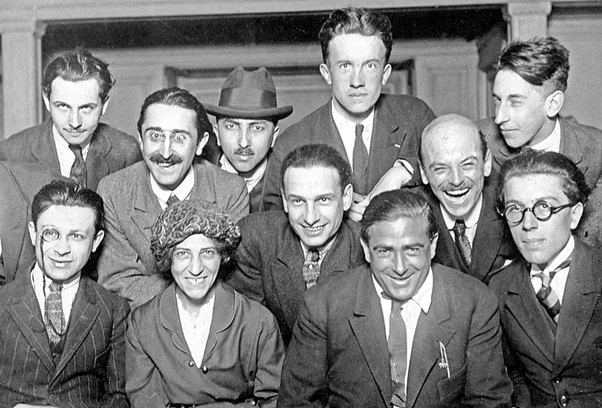
Tzara (bottom left) with other Dada artists in Paris 1920
It was widely observed at the time that the output of Paris Dada exhibited a “profound violence: physical hurt, damage to language, a wounding of pride or moral spirit,” that to native observers seemed wholly “uncharacteristic of French sensibility.” Comoedia, a Parisian arts daily focused on theatre and cinema, soon became the central forum for debates over Dada and its effects on French audiences. Charges of enemy subversion, lunacy and charlatanism regularly appeared — just as it did in many German newspapers — pretexts to isolate what seemed to many a traitorous insurgency against bedrock national values. Attacks on Dada in Paris soon took on an openly anti-Semitic tone when the French writer Jean Giraudoux, in explaining his rejection of Dada, pointed out: “I write in French, as I am neither Swiss nor Jewish and because I have all requisite honors and degrees.”
The French cultural establishment looked askance at Dada from its arrival in Paris at the beginning of 1920. It was common knowledge that the Dadaists were avowed partisans of revolution and supported the communist uprisings in Berlin and Munich that had barely been put down. Trotsky’s red legions were, at that time, cutting a swathe of death and destruction in Poland, and many perceived a conjoined ethnic agenda behind Trotsky’s Bolshevism and Tzara’s Dada — especially given Dada’s appearance at socialist and anarchist venues throughout Paris. The connection was unambiguous in the mind of the Romanian nationalist Nicolae Rosu who noted that “Dadaism and French Surrealism exploit the moral and spiritual exhaustion of a war-torn society: the aggressive revolutionary currents in art seem to be an explosion of primal instincts detached from reason; post-war German socialism, largely developed by Jews, uses the opportunity of defeat to dictate the Weimar constitution (written by a Jew), and then through Spartakism, to install Bolshevism. Russian Bolshevism is the work of Jewish activists.”
In October 1920, the messianic Jewish Dadaist Walter Serner arrived in Paris and reconvened with Tristan Tzara, who had just returned from his first visit to Romania since 1915. Serner’s campaign of shameless self-promotion, which included placing an advertisement in a Berlin newspaper describing himself as the world leader of Dada, was resented by Tzara, who was eager to establish his own priority as leader. By 1921, many of the original Dadaists had converged on Paris, and arguments among them created difficulties. By 1922, internal fighting between Tzara, Francis Picabia, and André Breton led to the dissolution of Dada. Dada was officially ended in 1924 when Breton issued the first Surrealist Manifesto. Hans Richter claimed that “Surrealism devoured and digested Dada.” Tzara distanced himself from Surrealism, disagreeing with its dream-centered Freudian dynamic, despite its anti-rationalism. Robert Short notes that
for Tzara, automatism [literary and artistic free association] was a visceral spasm, an explosion of the senses and the instinct that expressed the primitive and chaotic intensity in man and Nature. Where Surrealist automatism was introverted and sought to reveal patterns in the human unconscious, Dada art mimicked an objective chaos. … Surrealism was to prospect and exploit a vast substratum of mental resources which the Western cultural and economic tradition had deliberately tried to seal off. In place of science and reason, Surrealism was to cultivate the image and the analogy. In its efforts to restimulate the associative faculties of the mind, it turned its attention with respect and enthusiasm toward the thought processes of children and primitive peoples, towards the lyrical manifestations of lunacy and the synthesizing notions of occultism.
Tzara also increasingly disagreed with the political orientation of Surrealism which evolved from the near-nihilist anarchism of the Dadaists to a strict adherence to the Communist Party line by the late 1920s, and then to Trotskyism following Breton’s personal meeting with Trotsky in Mexico in 1938. Nonetheless, Tzara willingly reunited with Breton in 1934 to organize a mock trial of the Surrealist Salvador Dalí, who, at the time, was a confessed admirer of Hitler.
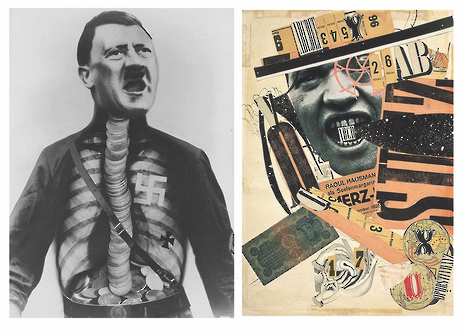
Left: Adolf the Superman: Swallows Gold and Spouts Junk by John Heartfield (Herzfeld) (1923). Right: ABCD by Raoul Hausmann (1923—24)
Tzara’s own politics were profoundly radical, and with Hitler’s ascension to power in 1933 effectively marking the end of Germany’s avant-garde, Tzara threw his support behind the French Communist Party (the PCF). Codrescu notes that the secular Jews of Tzara’s parents’ generation “were capitalists whose practical materialism horrified Samuel. The French resistance to the Nazis was, of course, the reason he later joined the Communist Party, but there was also an oedipal reason for his joining the communists: as a mystic, he was viscerally opposed to capitalism. He had to kill his father.” The allegiance of the great majority of Dadaists to Marxism was paradoxical given that Marxist dialectical materialism and forecast of the historical inevitability of communist revolution was based on a kind of mathematical rationalism that ran directly counter to the Dada spirit.
Tzara’s allegiance to Marxism-Leninism was reportedly questioned by the PCF and the Soviet authorities. This was because Tzara’s irregular vision of utopia made use of particularly violent imagery — shocking even by Stalinist standards. Tzara backed Stalinism and rejected Trotskyism (at least publically), and unlike some of the leading Surrealists, even submitted to PCF demands for the adoption of socialist realism during the writers’ congress of 1935. Tzara nevertheless interpreted Dada and Surrealism as revolutionary currents, and presented them as such to the public.
During World War II, Tzara took refuge from the German occupation forces by moving to the southern areas controlled by the Vichy regime. Back in Romania, he was stripped of Romanian citizenship, and his writings were banned by the Antonescu regime, along with 44 other Jewish-Romanian authors. In France, the pro-German publication Je Suis Partout made his whereabouts known to the Gestapo. In late 1940 or early 1941, he joined a group of anti-Nazi and Jewish refugees in Marseille who were seeking to flee Europe. Unable to escape occupied France, he joined the French Resistance and contributed to their published magazines, and managed the cultural broadcast for the Free French Forces clandestine radio station.
During 1945, he served under the Provisional Government of the French Republic as a representative to the National Assembly, and two years later received French citizenship. Tzara remained a spokesman for Dada, and in 1950 delivered a series of radio addresses discussing the topic of “the avant-garde revues in the origin of the new poetry.” Towards the end of his life Tzara returned to his Jewish mystical roots, with Codrescu noting that “after the Second World War, after the Holocaust, after membership of the French Communist Party, Tzara returned to the Kabbalah.”
In 1956, Tzara visited Hungary just as the hated government of Imre Nagy faced a popular revolt (with strong undercurrents of anti-Semitism), and while receptive of the Hungarians’ demand for political liberalization, did not support their emancipation from Soviet control, describing the independence demanded by local writers as “an abstract notion.” He returned to France just as the revolution broke out, triggering a brutal Soviet military response. Ordered by the PCF to be silent on these events, Tzara withdrew from public life, and dedicated himself to promoting the African art he had been collecting for years. He died in 1963 and was buried in the Montparnasse cemetery in Paris.
Dada in New York and Germany
According to the account of Marcel Duchamp, in late 1916 or early 1917 he and Francis Picabia received a book sent by an unknown author, one Tristan Tzara. The book was called The First Adventure of Mr. Antipyrine which had just been published in Zurich. In this work, Tzara declared Dada to be “irrevocably opposed to all accepted ideas promoted by the ‘zoo’ of art and literature, whose hallowed walls of tradition he wanted to adorn with multicolored shit.” Duchamp later recalled: “We were intrigued but I didn’t know who Dada was, or even that the word existed.” Tzara’s scatological message was the catalyst for the establishment of the antipatriotic and anti-rationalist Dada message in New York, and it may well have informed Duchamp’s decision to submit his infamous Fountain to the Society of Independent Artists in New York.
In 1917, Duchamp famously sent the Independent an upside-down urinal entitled Fountain, signing it R. Mutt (famously photographed by Alfred Stieglitz). By doing so, Duchamp directed attention away from the work of art as a material object, and instead presented it as an idea — shifting the emphasis from making to thinking. He later did the same with a bottle rack and other items. Through subversive gestures like these, Duchamp parodied the Futurist machine aesthetic by exhibiting untreated objets trouvés or readymade objects. To his great surprise, these readymades became accepted by the mainstream art world.
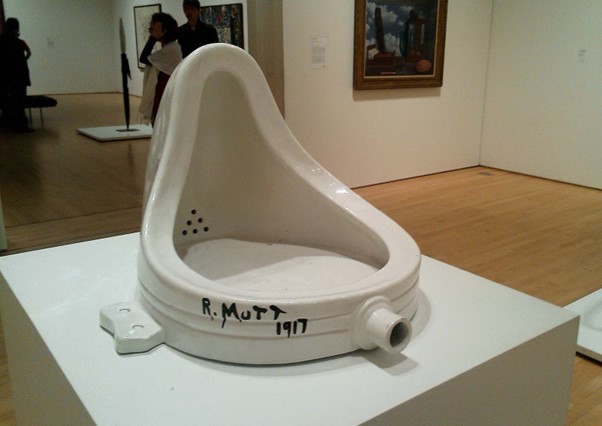
Marcel Duchamp’s Fountain (1917)
Alongside the Frenchman Marcel Duchamp (1887-1968) and the French-born Cuban Francis Picabia (1879-1953) were the American Jews Morton Schamberg (1881-1918) and Man Ray (1890-1977). The work of the New York Dadaists was focused around the gallery of the Jewish photographer Alfred Stieglitz and his publication 291, and the art collectors Walter and Louise Arensberg. Picabia later described this group as “a motley international band which turned night into day, conscientious objectors of all nationalities and walks of life into an inconceivable orgy of sexuality, jazz and alcohol.” They hotly debated such topics as art, literature, sex, politics and psychoanalysis. Dada in New York stayed in contact with Dada in Zurich, though it ultimately failed to take hold, and in 1921 Man Ray wrote to Tzara, complaining that “Dada cannot live in New York. All New York is Dada and will not tolerate a rival, will not notice Dada.”
Most of the artists of New York Dada left for Paris. Man Ray arrived there in July 1921, shortly after Duchamp, and remained there until 1940, becoming the youngest member of the Paris Dada group, and later of the Surrealists, even though this did not reflect any real modification of his art. With the arrival of Duchamp and Man Ray in Paris, New York Dada, which had not engaged in the kind of militant cultural protest seen in the European centers of Dada, came to an end. Their experiences were not dissimilar to those of other Dadaists “who were swept along, as they were, by the vehemence of André Breton into the coils of the new Surrealist movement which was, in many ways, an offspring of Dada.”
Early in 1917, Richard Huelsenbeck, a twenty-four-year-old German medical student and poet, returned to Berlin from Zurich, where he had spent the preceding year in the company of the Zurich Dadaists under the leadership of Tristan Tzara. After the war ended, Dada activity in Germany increased as Dadaists dispersed to various sites throughout the country including, most prominently, Berlin, Cologne and Hanover. In Germany, alongside George Grosz, Walter Mehring, Johannes Baader, Hannah Höch and Kurt Schwitters were Jews like Johannes Baargeld (1876–1955), Raoul Hausmann (1886–1971), and Eli Lissitzky (1890–1941).
The political radicalism of the Berlin Dadaists was even more pronounced than that of the Zurich or Paris Dadaists, with most belonging to the League of Spartacus, a radical socialist group that became the German Communist Party in 1919. German Dada was also closer to the Eastern European avant-garde led by Jewish artists like Eli Lissitzky and László Moholy-Nagy. The new Soviet state that emerged after the Bolshevik Revolution initially adopted a policy in favor of radical experimentation. In Berlin, more than anywhere outside the Soviet Union, “a direct equation could be made between political reform and artistic radicalism. Despite the seeming absurdity of some of their activities, the Dadas’ reinvention of poetic language and artistic form could be seen as a prelude to reforming the whole of the decayed social system.” A Dada Manifesto by Huelsenbeck and Hausmann, published in a Cologne newspaper, declared that Dada “is German Bolshevism” and that “Dadaism demands: the international revolutionary union of all creative and intellectual men and women on the basis of radical Communism.”
The Berlin Dadaists even condemned the Weimar Republic as representing a renaissance of “Teutonic barbarity,” and held Communism to be the best hope for freedom. Robert Short notes that, among the German Dadaists, were those for whom “Dada was a political weapon and those for whom communism was a Dadaistical weapon. There was a faction which saw anarchy and anti-art as a sufficient programme in itself, and a second faction which saw anarchy as a provisional precondition for the introduction of new values.”
Falling into the latter category was Johannes Baargeld. Born Alfred Emanuel Ferdinand Gruenwald to a prosperous Romanian-Jewish insurance director, “Baargeld” was the ironic, leftist pseudonym he adopted (Baargeld being the German word for cash or ready money). Growing up in Cologne in a wealthy home, he was exposed from a young age to contemporary art and culture, beginning with his parents’ collection of modernist paintings. He joined the Independent Socialist Party of Germany (USPD) — the radical left wing of the Socialist Party — and in the process “turned his back on his wealthy bourgeois upbringing and became actively involved in the leadership of the Rhineland Marxists.”
Baargeld (also called “Zentrodada”) and Max Ernst cofounded Dada in Cologne in the summer of 1919. Baargeld’s father was anxious about his son’s political leanings and sought Ernst’s help. Robert Short notes that: “They succeeded in convincing him that Dada went further than Communism and that its combination of new-found inner freedom and powerful external expression could do more to set the whole world free. In return, Grunewald senior financed the publication of a new international Dada magazine Die Schammade.”
In April 1920, Cologne Dada staged one of the most memorable of German Dada’s exhibitions. Entered by way of a public lavatory, it included “exhibits” like a young girl in communion dress reciting obscene verses, and a bizarre object by Baargeld consisting of an aquarium filled with red fluid from which protruded a polished wooden arm and on whose surface floated a head of woman’s hair. The First International Dada Fair was held in Berlin in June 1920, and was the most significant Dadaist event organized in the Berlin milieu. The radical political orientation of the organizers was illustrated by a mannequin of a German officer with the head of a pig hanging from the ceiling with a notice “Hanged by the revolution,” which triggered fierce debate about its subversive and anti-military character.
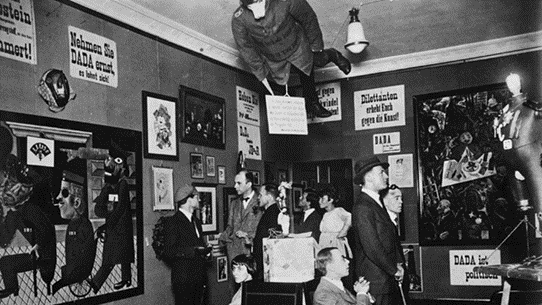
The First International Dada Fair in Berlin in 1920
Given such provocative gestures and the extensive Jewish participation in Dada, it was not surprising that, between the two world wars, German nationalists linked Dada (and avant-gardism generally) to Jews, claiming these modern trends aimed to destroy the principles of classical beauty and eradicate national traditions. The Dadaists were said to express the “nihilistic Jewish spirit” (a common phrase at the time), if they were not actually mad. In response to the activities of Jewish Dadaists, “calls for ‘degenerate’ art to be banned were widely published in pre-Nazi and later in Nazi Germany, as well as in France.”
Interestingly, Mein Kampf was composed by Hitler at the time of Paris Dada’s existence, and his comments about Jewish influence on Western art need be understood in this context. He mentions the “artistic aberrations which are classified under the names of Cubism and Dadaism,” and clearly has the Dadaists in mind when he observes that “Culturally, his [the Jew’s] activity consists in bowdlerizing art, literature and the theatre, holding the expressions of national sentiment up to scorn, overturning all concepts of the sublime and the beautiful, the worthy and the good, finally dragging the people to the level of his own low mentality.” Likewise, when he recalls how he once asked himself whether “there was any shady undertaking, any form of foulness, especially in cultural life, in which at least one Jew did not participate?,” he subsequently discovered that “On putting the probing knife carefully to that kind of abscess one immediately discovered, like a maggot in a putrescent body, a little Jew who was often blinded by the sudden light.”
In 1933, Hitler’s new government announced that: “The custodians of all public and private museums are busily removing the most atrocious creations of a degenerate humanity and of a pathological generation of ‘artists.’ This purge of all works marked by the same western Asiatic stamp has been set in motion in literature as well with the symbolic burning of the most evil products of Jewish scribblers.” At the exhibition of degenerate art held in Munich in 1937 the Dadaist works were considered the most degenerate of all — the epitome of Kulturbolschewismus. In that year the Ministry for Education and Science published a pamphlet in which Dr. Reinhold Krause, a leading educator, wrote that “Dadaism, Futurism, Cubism, and other isms are the poisonous flower of a Jewish parasitical plant.”
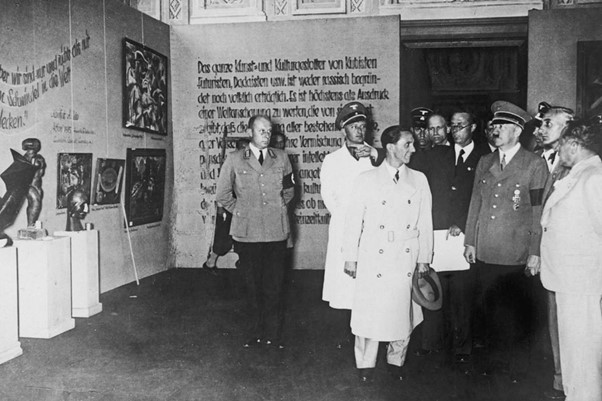
Hitler and Goebbels at the Degenerate Art Exhibition of 1937
British historian Paul Johnson points out that: “Hitler always referred to degenerate art as ‘Cubism and Dadaism’, maintaining that it started in 1910, and the ‘Degenerate Art’ exhibition bore a curious resemblance to the big Dada shows of 1920-22, with a lot of writing on the walls and paintings hung without frames.” He also notes that the Nazi campaign against “degenerate art” was “the best thing that could possibly have happened, in the long term, to the Modernist Movement.” This is because since the Nazis, universally reviled by all governments and cultural establishments since 1945, tried to destroy and suppress such art completely, then its merits were self-evident morally, and anything the Nazis opposed was assumed to have merit — on the illogical basis that the enemy of my enemy must be my friend. “These factors,” notes Johnson, “so potent in the second half of the twentieth century, will fade during the twenty-first, but they are still determinant today.”
The Legacy of Dada
Dada’s destructive influence has been seminal and long-lasting. As Dempsey points out, Dada’s notion that: “The presentation of art as idea, its assertion that art could be made from anything and its questioning of societal and artistic mores, irrevocably changed the course of art.” The movement represented “an assertive debunking of the ideas of technical skill, virtuoso technique, and the expression of individual subjectivity. … Dada’s cohesion around these procedures points to one of its primary revolutions — the reconceptualization of artistic practice as a form of tactics.” These tactics consisting, variously, of “intervention into governability, that is, subversions of cultural forms of social authority — breaking down language, working against various modern economies, willfully transgressing boundaries, mixing idioms, celebrating the grotesque body as that which resists discipline and control.”
Dada’s iconoclastic force had enormous influence on later twentieth-century conceptual art. Godfrey notes that: “Dada can be seen as the first wave of conceptual art” which exercised an enormous influence on subsequent art movements. In the late 1950s and 1960s, in opposition to the then dominant Abstract Expressionism and Post-Painterly Abstraction, Robert Rauschenberg and Jasper Johns resurrected the Dadaist tradition, describing the works they produced as “Neo-Dada” — a movement that, together with the “pre-emptive kitsch” of Pop Art, effectively relaunched the conceptual art of the original Dadaists, and which has plagued Western art ever since. The Neo-Dadaists themselves left a deeply influential Cultural Marxist legacy insofar as their
visual vocabulary, techniques, and above all, their determination to be heard, were adopted by later artists in their protest against the Vietnam War, racism, sexism, and government policies. The emphasis they laid on participation and performance was reflected in the activism that marked the politics and performance art of the late 1960s; their concept of belonging to a world community anticipated sit-ins, anti-war protests, environmental protests, student protests and civil rights protests that followed later.
Another pernicious influence of Dada stemmed from its rejection of the identity between art and beauty. Crepaldi notes that “many artists before Dada had called into question the aesthetic canons of their contemporaries and had proposed other canons, destined to meet varying degrees of success.” The Dadaists went beyond this, and called into question “the notion according to which the goal of art is the expression of a value called ‘beauty.’”
The Dadaists thus legitimized the idea that the artist has a right (nay a duty) to produce ugly works, and instituted a cult of ugliness in the arts that has since eroded the cultural self-confidence of the West.
Part Three
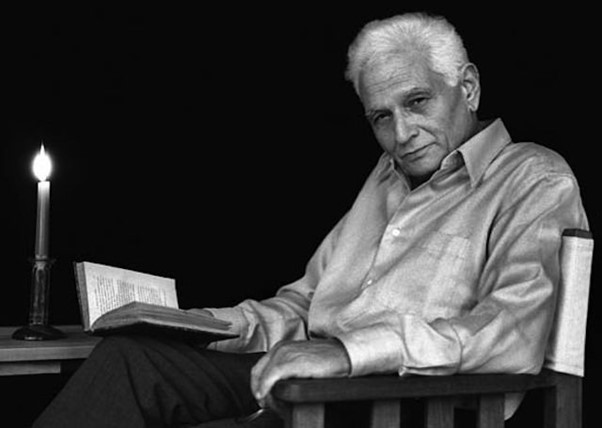
Jacques Derrida
Dada and Deconstruction as Jewish Attack Vectors
A final destructive legacy of Dada, and one which merits more attention, is how its anti-rationalism prefigured Jacques Derrida’s deconstruction as a Jewish intellectual movement arrayed against Western civilization. The parallels between Dada and Deconstruction have been noted by numerous scholars. Robert Wicks observes how strongly Dada resonates “with th