Select date

Europe Abandons All-Electric Car Mandate. Stupidity of the CO2 Transition


All Global Research articles can be read in 51 languages by activating the Translate Website button below the author’s name.
To receive Global Research’s Daily Newsletter (selected articles), click here.
Click the share button above to email/forward this article to your friends and colleagues. Follow us on Instagram and Twitter and subscribe to our Telegram Channel. Feel free to repost and share widely Global Research articles.
***
France24, Quartz, and the Wall Street Journal (paywall-free link) report that the EU abandoned its much-ballyhooed transition to electric cars, which was supposed to culminate with a total ban on gasoline cars in 2035.
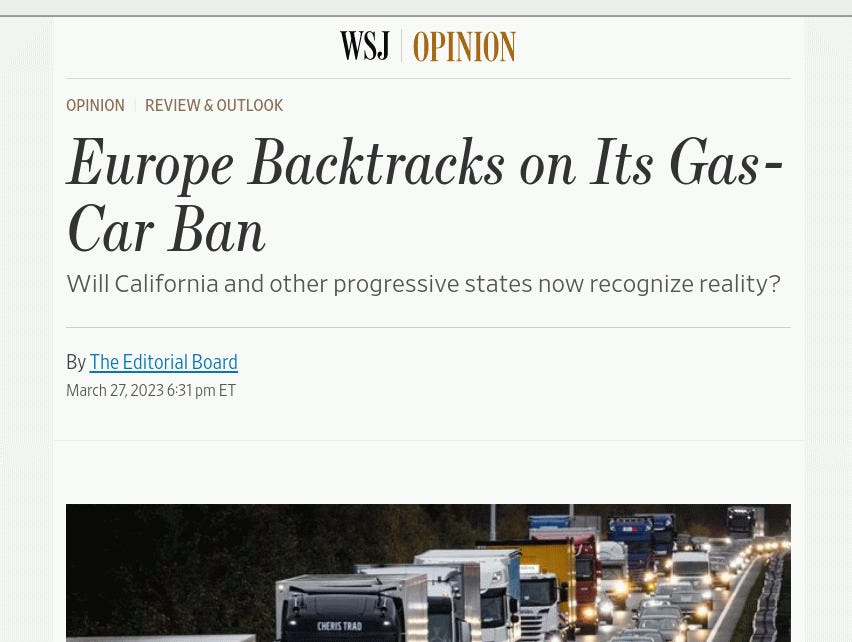
The EU’s reversal allows “the sales of new cars with combustion engines that run on synthetic fuels,” which sounds very environmentally friendly. But synthetic fuels are similar to gasoline or diesel, so the decision allows internal combustion cars to continue being produced. While electric cars will still be produced and incentivized, there is no longer a 100% mandate by 2035.

This transition was announced with a lot of pomp:

The transition was supposed to go on for 13 years after its announcement in 2022 but was abandoned only a year after its adoption. What happened?
Prodded by climate activists, the EU was pressured to ban fossil fuel vehicles and replace them with battery-powered vehicles. The problem is that such a transition is impossible:
- Transitioning to electric passenger vehicles will increase electricity demand by 25%.
- Transitioning to electric trucks will further raise electricity demand to a total of 40% increase.
- EU is phasing out fossil fuel generation and replacing it with unreliable solar and wind generation – thus decreasing power availability instead of increasing it to meet greater demand.
- As cars and especially trucks are charged at night, solar and wind power cannot contribute to charging.
Running a gasoline car involves:
- Burning gas in the internal combustion engine and converting thermal energy to mechanical energy. That’s it.
Charging an electric car’s battery from the grid and driving the car involves:
- Burning gas at the power station and converting thermal energy of gas to mechanical energy of the gas turbine. This is only moderately more efficient in a power station than gasoline cars.
- Then, losses begin:
- Converting the mechanical energy of the turbine into electrical energy in the generator involves generator losses
- Converting medium voltage from the generator into high transmission voltage involves transformer losses
- Transmitting the power along the high voltage lines involves transmission losses
- Stepping down the voltage in several substations involves transformer losses again
- In a home charging station, converting 220v power into DC for car charging again involves conversion losses
- A chemical process in the battery being charged heats the battery, involving charging losses
- Running the car’s electrical motors from the battery requires inverter losses to generate electricity for traction motors and motor losses.
Take a look at what happens when a driver needs heat in the cab:
- Heating a gasoline car in winter involves redirecting waste heat (hot antifreeze) from the engine into the cab heater, thus not requiring additional fuel.
- Heating an electric car requires a resistance heater or a heat pump, needing to eventually consume more energy from the grid – with all the above conversion losses included.
Which process (gasoline car vs. electric) is more efficient at converting fuel, burnt directly in the car engine or at distant power stations, into usable energy to propel a car traveling on a highway? The gas engines win outright.
The situation would be different if we had a clean, weather-independent, and inexpensive electrical power source. But, alas, we do not have that yet.
Last December, eugyppius wrote a nice post about Switzerland banning electric cars due to a lack of electricity to charge them.
The fact that a pompously announced thirteen-year “electric car transition” was canceled only one year after it was adopted strongly suggests that the original idea was untenably stupid.
As I mentioned above, a 13-year policy canceled in its second year surely is stupid, almost by definition. However, the EU is not alone. California and New York, the bastions of virtue-signaling climate activism, are still going full speed ahead, banning gasoline cars while phasing out fossil fuel generation and doing nothing for nuclear power.
This so-called transition will make much money for the movers and shakers but is technologically unfeasible due to the lack of cheap, carbon-neutral baseload energy (baseload means not depending on weather).
The best outcome would be to see such plans canceled under the pretense of “unforeseen circumstances,” like it just happened in the EU.
The worse outcome would be our collective inability to have enough energy to heat our homes and drive cars. That would necessitate living in cramped “15-minute cities” that are being proposed everywhere.
I want to share a thought that many people may disagree with. Feel free to share your thoughts in the comments.
- Social experiments like banning gasoline cars and simultaneously killing reliable power generation are dangerous; most readers of this substack would agree.
- Geoengineering experiments such as darkening the skies by spewing millions of tons of sulfur dioxide are dangerous. Most readers of this substack would agree with that as well.
- But emitting billions of tons of CO2 into the atmosphere yearly is also a potentially dangerous geoengineering experiment.
The climate change field is full of crooks and is directed by those who recently gave us a non-working and dangerous Covid vaccine.
I do not believe them or their paid scientists any more than I believe the dishonest “Covid science.”
However, even though I do not believe those people, I have a concern and a feeling of responsibility for our planet.
We only have one planet. So we better be careful with it.
Somehow or other, honest humans need to band together and reach a better understanding of climate and the Earth.
At the same time, if a fraction of the billions of dollars wasted on electric cars and climate grandstanding were spent on nuclear fusion, we’d possibly have a clean, safe, and limitless energy source much sooner.
What do you think?
*
Note to readers: Please click the share button above. Follow us on Instagram and Twitter and subscribe to our Telegram Channel. Feel free to repost and share widely Global Research articles.
Featured image is from the author