Select date

Russian Eurasianism: Its History & Core Ideas


 2,152 words
Marlène Laruelle
Russian Eurasianism: An Ideology of Empire
Washington, DC: Woodrow Wilson Center Press, 2012
Eurasianism is the dominant ideology of Russia today, as well as of the “Stans” of Central Asia. Eurasianism is a civilizational ethos in its own right. It is a powerful subset of Orthodox civilization, which combines the destiny and cultures of the Russians and the Turkic people — either Orthodox or Muslim — in a single ideological narrative.
Eurasianism’s ideological origins begin with the pan-Slavic ideas of the nineteenth century. Russian intellectuals fully explored pan-Slavism at that time, but they had a difficult time truly feeling at home in the Romantic era’s super-grouping with the other Slavic nations. The Russians felt Asian in Europe and European in Asia. After the Bolshevik Revolution, Eurasianism as a metapolitical force emerged from the pens and presses of the Russian émigré community scattered across Western Europe.
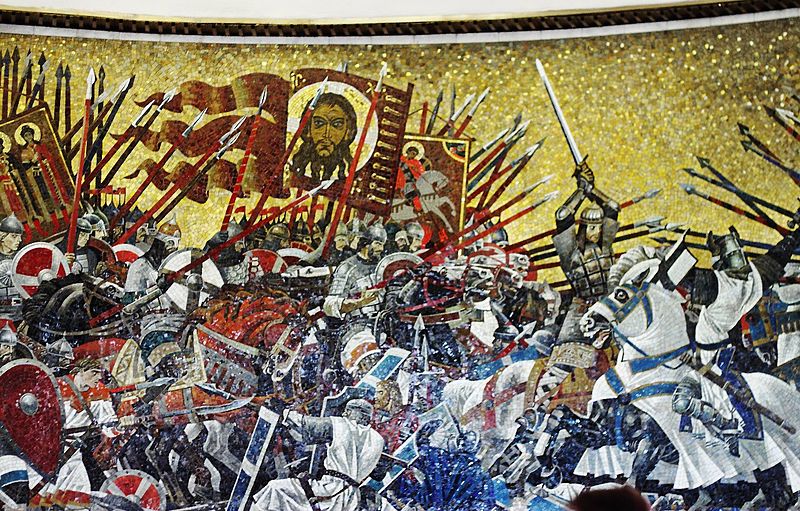
The Teutonic Knights invaded Russia in 1240 but were turned back. It was one of many from Western Europe. Russia therefore views the West with hostility.
The Eurasianists set themselves against Europe in the 1920s:
. . . Europe obfuscates the diversity of civilizations and establishes a benchmark for measuring political and economic backwardness. However, Europe does not represent a state of development that all nations must reach but a specific mode of development that cannot be reproduced. Seen through the historicist Western prism, Russia is a backward country; but the Eurasianists suggested that Russia should unlearn the West and perceive itself geographically: History, the argued, is the mode in which Europe expresses its identity; geography is Russia’s. (p. 31)
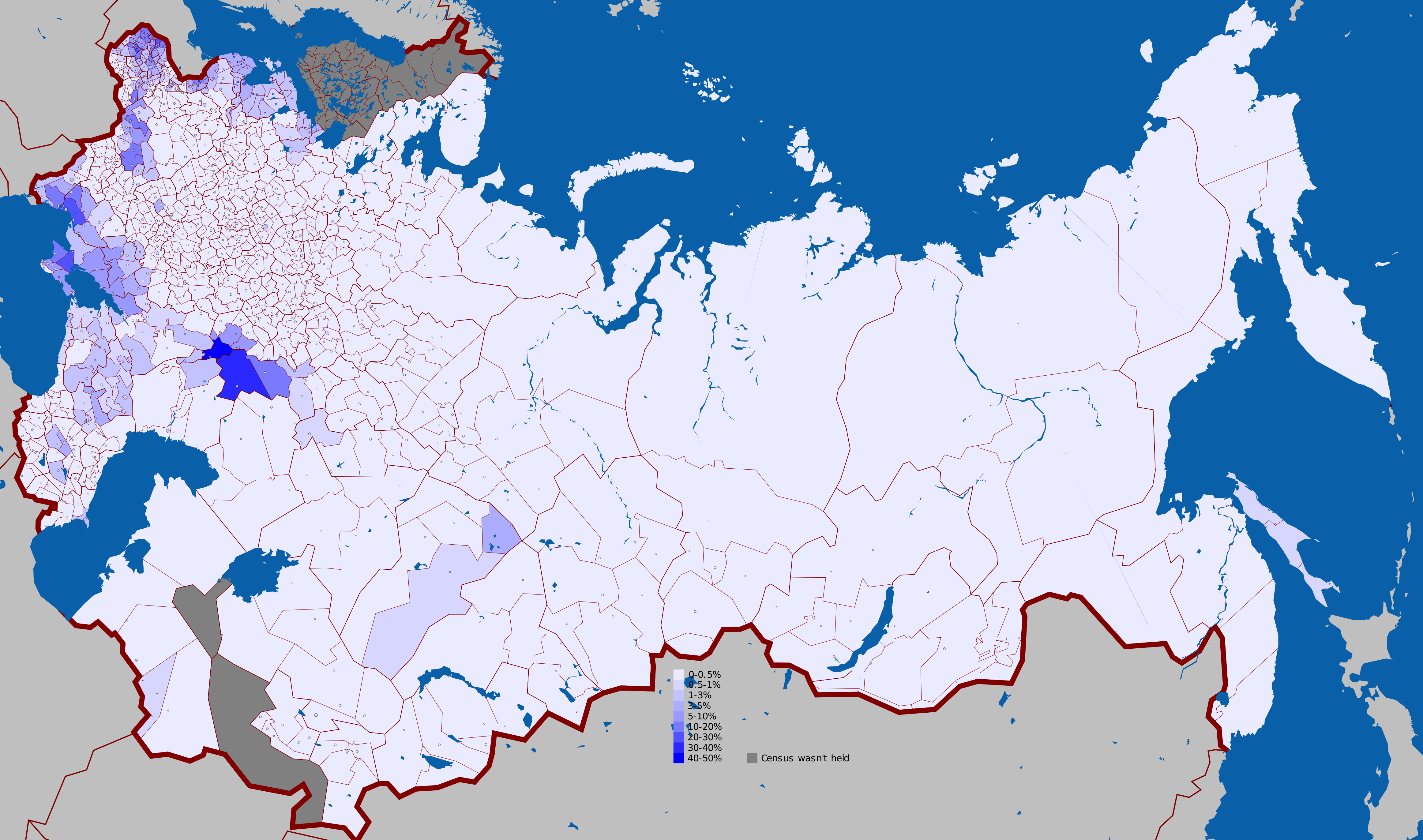
Distribution of German Speakers in the Russian Empire in 1917.

The Ukrainian language at the time of the Revolution. The western frontier of the old Russian Empire does not fit in an empire whose ideological ethos is Eurasianism.
Many of the early Eurasianists believed that all Russians had intermixed with Khazar, Polovtsian, Tatar or Bashkir, and Mordvin or Chuvash people at some point in the past. This separated them from other Slavs. Prince Trubetzkoy, an early Eurasianist, wrote that “[t]he Russians, along with the Ugro-Finnic and the Volga Turkic peoples, constitute a special cultural zone that is closely linked with both Slavdom and the ‘Turanian’ East, and it is difficult to say which of these links is stronger and more stable” (p.35).
Both the early Eurasianists (White Russian émigrés in 1920s Western Europe) and the neo-Eurasianists (post-Soviet Russian intellectuals) reject the story of Russia’s civilizational origins in Kiev.[1] They argue that the central fact of Russian history is Slavdom’s cohabitation with Turandom (Turkic and Finnic Asians).
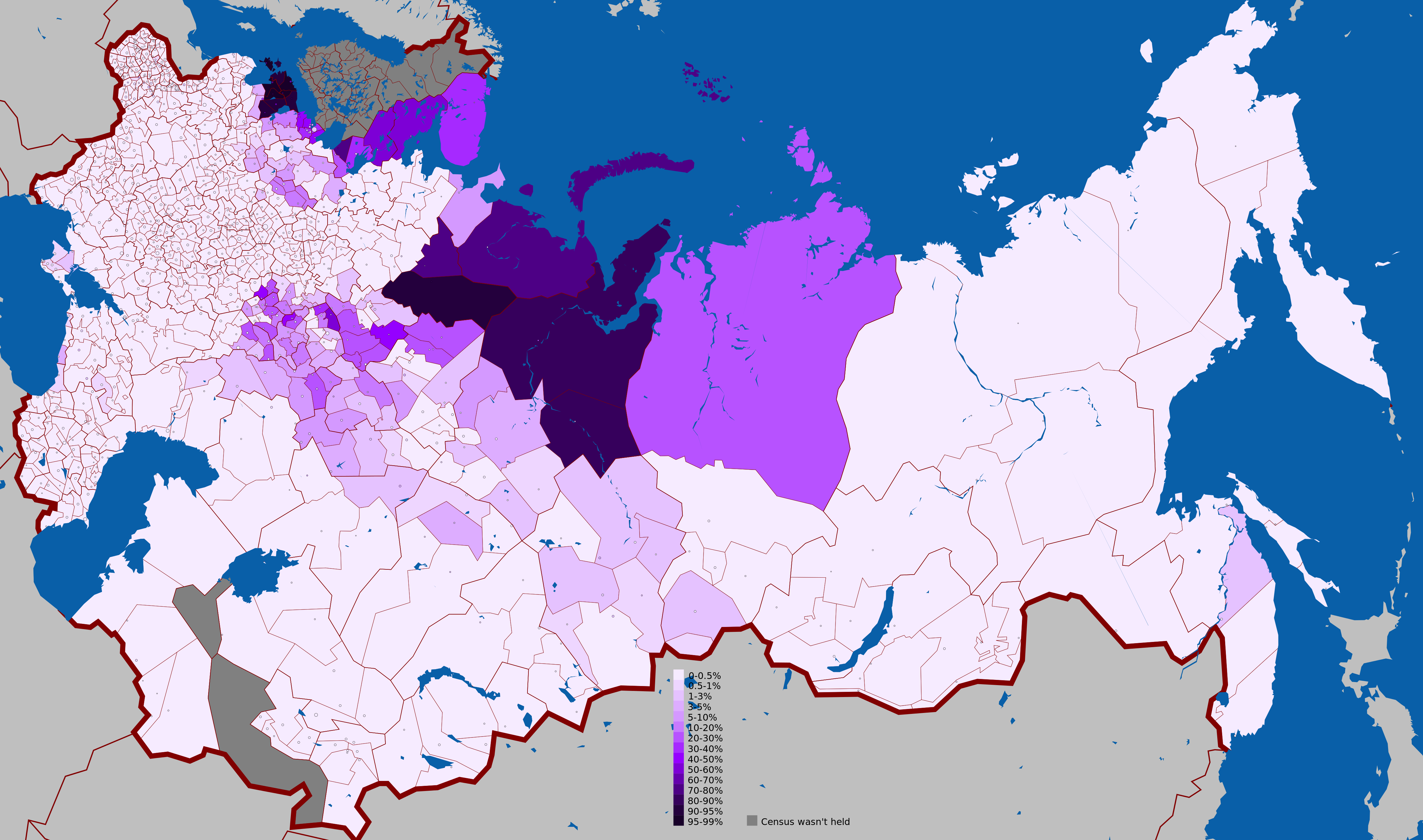
The distribution of the Uralic languages (which include Hungarian, Finnish, and Estonian) in the Russian Empire at the time of the Russian Revolution.
Lev Gumilëv (1912-1992) is the most popular Eurasianist in Russia and Central Asia. His works are studied by senior government officials, taught in schools, and provide a bridge between the writings of the Eurasianist émigrés of the 1920s and the resurgence of Eurasianist ideas after the fall of the Soviet Union.
Gumilëv was the child of two famous Russian poets. His father, Nikolai, was executed by the Bolsheviks in 1921. This put young Gumilëv at a disadvantage when trying to get into university, so he volunteered for research expeditions to Siberia and Crimea. He worked for the Soviet epidemiological services in the 1930s to stop malaria in Tajikistan. He was later arrested for anti-revolutionary activities and sent to a Gulag, where he labored on the White Sea-Baltic Canal. He was then sent to Norilsk. He volunteered for front-line service in 1943 and took part in the Battle of Berlin in 1945.
He received his doctorate at the Institute of Oriental Studies and was then sent back to the Gulag until 1956. Upon release, he joined the Hermitage Museum as a specialist on the Khazars. After his final release from the Soviet labor camps, his intellectual output increased in volume and influence.

Lev Gumilëv remains the most influential Eurasianist.
Gumilëv first wrote about the Turkic and nomadic people of the steppes and their interactions with China and other civilizations in the late 1960s. His book One Thousand Years around the Caspian (1990) charts the interaction between climate fluctuations and the history of the nomadic tribes around the Caspian Sea. The idea that the Steppe peoples were constrained by climate corresponded to other themes in Gumilëv’s work. He didn’t believe that individual actors affected events so much as the laws of history: Nations rose and fell based on factors beyond human control.
His later works focused on ethnogenesis. He rejected the idea of the Mongol Yoke and argued that the Russians and the Turkic/Mongol peoples had in fact had a positive relationship. Since it is unquestionable that the Mongols had a greater influence on the Russians than on the Ukrainians and the Poles, Gumilëv is redefining the Mongol conquest by putting it in a positive light.
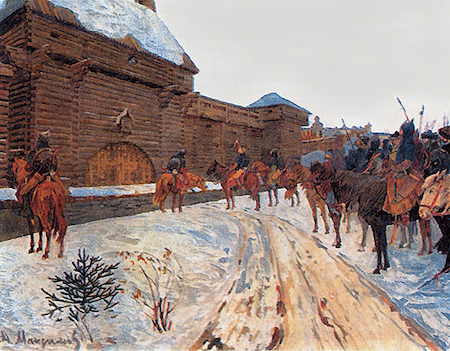
Lev Gumilëv put a positive spin on the Mongol conquest of Russia.
Gumilëv was influenced by the Eurasianist émigrés, but his theories went beyond what they had formulated. He viewed what he called the Romano-Germanic World as mortal enemies — especially Balts, Poles, and Swedes. He also viewed Jews as the enemy. He saw them as “destructive of ethnic totalities” (p. 75).
You can buy Alain de Benoist’s Ernst Jünger between the Gods and the Titans here.
Gumilëv believed that only two super-ethnoi (Russians and the various Steppe peoples) were the Soviet Union’s core ethnic groups. Russians and the Steppe peoples had evolved in Eurasia, and the region was their native habitat. All other ethnicities in the Soviet Union had arrived through geopolitical happenstance, and they belonged to different civilizational groups.
After Gumilëv passed away, his legacy grew through his disciples, who propagated his ideas and built on his work. One such intellectual was Aleksandr S. Panarin, who wrote several well-received Eurasianist books. One, The Revenge of History (1998), was a response to Francis Fukuyama’s end of history thesis. Panarin rejected the shock-therapy economic reforms being pushed by Boris Yeltsin and his Jewish advisors after the end of the Cold War and attempted to create a middle way of economics to soften the collapse of the Russian economy in the 1990s.
Panarin viewed the neoconservative idea of American “hyperpower” in the period between 9/11 and the invasion of Iraq as a delusion. He also saw European and Western civilization as being like that of ancient Athens, but viewed them from a hostile perspective. He saw Athens as a slave economy: Greek maritime pirates interested only in enriching themselves. Europe was like Athens, working only to enrich those who are white and Catholic or Protestant. Panarin’s views were very much in line with Samuel Huntington’s “civilizational” ideas, and he valued his Orthodox/Eurasian civilization over that of the West.
Panarin likewise endorsed a fusion between Russian Orthodox Christianity and Islam as it is practiced by the Turkic peoples of Central Asia and Russia. He supported Turkic identity provided it was in line with a Russian alliance rather than as part of a neo-Turkic Empire ruled by Ankara. He was hostile to the organized Jewish community.
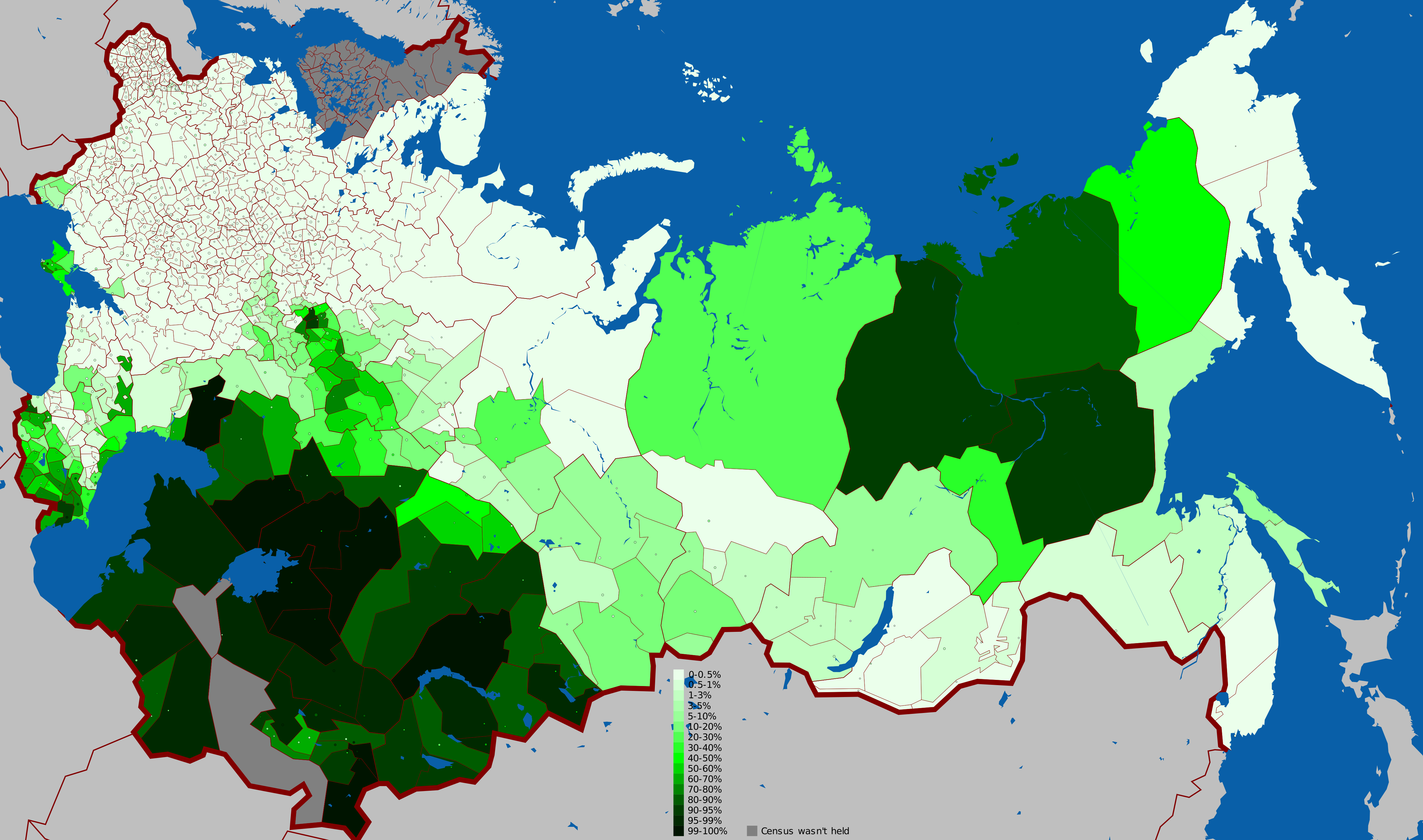
Turkic languages in the Russian Empire at the time of the Bolshevik Revolution.
The original Eurasianists were White Russians who had been forced to flee from their homeland by the Reds. They had no connection to Soviet political power. Lev Gumilëv, for his part, had been a political prisoner and a dissident — or at least a suspected dissident — for much of his early life, and wasn’t recognized until late in his life. And Aleksandr S. Panarin was unable to stop the disaster of Yeltsin’s economic policies. Then came Alexander Dugin. Before Dugin, the Eurasianists had been like the Biblical Prophets: They were free to tell the truth as they saw it, but they were outside the political process. But Dugin became a highly esteemed advisor. His Eurasianist ideas have influenced Russian politics as well as nationalist intellectual currents abroad.
During the late 1980s and 1990s, Dugin worked with several small political parties in Russia that were loosely based on traditionalist and nationalist ideas before establishing his own Eurasia Movement in 2002. America’s involvement in Russia’s Near Abroad — Georgia in 2003, Ukraine in 2004, and Kyrgyzstan in 2005 — deeply alarmed him. He formulated geopolitical theories aimed at helping Russia to reassert her international position.
Dugin’s ideas have been influenced by a variety of thinkers, often Western European ones. They include René Guénon, Ernst Jünger, and Alain de Benoist. Dugin’s ideas can be summed up as follows, in an oversimplified manner:
- Russia’s society should be traditionalist and centered on the Russian Orthodox Church.
- Islam as practiced by the Turkic people within Russia and Central Asia is complementary to Russian Orthodoxy. While Turkic Islam in Russia is acceptable, the United States government is supporting a violent, radical form of Islam.
- Russia is a land power — a tellurocracy. Russia’s main rivals — the Americans, British, Western Europeans, and so on, or what he calls “The Atlanticists” — are sea powers, or a thalassocracy. Russia’s military, diplomatic, and economic policies should align to with its status as a land power. Dugin is the yin to the yang of America’s Alfred Thayer Mahan.
- Russia should recapture those western territories that were part of the old Russian Empire. These include Ukraine and the Baltics. Dugin is different from other Eurasianists in this sense, as they typically regarded the people of Russia’s western frontier as fundamentally different from the Eurasian Russian, Turkic, and Finnic peoples.
- Russian should undertake geopolitical outreach to Germany, Japan, and Iran. These alliances will help Russia to oppose Atlanticist incursions against Russia.
- Dugin doesn’t believe in a biological definition of race, and he is not involved in counter-Semitic activity, although this is almost certainly due to political expedience.
Prophets are often killed by angry members of their own society, while political advisors face foreign enemies. Alexander Dugin’s daughter, Daria Dugina, was most likely murdered by Ukrainian spies in a car bomb attack in August 2022. The actual target was likely her father. He has therefore paid a tremendous price for his ideas.
Eurasianist ideology is not only propagated by Russian nationalists, but is also embraced by the Turkic people of the Central Asian “Stans.” The people in these nations are often Muslim, but they don’t practice Islam in the same way as in the Arab countries. They see Eurasianism as a way of interpreting their role in the Russian project. Are they a critical junior partner or equals?
The Turks have their own form of Eurasianist ideology that seeks to unite Turkic peoples. It had an impact on the Ottoman Empire during the First World War, but was never realized. The Turkic peoples of Central Asia feel more comfortable with the Russians than their distant kinsmen in Anatolia.
Eurasianism thrives in Russia because of several truths. Russia has a different way of conducting economics and politics than the Anglo-Americans. Russia also has competing security concerns due to its geographical location. And Russia’s long interaction with the Steppe nomads have led to the Russians becoming ethnically and culturally different from the Balts and Western Slavs. Understanding Eurasianism therefore means understanding Russia, and its similarities and differences with the West.
* * *
Like all journals of dissident ideas, Counter-Currents depends on the support of readers like you. Help us compete with the censors of the Left and the violent accelerationists of the Right with a donation today. (The easiest way to help is with an e-check donation. All you need is your checkbook.)
For other ways to donate, click here.
Note
[1] Lothrop Stoddard wrote about the origins of Russian civilization in his book Racial Realities in Europe (1924):
Significantly enough, the beginnings of political cohesion ere due, not to the Russians themselves but to a foreign ruling element — the Scandinavians. Back somewhere in the dim past adventurous Scandinavian Nordics discovered a trade-route across Western Russia and established commercial contact between their Baltic homeland and Constantinople, then the capital of the Byzantine Greek Empire and a center of civilization. Despite their small numbers, these masterful Norse Vikings easily kept in order the petty tribes along the rivers which formed their trade-highway, and as time passed the natives came to regard the strangers as arbiters in their endless intertribal quarrels. Becoming more and more influential, the Norsemen established themselves firmly at several points and at length founded a real state at Kiev, a natural center in Southwestern Russia situated on the great river Dnieper — the water route to the Black Sea and Constantinople. The legend of the founding of Kiev is quite significant. The story goes that the local tribes were so afflicted by domestic feuds and raids by their neighbors that they invited a famous Viking chief to be their ruler. Their invitation is said to have run as follows: “Our land is great and has everything in abundance, but it lacks order and justice. Come and take possession and rule over us.” Whether or not the legend states the exact facts of the case, certain it is that Rurik did become ruler of Kiev and built up a state which soon became powerful and which laid the foundations of Russian nationality and civilization. It is also noteworthy that the early political centers in northern Russia, like Novgorod and Pskov, lay likewise on the Scandinavian trade-route and seem to have been mainly due to Scandinavian influence.
Lothrop Stoddard, Racial Realities in Europe (New York: Charles Scribner’s Sons, 1924), pp. 192-193.