Select date

The Crusader Armies, by Chris Woltermann


The Crusader Armies 1099–1187
Steve Tibble
Yale University Press, 2018
The ethnic composition of the Crusader armies changed during the decades after the First Crusade took Jerusalem in 1099. By the 1140s, Turkic Muslim mercenaries served openly in the Latin Kingdom of Jerusalem’s military. The resident Crusader society likewise grew culturally and genetically distinct from its European roots. Crusader men married local Christian women, particularly Armenians for the knights, and otherwise adapted in language, diet, and dress. Successive generations born into such mixed-heritage families felt an ever diminishing connection to Europe. Their menfolk formed the core of the Crusader armies.
Dr. Steve Tibble of the University of London offers a probing study in The Crusader Armies 1099-1187. He cites modern archaeological evidence and sleuths through the historical chronicles to rectify their neglect of the Crusaders’ infantry and their Turcopole light cavalry. Although the heavy cavalry knights were the Crusaders’ most powerful force, their efficacy and very survival depended on the auxiliary services.
Today’s anti-colonial mindset holds that the Crusaders were foreign intruders. They were, but so were all militarily active parties in the region at the time. For centuries, alien rulers had kept the locally established peoples, Armenians excepted, disarmed and subjugated. It was the policy of Byzantines, Arab conquerors, Egyptians, and the Turkic invaders who arrived shortly before the latest interlopers, the Crusaders.
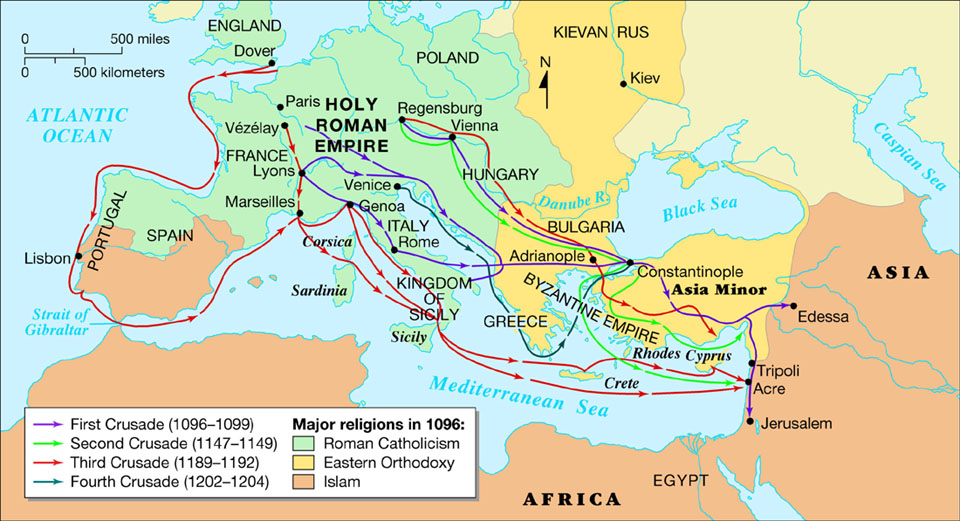
Everything about the Turks made them the drivers of military and social change in the Crusader era. They were nomadic herders from the steppes of central Asia. Expert mounted archers on small, nimble ponies, they were confident warriors who would swarm their enemies while quickly discharging showers of arrows. Droughts on the steppes spurred them to greener pastures. They met and defeated the Byzantines at Manzikert in 1071. Their subsequent migrations proceeded rapidly. They substituted themselves for nearly all the Arab rulers of statelets in Syria and Palestine. They seized Jerusalem from the Egyptians (who returned to Egypt only to be evicted by the Crusaders). And they encountered the First Crusade soon after it had crossed the Bosporus.
Responding to Turkic weapons and tactics transformed the Crusaders’ Western style of warfare. While armor protected the knights from Turkic arrows, weight considerations precluded the armoring of their horses, which Turkic archers sought to wound or kill before or during battle. The Crusaders responded by reinvigorating an institution much slighted in Western medieval warfare, the infantry.
The idea was to have the knights shielded by an infantry cordon of crossbowmen and pikemen. On a “fighting march” or deployed for battle, the crossbowmen’s arrows would fend off enemy archers whose own arrows had less range and penetrating power. The infantry would open to allow the knights their signature charge. Properly executed with intact warhorses, it could overwhelm any adversary. The system began haltingly during the First Crusade and became standard practice in the Latin Kingdom, the principality of Antioch, and the counties of Edessa and Tripoli.
Infantry requires infantrymen. It was in their recruitment that military change became entwined with social change.
Crusader infantrymen had to be part-timers, in complicated contrast to their knightly comrades. The knights, even with their armed dependents, did not form a permanent army so much as a warrior caste whose status they maintained without intermission. They were born for combat, much as birds are born for flight, and saw it as their calling. Infantrymen were less attuned to war. They were recruited from the resident Christian population, both native and immigrant, urban and rural. Most adult men served in some capacity, if only for garrison duty.
Centuries of Muslim rule had left large, varied Christian populations in place. In the Latin Kingdom, roughly the area comprising modern Israel and Dr. Tibble’s focus, they were perhaps fifty percent of residents. They were more prevalent in Antioch and Edessa where Christian Armenians had, with perseverance, retained a martial culture congruent with the Crusaders’ own. Greek and Syrian Christians of various sects predominated in the Latin Kingdom where they commonly spoke Arabic.
The Crusader rulers bolstered their manpower pool by encouraging farming colonists from the West to settle vacant lands. This magnitude and success of this undertaking have only recently come to light. There are 235 known such colonization sites in the Latin Kingdom alone, with less intense colonization elsewhere.
Newcomers and native Christians generally got along well. They often intermarried, to the dismay of Church officials in Rome who regarded Eastern Christians as schismatics or heretics, but with the complicity of local Catholic churchmen who paid little heed to doctrinal niceties. Strong evidence of Western convergence with the East comes from the military where Armenian and Arabic displaced the Crusaders’ medieval French as the usual languages for training and tactical field commands. Some intrepid men of Eastern-Christian heritage achieved knighthood.
Some indigenous and mixed-heritage Christians became Turcopoles, the Crusaders’ light cavalrymen. Named pursuant to a Byzantine precedent, they specialized in reconnaissance and patrolling. They sometimes had knights and infantry accompany them as they sought to detect and engage hostile infiltrators. Most fighting in the Crusader East occurred in such small-unit actions, not the few great battles. Skirmishers par excellence, and the Turcopoles were in the thick of it.
Completing the Crusaders’ manpower resources were Italian seafarers and the warrior-monks of the military religious orders. Italian sailors and merchants provided crucial assistance to capture the Egyptian-held Palestinian ports. Carpenters and engineers from Italian ships built the Crusaders’ siege engines. The military religious orders, principally the Order of the Hospital of St. John (Hospitallers) and the Knights of the Temple (Templars), augmented the Crusader armies in several ways. As the twelfth century progressed, they promoted tactical “best practices” and placed large contingents of their members in the field armies. They funneled wealth and fresh manpower from Europe to the East. By the 1170s, the orders were responsible for most of the great Crusader castles, Kerak notably excepted.
Military resources available to the Crusaders lagged their enemies’ growing strength. Political changes exacerbated the disparity. Whereas early Crusaders faced feuding Turkic mini-states and an independent Egypt, their successors confronted a united Turkic/Egyptian superpower whose consolidation its Kurdish ruler, Saladin, had largely completed by 1186. Egyptian revenues enabled Saladin to fund several armies, each larger than any the Crusaders could muster. Finally in 1187, Saladin crushed the Crusaders at Hattin. A truncated Latin Kingdom, bereft of Jerusalem, survived on a narrow strip of the Palestinian coast. With Edessa having fallen generations before, Antioch and Tripoli also continued as diminished survivors. The Crusaders triumphal years were behind them.
The Crusader Armies offers fine style, rigor without academic jargon, and thorough, unobtrusive documentation. Anecdotes illuminating historical nuances grace Dr. Tibble’s presentation. For example, an account of insubordination attests to how seriously Crusaders, unlike contemporaneous Europeans, stressed military discipline. The culpable fighter won grudging acquittal only because his infraction had harmed the enemy. His excuse, that as a Turk he did not understand the spoken command he had disobeyed, seems not to have mattered.
Some readers will object to Dr. Tibble’s dismissal of religion’s role. He claims that the Crusades can be explained as a clash between nomadic and settled societies without reference to religion. To his credit, he often ignores this dictum. Taken to extremes, it accounts for the Turkic invaders well enough but not their Crusading adversaries.
Dr. Tibble’s treatment of Jews, i.e., his failure even to mention them, is mystifying. He discusses in detail the Crusaders’ relations with everyone else. Why not the Jews? He leaves readers clueless.
His foray into White Crusaders’ attitude toward blacks is welcome but not entirely satisfactory. The Egyptian infantry mostly comprised Black Nubians whom the Crusaders often fought and disdained as men and fighters. Even so, Dr. Tibble writes too loosely of medieval Whites’ “casual racism.” The medieval Song of Roland treats Blacks respectfully. Then again, the author(s) of Roland probably had no experience with Blacks.
The biggest disappointment in The Crusader Armies is the absence of reasoned speculation on the self-identification of the mixed-heritage Crusader families. Many knightly families, for example, including the Latin Kingdom’s royal family, were as much Armenian as European. How did they regard themselves? Perhaps this question presupposes a too modern mentality. Medieval men and women, not indoctrinated with self-identity qualms, could experience personal wholeness within their extended families and their people, where the latter understood is as one’s family’s social milieu, not the modern abstract monstrosity called “the nation.”
Whatever self-identification there had been meant little after Hattin when Saladin launched a sweeping ethnic cleansing of the Crusaders’ hinterlands. All apparently Western Christians, but not Christians identifiable as native, were purged by slaughter, enslavement, or forced exile. It was a draconian program. It also made possible some of the Crusaders’ finest moments.
The scope and speed of ethnic cleansing left Crusader castles isolated in enemy territory without hope of relief. Their defenders, as “men trying to make a point,” Dr. Tibble writes, nonetheless fought heroically. The Hospitallers held Belvoir for eighteen months. At Kerak and Montreal, castles of the secular lord Reynald of Chatillon, whom Saladin personally murdered after Hattin, defenders likewise held out, for nearly two years at Montreal.
It was of these defiant Crusaders that Sir Steven Runciman movingly spoke: “Their lives were precarious and they knew it. … [T]hey faced their doom with pride and resolution.” (Creighton Lecture, Athlone Press, London, 1960, not quoted by Tibble).
The pride of the doomed Crusaders haunts me. It was also the pride of the ancient aristocratic warriors whom Ricardo Duchesne posited as the wellspring of Western civilization and its abiding unique qualities. Modern Christian and Jewish moralists, or, arguably more accurately, the Christian ones goaded by their watchful Jewish mentors, tell us that this pride is a sin or, at best, an abnegation of one’s unceasing obligation to self-criticize and remake oneself and one’s society. Very well, I shall sin and abnegate. I shall not revere Abraham Foxman, Martin Luther King, Pope Francis, Nelson Mandela, Nancy Pelosi, and their ilk as my heroes. For solace, I shall take refuge, if only in my imagination, with the great Christian warlords of the Latin East.