Select date

A First Look at a Half-Century of Black Militancy


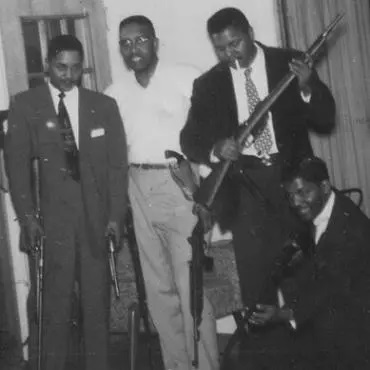
Robert F. Williams (second from right), the first “President in Exile” of the Republic of New Africa.
2,655 words
Lionel Lokos
The New Racism: Reverse Discrimination in America
New Rochelle, NY: Arlington House, 1971
It is one of the curious paradoxes of our time that most white Americans know more about Europe and Asia than they do about Harlem and Watts, that they can name the leaders of far-off lands but would be hard-pressed to name more than two or three elected Negro officials in this country, that they are far more interested in world journalism than in the closeup firsthand reporting of the Negro press in the United States. . . . Perhaps this is one of the prime reasons that white Americans find themselves continually in a state of surprise and bewilderment when news breaks of the latest “black blitzkrieg” . . . And yet almost without exception there were loud and clear storm warnings of every twist and turn of black militancy, months and sometimes even years before, in the pages of the Negro press. (pp. 147-8) — Lionel Lokos
In 1971 Lionel Lokos, a former New Dealer who switched in 1964 to become a Barry Goldwater supporter, wrote a book describing the rise in anti-white attitudes among sub-Saharans following the adoption of the 1964 Civil Rights Act. The book details in depth the mainstream conservatives’ criticisms of sub-Saharan extremist political activity following the victory of the “civil rights” movement — i.e., the Black Muslims, the Black Panthers, and so on.
More importantly, The New Racism describes the establishment of the Black Studies departments in the American university system. Black Studies was established through violence and credible threats of violence alongside great heapings of liberal white cowardice. The discipline of Black Studies created a large caste of overeducated and aggrieved sub-Saharans using carefully-crafted soundbites to shape the national narrative. The analysis of Black Studies graduates’ academic output as found in this 1971 book goes a long way toward explaining how the Black Lives Matter movement and George Floyd riots spread destruction so quickly in 2020.
Sub-Saharan Separatists
The New Racism begins with a look at the sub-Saharan separatists. The major separatist group of the time was the Black Muslims, otherwise known as the Nation of Islam (NOI). One cannot call the NOI the top sub-Saharan menace today, nor should a white advocate feel that the NOI is always aligned against him. The Nation of Islam is aware of the Jewish Question and simply seeks a separate sphere for sub-Saharans. The NOI is not us, but it is not directly against us, either.
The NOI did tolerate violence for political ends during the 1960s and ‘70s, as well as criminal behavior, however. Shortly after The New Racism was published, in 1973-74, a group of criminals vaguely affiliated with the NOI went on a killing spree in California. Malcolm X, an NOI minister, likewise endorsed revolutionary violence.
Lokos quotes Malcolm X in depth and points out that his ideology wasn’t Islam in the strictest sense, but rather the Jacobin/Leftism of the third-worldist social movements that were ongoing in the 1960s. Malcolm X also supported violence, saying,
[r]evolutions are based upon bloodshed. Revolutions are never compromising. Revolutions are never based upon negotiations . . . Revolutions overturn systems. And there is no system on this earth which has proven itself more corrupt, more criminal, that this system that in 1964 still colonizes 22 million African Americans, still enslaves 22 million Afro-Americans. (p. 53)
Malcolm X’s statements were made after the “civil rights” movement had reached its goals, and while the corrupt and criminal system of Jacobin-Leftist China under Chairman Mao was barely recovering from its famine of 1958-62. Malcolm X was part of a much larger upwelling of sub-Saharan belligerence. This increase in hostility was not a result of white suppression of sub-Saharans, but rather the opposite. This weakness on the part of old-stock Americans invited sub-Saharan attacks. Additionally, the moral condemnation of “colonization” was made just as the colonial powers were withdrawing from Africa. Malcolm X would go on to have a falling out with NOI leader Elijah Muhammad and would be murdered by Muhammad’s followers in 1965.
Other separatists included The Republic of New Africa. After the Civil War, the idea of a sub-Saharan ethnostate along the lines of an Indian reservation were fielded. It never got off the ground. Finally, in the late 1960s a group of sub-Saharans hit upon the idea of creating a Republic of New Africa in the Deep South.
In 1968, the movement for the Republic of New Africa picked up steam among the radicalized sub-Saharans, who were mostly located in Michigan. These radicals sent a letter to the US Secretary of State Dean Rusk demanding reparations, as well as an independent homeland in the South. Those supporting the Republic had been part of Malcolm X’s professional and social circles. They included Milton and Richard Henry, who had been Malcolm X supporters, as well as Betty Shabazz, his widow.[1]
The President of the Republic of New Africa was Robert F. Williams. Williams started his career as a “civil rights” activist in the 1950s. In 1961 he kidnapped a white couple at gunpoint and attempted to exchange them for the release of sub-Saharans in prison elsewhere. After being indicted by a grand jury on kidnapping charges, Williams fled to Cuba. From there he published Negroes with Guns in 1962. He eventually went to mainland China and published The Crusader, a Republic of New Africa newspaper.
Those involved in the Republic of New Africa had numerous run-ins with the law, and all their crimes have been downplayed by liberal historians and Hollywood producers. The sub-Saharans indeed carried out some of the worst crimes on the books, including kidnapping and murder, but their charges were dropped by sympathetic sub-Saharan or liberal judges on technicalities. The one-sided legal process of today already existed in the 1960s.
There are plenty of opportunities for sub-Saharans to relocate to Africa and create Wakanda without having run-ins with the law or making hopeless demands for all the gold in Fort Knox. While many sub-Saharans have demanded a New Africa, none really work for it. This gets to the heart of the matter: Sub-Saharan Separatist demands for a New Africa are a swindle to extract money from whites while enjoying all the perks of life in the United States. Lokos writes,
. . . the most effective weapon the Republic of New Africa possesses is the fact that it requires no renunciation of American citizenship, that a supporter can have his black separatist cake and eat it too. He can denounce America, but never formally renounce it — cling to American citizenship, but pledge undying love for the RNA. Even participating in an election of the Republic of New Africa would not jeopardize the voter’s American citizenship; such a voter could simply refer to the US Supreme Court decision in Afroyim v. Rusk.[2] (p. 96)
Lokos argues that the concept of the Republic of New Africa should be alarming:
. . . [I]t is now possible for black separatists to openly advocate disloyalty, the destruction of the United States as a political entity, allegiance to a foreign government, and risk to greater penalty than a reproving glance. The point will undoubtedly lure some wavers into the black separatist camp and exert a powerfully persuasive influence upon youthful black militants. In the sea of racial troubles that beset us, a black separatist group like the Republic of New Africa is the tip of the iceberg. We should not magnify it beyond its true significance, but neither should we delude ourselves by simply ignoring it. (p. 97)
Lokos also writes about the Black Panthers. This organization was heavily influenced by Jacobin-Leftism and held that the police were at war with the sub-Saharan community. The Black Panthers published a great deal of material supporting 1970s-style Leftism and encouraged sub-Saharans to become as big a problem for white American society as possible.
In the military, this created a culture of murderous insubordination on the part of junior enlisted sub-Saharans. Lokos shows the problems that senior military leaders faced and how they dealt with them. On one base, the garrison commander had to position military police, backed by details of trustworthy men, on every trail, walkway, and barracks hallway to prevent trouble. In Vietnam, racial affrays caused by rear-echelon sub-Saharans were a menace on several bases. And of course it should be pointed out that since racial integration in 1948, the United States military hasn’t won any wars.
You can buy Greg Johnson’s White Identity Politics here.
The most prominent member of the Black Panthers was Bobby Seale. He was tried along with seven others — whites and Jews — for leading the rioting in Chicago during the 1968 Democratic Party Convention.
In 2020, Netflix produced a movie about the trial and it portrayed the Jewish presiding judge Julius Jennings Hoffman (Frank Langella) as an abusive racist for ordering Bobby Seale to be chained and gagged. As usual, this is a Hollywood take adopting a simplistic pro-sub-Saharan and Leftist line. Judge Hoffman was well within his rights to do what he did, as Seale was carrying out a strategy designed to make Hoffman look bad and to disrupt the court’s proceedings.
Bobby Seale had a Marxist lawyer representing him named Charles Garry. During the trial of the Chicago Eight, Garry became ill. Seale was then represented by the Jew William Kunstler, who filed several motions on Seale’s behalf. When the trial started, Seale fired Kunstler and then claimed he was not being represented, and was therefore oppressed and so on. Seale then proceeded to insult the judge, the court, and generally make trouble.[3]
Sub-Saharans in Academia
Sub-Saharans have also disrupted American academia, moving along two lines. The first line is a simple lack of ability. Sub-Saharans enter a university without the ability to complete the coursework. This diverts resources into remedial training. Much of the remedial training is too little and too late for them, so many sub-Saharans are given artificial degrees which have the effect of making all other degrees worthless or suspect.
The second line of disruption is political:
[M]any white colleges were either woefully uniformed about the lust for power — and the intoxication with violence of the new breed of black student militants on Negro campuses — or woefully arrogant enough to believe that white paternalism could succeed where Negro colleges have failed. (p. 149)
Today there is a Black Studies program in nearly every university. They are designed to create an aggrieved class of sub-Saharans who can make use of the legal, social, and media landscape to advance sub-Saharan political power. This field grew out of a dispute in 1967 between older academics who sought to offer more “useful” degrees to students as well as younger, more radical students and teachers who wished to focus on revolution at the top “Negro college”: Howard University.
This dispute and how it was resolved is described in depth by Lokos. The most important thing that came out of it was Nathan Hare, who was a Black Power radical who was dismissed as a teacher at Howard, but was quickly hired by San Francisco State.
San Francisco State underwent a Mau Mau rebellion on campus under Hare’s influence, with the core of activists being members of the Black Students Union (BSU). On November 6, 1967, BSU students attacked the editor of the college newspaper. A gang of sub-Saharans beat him to the point that he was hospitalized, while other sub-Saharans stood at the door as guards. The cause of the beating was a photo they had wanted published that wasn’t submitted by the deadline for that evening’s print run.
The students involved in the attack were suspended, but their suspensions ended up being reduced. The attackers essentially got away with serious crime. Eventually, the unrest was enough that Hare was fired from San Francisco State, but the damage was already done. The college got its Black Studies department and set the precedent for allowing sub-Saharans to carry out crime in the name of politics.
At Federal City College, a mostly sub-Saharan institution in Washington, DC, Black Studies made considerable inroads in the teeth of considerable student resistance. The students at Federal City were older, being primarily a “night school” crowd. They were seeking degrees to further ordinary careers. Black Studies was taking away resources from other academic areas, but Federal City’s administrators were unable to resist the pressure coming from the radicals.
Black Studies was described in the following way at Federal City:
. . . [T]he “focus” of the first-year program is given as “Decolonization of the mind. Development of the ways of looking at the world . . . If education is to be relevant to Black people, it must have a two-fold purpose: revolution and nation building. If the education of Black students is to be meaningful, it must direct these students toward the destruction of the forces of racism, colonialism and oppression that continue to drain Black people all over the world; and it must develop in them the skills which will allow them to conceptualize and structure the projections of future Black existence. (p. 222)
Lokos likewise describes sub-Saharan activism at Cornell University and the City College of New York. All the activism described could not be countered by mainstream white conservatives despite the fact that it was universally understood. This includes allowing lower SAT scores for sub-Saharan admissions, but requiring higher scores for whites.
By 1969, whites and sub-Saharans had divided into separate warring camps at the universities. Lokos has a chapter on sub-Saharan anti-Semitism, which is ironic since ethnonationalist Jews had pushed for “civil rights” for decades prior to the 1964 Civil Rights Act. White advocates should never get involved in conflicts between sub-Saharans and Jews, but should rather stand aside and let them play out. The book concludes with a call to reject Black Studies and separatism and replace it with civic nationalism.
The Half-Century of “Civil Rights” Oppression
The book’s weakest part is its call for civic nationalism. Civic nationalism doesn’t work when groups as different as whites and sub-Saharans share the same government. It is a fiction which allows sub-Saharan racial activists to continue to point to the longstanding inequality in group outcomes and demand ever more concessions from whites.
The New Racism is prophetic. Whites in the universities should have ceased being liberal “civil rights” supporters by 1970, but they continued their cowardly ways. Today, universities are no longer towering establishments supporting scientific achievement and supporting the development of excellent cultural works. Instead, they teach a weepy ideology which is as dangerous to civilization as it is contemptible. Capturing academia is a task which white advocates should consider taking on.
After reading The New Racism, it became clear to me that the lunacy which spread across American society so quickly during the 2020 Summer of Floyd was built upon a metapolitical foundation more than half a century old. The reverential capitalization of “black,” the religious undertones supporting the idea of decolonization, and the calls to keep the police away from events where sub-Saharans press demands upon white institutions were already in place in academia by 1967.
* * *
Like all journals of dissident ideas, Counter-Currents depends on the support of readers like you. Help us compete with the censors of the Left and the violent accelerationists of the Right with a donation today. (The easiest way to help is with an e-check donation. All you need is your checkbook.)
For other ways to donate, click here.
Notes
[1] Malcolm X’s widow Betty Shabazz, a Republic of New Africa supporter, was burned to death by her then 12-year-old grandson Malcolm Shabazz in 1997. Malcolm was able to get a light sentence for the crime due to his political connections, but he continued living a reckless life before being beaten to death in Mexico over unpaid bar debts in 2013. The descendants of America’s white founders don’t always become presidents and notables themselves — but almost all of them end up having solid careers and genuine accomplishments. The descendants of notable sub-Saharans often end up dying a gangsta’s death. This phenomenon is called regression to the mean.
[2] Afroyim v. Rusk (1967) was a Supreme Court case filed on behalf of an Israeli Jew who wished to retain his American passport.
[3] Bobby Seale’s outbursts and actions were unusual in 1969. Today, judges are better prepared to restrain pseudo-legal outbursts from the accused. Darrell Brooks, Jr., the anti-white sub-Saharan who attacked whites at a Christmas parade in 2021, often engaged in outbursts during his trial and had to be restrained and led away from the court to watch the trial on closed-circuit TV in a different courtroom on numerous occasions.