Select date

Wasting Wales: Welsh Labour and Plaid Cymru Have a Virtuous Vision of National Negation, by Tobias Langdon


Right behind your eyes. That’s where you’ll find the most complex thing in the known universe. And right before your eyes is where you’ll presently find the second-most complex thing in the known universe. What are those things? Well, the most complex thing in the known universe is the human brain. And the most second-complex thing is language, as created and processed by the human brain. A single, simple sentence like this is, in some ways, much more complex than a star. A longer text, like a short story or novel, is more complex than a galaxy or even an entire universe of non-biological phenomena.
Geniuses of language
That gap in complexity is why human beings have made so much progress in astronomy and physics and so little progress in linguistics. Of course, physics has attracted geniuses for centuries and linguistics hasn’t, but that’s because physics is a much simpler science. A genius can make progress in physics but not in linguistics in rather the way that a good athlete can swim across the Mississippi but not across the Atlantic. Problems in physics are river-crossings; problems in linguistics are ocean-crossings. How did language evolve? How is it encoded in our genes and instantiated in the brain? Those are much tougher questions than, say: How does the sun shine? When it comes to language, we human beings are like spiders spinning webs or bees building hives. We can do amazing things with words, but we don’t know how. Like spiders and bees, we do it by instinct. We speak, we listen; we write, we read. But how? What’s going on in that warm, wet, sticky mass behind our eyes and between our ears?
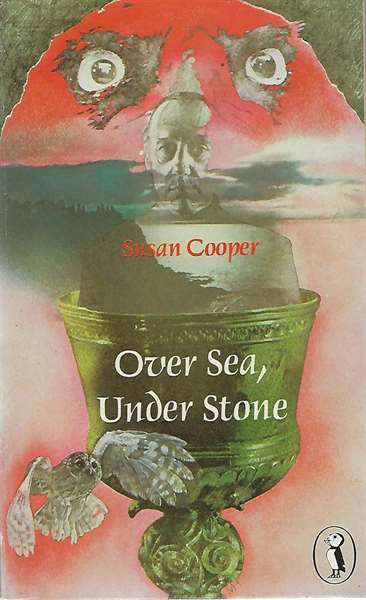
Over Sea, Under Stone: a wonderwork of verbal magic
You can ask that question of the simplest conversation or simplest text, but it becomes even more compelling when you ask it of great literature. We don’t have geniuses of linguistics, but we do have geniuses of language. Obvious names spring to mind: Dante, Shakespeare, Goethe. Here’s a less obvious name: Susan Cooper (born 1935), an English-American writer most famous for a five-book series of children’s fantasy called The Dark Is Rising (1965—77). Perhaps I’m wrong to bring her into the illustrious company of that male triumvirate. I’m not sure that she is a genius, but I am sure that she is more than simply an excellent writer. Like the late Rosemary Sutcliff (1920—92), another female writer of children’s fiction, Cooper is a verbal magician or alphabetic alchemist, able to conjure reality with words, to turn the dross of black ink on white paper into the gold of stories that glow and glisten in your mind for life. Two of the most powerful books I’ve read in recent years have been Sutcliff’s The Eagle of the Ninth (1954), set in Roman Britain, and Cooper’s Over Sea, Under Stone (1965), set in modern Britain but incorporating themes and characters from Arthurian legend and Celtic myth.
The might of Mystic Wales
As someone once said, reading is like dreaming with your eyes open. And reading those two books was like dreaming in full color with sound and scent and sensation all thrown in. Which was a pleasant surprise, because I first read those books as a child and returning to childhood favorites is often a disappointment. Not in this case. But one of Cooper’s books did once cause me big disappointment. It wasn’t that the book was weak — quite the opposite. The book was in fact too strong for the reality that it drew upon. When I read Cooper’s The Grey King (1975) I was initiated into Mystic Wales, because the book is set in Wales and draws on the special power of Arthurian legend and the unique beauty and mystery of Celtic mythology. For example, one of the chief characters is Bran Davies, an albino boy with golden eyes who is named after a Celtic crow-god and who owns a white dog that can literally see the wind. Bran has a mysterious father, is far older than he first appears, and takes part in a quest for a golden harp amid wild mountains and dark lakes.
Pwyll Pendeuic Dyuet a oed yn arglwyd ar seith cantref Dyuet. A threigylgweith yd oed yn Arberth, prif lys idaw, a dyuot yn y uryt ac yn y uedwl uynet y hela. Sef kyueir o’y gyuoeth a uynnei y hela, Glynn Cuch. Ac ef a gychwynnwys y nos honno o Arberth, ac a doeth hyt ym Penn Llwyn Diarwya, ac yno y bu y nos honno. A thrannoeth yn ieuengtit y dyd kyuodi a oruc, a dyuot y Lynn Cuch i ellwng e gwn dan y coet. A chanu y gorn a dechreu dygyuor yr hela, a cherdet yn ol y cwn, ac ymgolli a’y gydymdeithon. Ac ual y byd yn ymwarandaw a llef yr erchwys, ef a glywei llef erchwys arall, ac nit oedynt unllef, a hynny yn dyuot yn erbyn y erchwys ef. Ac ef a welei lannerch yn y coet o uaes guastat; ac ual yd oed y erchwys ef yn ymgael ac ystlys y llannerch, ef a welei carw o ulaen yr erchwys arall. A pharth a pherued y llannerch, llyma yr erchwys a oed yn y ol yn ymordiwes ac ef, ac yn y uwrw y’r llawr.
The Mabinogion: sample lines in Welsh and cover of an English translation
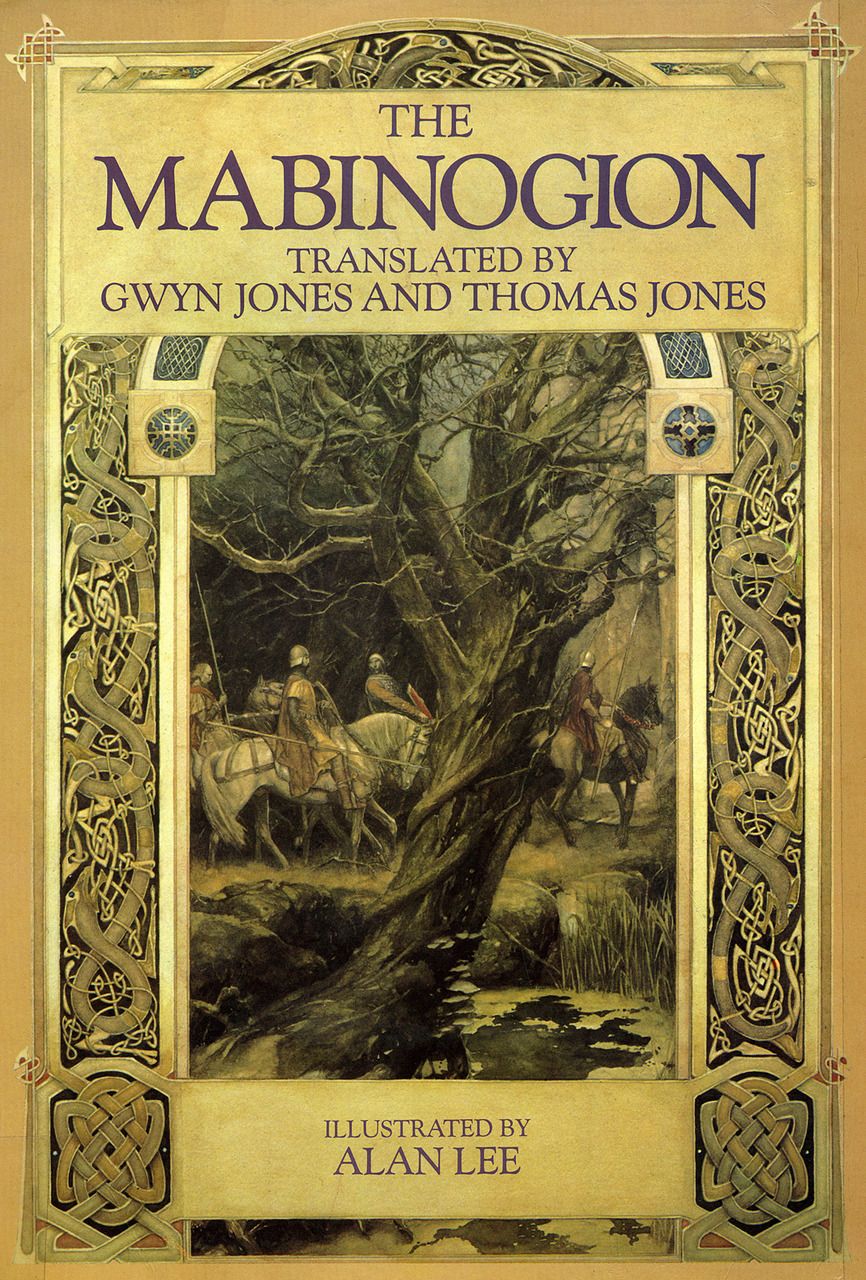
Alas, it was a disappointment to visit the real Wales after experiencing the Mystic Wales conjured by the word-magic of Cooper and other story-tellers. In the real Wales, there are exhaust-spewing cars, not fire-breathing dragons. In the real Wales, there are fat women eating fish’n’chips, not beautiful maidens created from flowers like Blodeuwedd in The Mabinogion (12th century).
Real Wales can’t live up to Mystic Wales, and nor can real Welsh people. The Welsh rock-band Super Furry Animals have experienced the disappointment in reverse: they said in one interview that their Welshness made audiences in Europe expect them to be druids with mist in their beards. The fantasy of Wales has become more powerful than the reality, but that’s another tribute to the magic of language and of the stories created in Welsh and other branches of the Celtic family. And in one way, real Wales isn’t a disappointment. Not when you visit an area where Welsh is a living language, still flowering after centuries of withering wind blown in from England. Welsh is a special and seductive language, as strange and subtle as the stories that have used it in collections like The Mabinogion.
Deeper, richer, stranger
And many millions more people have experienced the magic of Welsh than have ever spoken it, because it was one of the linguistic ingredients mixed by J.R.R. Tolkien into his mighty epic Lord of the Rings (1954—55). Welsh and Finnish were the bases of Elvish, the language (or languages) of Tolkien’s immortal Elves, who are tall and beautiful warriors, poets and artisans, lovers of flowers and gems and moonlight, haters of evil and ugliness and cruelty. Like Susan Cooper, Tolkien drew on Celtic mythology to create his stories. But although he was undoubtedly the greater scholar, I think she is the better writer, more adept at word-magic and better able to conjure on paper the beauty of the Light and the foulness of the Dark. Compare the verses that lie at the heart of both writers’ most famous stories. Here are Tolkien’s:
Three Rings for the Elven-kings under the sky,
Seven for the Dwarf-lords in their halls of stone,
Nine for Mortal Men doomed to die,
One for the Dark Lord on his dark throne
In the Land of Mordor where the Shadows lie.
One Ring to rule them all. One Ring to find them,
One Ring to bring them all and in the darkness bind them
In the Land of Mordor where the Shadows lie. (The Fellowship of the Ring, Book 1, ch. 2)
And here are Cooper’s:
When the Dark comes rising, six shall turn it back,
Three from the circle, three from the track;
Wood, bronze, iron; water, fire, stone;
Five will return, and one go alone. (The Dark Is Rising, ch. 3)
Tolkien’s verses can still make the hair rise on the back of my neck decades after I first began reading and re-reading Lord of the Rings. But I think Cooper’s are deeper, richer, and stranger, saying more with fewer words. Either way, it’s clear that Tolkien and Cooper are both lovers of the Light and the haters of the Dark. In Christian terms, they serve God and reject Satan, which is why I am sure that Tolkien would have hated what is happening in the real Wales that so inspired him. And I hope that Susan Cooper, who is still alive as I write this in mid-November 2022, does hate what is happening in Wales too, if she knows about it.
Labour is hostile to ordinary Whites
Yes, the Dark is certainly rising in 21st-century Wales. Or rather, it’s rising faster, because Wales has been ruled for decades by traitors who hate the Welsh people and the Welsh language, despite all their posturing and protestations to the contrary. I call them traitors because they are themselves Welsh and work under the banners of Llafur Cymru, Welsh Labour, and Plaid Cymru, the Party of Wales. I’ve often quoted the words of Maurice Glasman, a Jewish Labour peer who saw from the inside how his party had betrayed the group that inspired its own name. Here again is what Glasman admitted in 2011: “In many ways [Labour] viewed working-class voters as an obstacle to progress. Their commitment to various civil rights, anti-racism, meant that often working-class voters … were seen as racist, resistant to change, homophobic and generally reactionary. So in many ways you had a terrible situation where a Labour government was hostile to the English working class.”
In other words, Labour hates ordinary Whites. And what’s true of Labour in England is also true of Labour in Wales: Llafur Cymru hates the White Welsh working-class and is working hard to destroy its future. Like leftists around the world, Welsh leftists have recruited and trained mercenaries against those whom their party was founded to serve and protect. That is, Welsh leftists are using non-White outsiders to wage war on the White Welsh. And they’ve set out their vision of a totalitarian future Wales, where their own power is secure, their non-White servants rewarded with permanent privilege, and their White enemies degraded and stripped of power. They want something utterly contradictory: Cymru Wrth-hiliol, or “An Anti-Racist Wales.” That’s the title of Welsh Labour’s “Race Equality Action Plan for Wales.”
Crumbs of creation
And it’s an ominous title, especially for those familiar with Critical Race Theory (CRT), the branch of cultural Marxism dedicated to waging war on Whiteness. CRT preaches the eternal villainy of Whites and the eternal virtue of Blacks and other non-Whites. One of its leading theologians is the high-status, wealthy, low-IQ Ibram X. Kendi (born 1982), who teaches that every crumb of creation participates in the struggle between wicked Whiteness and virtuous Blackness. For Kendi, you are inescapably racist if you aren’t actively anti-racist. And that’s what the title of Welsh Labour’s Race-Equality Plan refers to: a permanent war on racism. In the ominous words of the traitorous Siân Gwenllian, deputy leader of the supposedly Wales-loving Plaid Cymru: “We are absolutely committed to celebrating diversity and will move to eliminate inequality in all its forms.” Welsh Labour and Plaid Cymru have a virtuous vision of an Anti-Racist Wales where nothing escapes the baleful gaze of anti-racist commissars, who will monitor and interfere in all aspects of life and culture. A more honest title for the Plan would be “An Anti-Welsh Wales,” because the Plan is intended to lay waste to the ancient White nation of Wales, raise non-Whites far above ordinary Welsh Whites, and ensure the power of leftists in perpetuity.
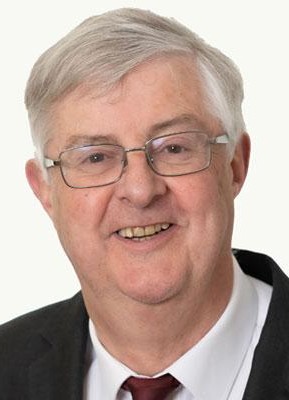
Man with a Plan: the physically degenerate Mark Drakeford, so-called First Minister of Wales
Naturally enough, the Plan has a foreword by the traitorous Mark Drakeford (born 1954), the leader of Welsh Labour and so-called First Minister of Wales. He’s someone whose flaccid, unhealthy features remind me strongly of a passage in George Orwell’s Nineteen Eighty-Four (1949). Winston Smith, the protagonist of the novel, is sitting in a canteen at the Ministry of Truth and musing on the physiological effects of IngSoc, the totalitarian leftism that controls the British Isles:
He looked round the canteen again. Nearly everyone was ugly, and would still have been ugly even if dressed otherwise than in the uniform blue overalls. On the far side of the room, sitting at a table alone, a small, curiously beetle-like man was drinking a cup of coffee, his little eyes darting suspicious glances from side to side. How easy it was, thought Winston, if you did not look about you, to believe that the physical type set up by the Party as an ideal — tall muscular youths and deep-bosomed maidens, blond-haired, vital, sunburnt, carefree — existed and even predominated. Actually, so far as he could judge, the majority of people in Airstrip One were small, dark, and ill-favoured. It was curious how that beetle-like type proliferated in the Ministries: little dumpy men, growing stout very early in life, with short legs, swift scuttling movements, and fat inscrutable faces with very small eyes. It was the type that seemed to flourish best under the dominion of the Party. (Nineteen Eighty-Four, Book 1, ch. 4)
That passage reminds me of Mark Drakeford, although he’s more like an amphibian than a beetle. He’s the type that flourishes best under Welsh leftism, an intellectual and ethical non-entity devoted to the service of leftism, the pursuit of power, and the destruction of his own nation. Not being a masochist, I haven’t read the entire 142 pages and 50,000 words of the Race-Equality Plan overseen by Drakeford. In fact, I’ve found it difficult to read as much as one page and fifty words. But I can confidently say that every last bit of the Plan oozes repulsively with what Sam Francis called the managerial state and Bruce Charlton has so aptly called “The Cancer of Bureaucracy”:
Everyone in modernizing ‘Western’ societies (roughly the USA, UK, Western and Central Europe) will, no doubt, have noticed that there has been a long-term, progressive growth and spread of bureaucracy. Except during major war; this has not been a matter of pendulum swings, with sometimes less and sometimes more bureaucracy, but instead of relentless overall expansion — albeit sometimes faster and at other times slower.
The bureaucratic takeover applies to science, medicine, education, law, police, the media — indeed to almost all social functions. Such unrelenting growth implies either that 1. Bureaucracy is vital to societal functioning and the more bureaucracy we have the better for us; or that 2. Bureaucracy is parasitic and its growth is uncontrollable. Since the first alternative has become obviously absurd, I am assuming the second alternative is correct: that bureaucracy is like a cancer of modernizing societies — i.e., its expansion is malignant and its effect is first parasitic, then eventually fatal. (“The Cancer of Bureaucracy,” Charlton’s Notions, 31st October 2013)
Welsh Labour’s “Race Equality Action Plan” will feed the cancer of bureaucracy in Wales, but will not bring about “race equality” there. Equality is an impossible objective and the Plan isn’t intended to pursue it in any case. Instead, the Plan will pursue inequality: it will further increase the privilege of non-Whites, further encourage their grievances, further incite them to harm Whites, further hasten the transfer of wealth from productive Whites to unproductive non-Whites, and further advance the cause of leftists around the world. Leftists want to wreck Western civilization and rule the ruins. In this case, Welsh Labour want to lay waste to Wales.
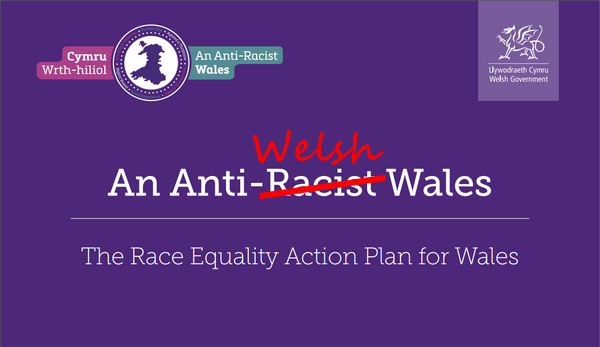
An Anti-Welsh Wales: the cover of Welsh Labour’s Race-Equality Action Plan
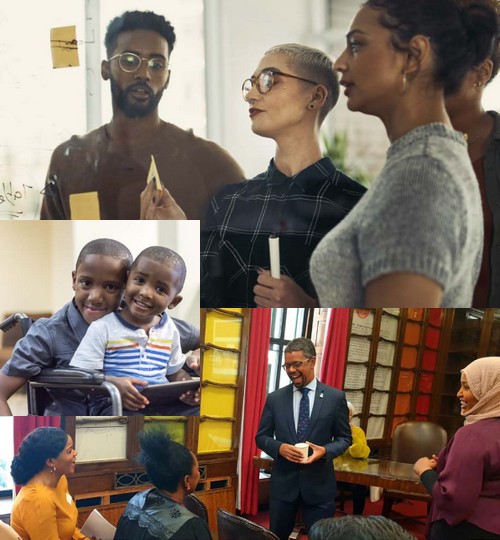
Not white, not Welsh, warmly welcomed by Welsh Labour: typical images from the Race Equality Plan
And they’ve proclaimed that aim by saying that they want Wales to become “an Anti-Racist Nation.” The concept of an anti-racist nation is as absurd as the concept of a square circle. The word “nation” comes ultimately from the Latin verb nasci, meaning “to be born.” That is, a nation is formed by birth and blood, by the natural process of unification that takes place among people who have a common ancestry, history, language, and culture. Nationhood is a question of ethnography, not geography. For example, down the centuries Jews were a supreme example of a nation without a homeland. They wandered and settled, were uprooted and expelled, but they never lost their sense of racial, religious and cultural separateness, and they never ceased to be a nation.

Blanking the blonde: a Black teacher turns her face away from a passive White girl towards active Black children
In other words, a true nation has to be “racist”: it has to discriminate between racial insiders and outsiders, between those who belong and those who don’t. If a nation ceases to discriminate between insiders and outsiders — that is, if it ceases to be “racist” — it also ceases to be a nation. But that national negation is what Welsh Labour want to happen in Wales. They want to destroy the true nation of Wales and replace it with a pseudo-nation of privileged non-Whites and parasitized Whites, all overseen by power-hungry leftists like Mark Drakeford. Leftists like Drakeford understand perfectly that the quickest way to destroy a White nation is to open its borders to non-Whites who aren’t and never will be part of the nation. That’s why those non-Whites don’t care about the most precious parts of nationhood, like language and tradition. This story from Scotland also applies to Wales, because non-White immigration will be just as bad for the Welsh language as it is for Gaelic:
Funding for Gaelic “discriminates against Muslims”
A former SNP [Scottish National Party] Holyrood candidate has claimed “anti-Muslim racism” is seeping into Scottish education because language policies treat ethnic minorities as inferior to white Scots. Nighet Riaz, an academic at the University of the West of Scotland, said Gaelic was promoted and given millions of pounds in ring-fenced public funding while the traditional languages of non-white groups were sidelined in schools. She said that there was a lack of Urdu teachers, with schools unable to meet the needs of large Pakistani communities, particularly in Glasgow.
Dr Riaz was a regional list candidate for the SNP at the 2016 Holyrood election, endorsed by Alex Salmond, the former party leader, and Robin Sturgeon, Nicola Sturgeon’s father, but was not elected. She is an SNP equalities officer for Pollokshields and the first minister’s Glasgow Southside constituency.
She said the SNP narrative of Scotland being a “more tolerant, welcoming nation” clashed with the experiences of ethnic minority communities and described lack of provision for Urdu as “a form of anti-Muslim racism being played out by the state”.
She added: “The reality is that no new funding is being diverted to minority languages other than Gaelic which is ring-fenced by the Gaelic School Capital Fund and protected by legislation, as it is seen as the ‘Scottish’ language. We cannot ignore that Gaelic is spoken by white Scots, whilst Urdu is spoken predominantly by brown Muslims. This suggests that ethnic minorities, Muslims in particular, are not considered equally Scottish as white ‘native’ Scots.”
According to the most recent census Urdu is the fourth-most commonly-spoken language in Scottish homes, after English, Scots and Polish, while Punjabi is the fifth most common. Gaelic is eighth. (Funding for Gaelic “discriminates against Muslims,” The Times of London, 6th October 2018)
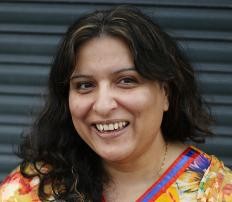
Not White, not Scottish: the anti-Gaelic Muslim invader Nighet Riaz
You can’t blame Nighet Riaz for not caring about Gaelic. She’s not Scottish, has no roots in Scotland, and plainly feels nothing for Scotland’s unique history and traditions. All that interests her is the promotion of her own non-White group and its culture. She was stupid, of course, to make her disdain for Gaelic so obvious, but you can be sure that what she said openly is thought privately by countless other non-Whites. As for me, I’m not Scottish either, but I am White and I recognize the immense importance of Scotland in Western history. It is a small nation that has made an outsize contribution to Western civilization.
Hungry cats and rats
But even if Scotland were small and obscure, I would still be saddened to see that Scots Gaelic is the eighth-most commonly spoken language in its only homeland. Urdu and Punjabi shouldn’t be spoken by large numbers of people in Scotland, because speakers of those languages have homelands of their own. Their presence in Scotland harms ordinary Whites there and increases the power of the leftists in the so-called Scottish National Party or SNP. Urdu and Punjabi are bad for Gaelic in Scotland just as they are for Welsh in Wales. They’re invasive languages, like hungry cats and rats introduced to a small island with a unique — and very tasty — flora and fauna. Over the years I’ve studied all of these languages, and I know that, alphabets aside, the Celtic languages are more difficult and more unusual than the Indian ones. They’re also much more fragile. Native speakers of Gaelic and Welsh are numbered in thousands and grow fewer by the year; native speakers of Urdu and Punjabi are numbered in millions and grow more numerous by the minute.

But the Scottish National Party wants more and more speakers of Urdu and Punjabi to enter Scotland and have children there. The party is led by the power-hungry poison-dwarf Nicola Sturgeon (born 1970), a dedicated high-priestess in the cult of minority-worship. For example, Sturgeon became “the only serving prime minister or first minister in the UK to have led a [Gay] Pride event” when she marched at the head of “Scotland’s largest ever LGBT event” in 2018. She was wearing a rainbow “Choose Love” T-shirt, a slogan that’s as insincere as it is saccharine and smarmy. But next to Sturgeon marched another female poison-dwarf in a T-shirt bearing words that were much more honest. They ran like this: “WHY BE RACIST, SEXIST, HOMOPHOBIC OR TRANSPHOBIC WHEN YOU CAN JUST BE QUIET?” The threat is obvious and the message is clear. Evil folk have a simple choice under leftism: either keep their mouths shut or spew their vile hate and be crushed.
Satanic inspiration and intent
Nicola Sturgeon does not believe in free speech and free enquiry, only in power for herself and punishment for her enemies. As a leftist, she has the same enemies as Labour in England and Wales: the ordinary Whites of her nation. The Scottish National Party should really be called the Scottish Negation Party, because like Llafur Cymru in Wales it is dedicated to the destruction of the nation over which it presently rules. The concept of negation is the key to understanding leftists like Nicola Sturgeon and Mark Drakeford. They can’t create: they can only destroy. The German writer Goethe, whom I named above as one of a triumvirate of White geniuses, may have best captured the psychology of leftism in a famous speech by Mephistopheles in Faust (1775 onward). Indeed, Goethe may have captured the literally Satanic inspiration and intent of poison-dwarfs like Sturgeon and cancerous bureaucrats like Drakeford:
Ich bin der Geist der stets verneint!
Unde das mit Recht; denn alles was entsteht
ist werth daß es zu Grunde geht;
Drum besser wär’s daß nichts entstünde.
So ist denn alles was ihr Sünde,
Zerstörung, kurz das Böse nennt,
Mein eigentliches Element. (Faust: Eine Tragödie, Part 1)
I am the spirit that negates!
And rightly so, for all that comes to be
Deserves to perish wretchedly;
’Twere better nothing would begin.
Thus everything that your terms, sin,
Destruction, evil represent —
That is my proper element. (Faust, translation by Walter Kaufmann)
Another possible Englishing of Mephistopheles’ opening line is “I am the spirit that ever denies!” Both translations provide key insights into leftism. It is the ideology that ever negates Truth, Beauty and Goodness, that ever denies reality and pursues ugliness, evil and lies. When I say that Welsh Labour and the SNP are hell-bent on the destruction of Wales and Scotland, I mean literally that: Hell is where their lies and lunacies will take these ancient White nations. The anti-woke writer Irish Savant has chronicled the same national negation in Ireland, whose traitorous leftists are eagerly importing Somalis and Syrians to destroy a third Celtic homeland.
And where small White nations like Wales, Scotland and Ireland are leading, the rest of the White West will inevitably follow. However, just as Susan Cooper and J.R.R. Tolkien prophesied in their books, that will not happen. The Dark is indeed rising, but the Dark will be thrown back. Leftism will not triumph and the West will not perish. The struggle will be hard and long, just as it was for the Servants of Light described by Cooper and the Company of the Ring described by Tolkien, but it will end in victory. The malevolent and mendacious word-magic of leftism — “Race Does Not Exist,” “Choose Love,” “An Anti-Racist Wales” — will not hold back reality for much longer. As the Roman poet Virgil, another genius of language, said long ago: Naturam expellas furca, tamen usque recurret — “You can drive Nature out with a pitch-fork, but she’ll be back.” And Nature is not a poison-dwarf like Nicola Sturgeon, but a giantess of joy.