Select date

The Magic of Harry Potter


 2,274 words
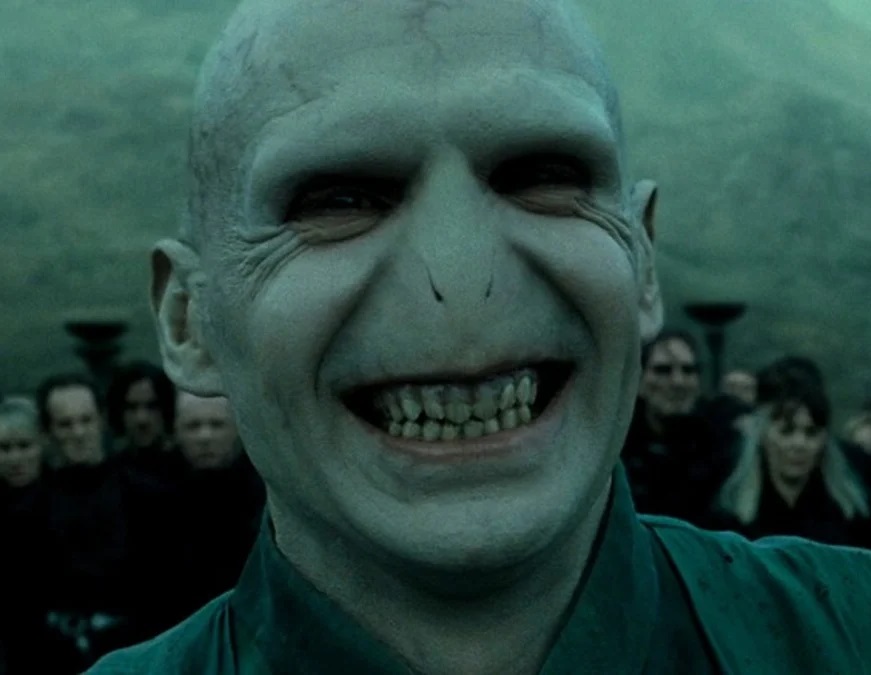
It has become an important part of Right-wing lore to mock liberals for framing current events in terms of Harry Potter. Donald Trump restricts entry to persons from a number of Muslim countries? That’s just like Voldemort persecuting Muggles! A court refuses to convict a white person for defending himself against black crime? That’s just like Cornelius’ Fudge inaction in the face of Voldemort’s rise! Parents organize to stop anti-white propaganda from brainwashing their children? That’s just like Dolores Umbridge torturing Harry because he spoke the truth! A black criminal was killed in a shootout with police? That’s just like Bellatrix killing Dobby! And so on.
The usual retort — one that is devastatingly good — is “read another book,” reinforcing the idiocy of reducing everything to conflicts in a novel for young adults. It is indeed a sad testament to our predicament. We were once ruled by men who read Homer and Goethe, whereas now our ruling class prefers J. K. Rowling — or not, depending on how TERFy she feels this week.
While it may make sense to mock liberals for their reliance on Harry Potter and cite it as illustrative of their low level of culture, we should nevertheless not fall into the trap of assuming that this makes them stupid or that it lessens their danger, however. Indeed, in this essay I intend to demonstrate that this use of Harry Potter to explain situations is a very potent weapon in our enemy’s hands. As usual, we shall start with a personal anecdote.
For some time now, I’ve been trying to follow the unfolding ethnic tensions in Bosnia and Herzegovina between the Bosniaks and the Herzegovian Croats. However, for the life of me, owing to the preponderance of noise over signal coming from people talking about the subject, the high-context nature of Balkan cultures and my related distance from the context of Bosniak and Herzegovian Croat cultures, as well as Bosnia and Herzegovina’s convoluted constitutional system — as a result of its diversity — means that it is very difficult for me as an outsider, even as one who understands the language of these peoples, to follow what is going on. In a moment of joking exasperation, I asked my followers and friends on Twitter to explain the situation to me in terms of Harry Potter. It was supposed to be funny, but then someone obliged me, likely partaking in the joke, and I realized that the situation was made crystal clear to me by this explanation. Clearly, this deserved deeper exploration.
When I say deeper exploration, I usually mean searching the Counter-Currents archives. This place has been around for a while, and there is much wisdom to be found among the dusty tomes. I came across Charles Jansen’s “The Metapolitics of Harry Potter.” It’s an excellent essay in its own right, pleasant to read and informative about the saga’s deeply white nature, but it also contained the answer to my conundrum regarding Harry Potter’s explicative power. From the text, which you’d do well to read in its entirety:
Beyond the massive promotional campaigns for each new book and movie, several features may have contributed to the success of Harry Potter. . . .
Second, it shows us a rich, colorful world. A world full of humans, sorcerers, magical creatures, intrigue, quests — a world that makes a perfect supplement to the real one, “something more” for those who feel bored with the bland world of business, the dirty world of politics, and the generally impoverished world of modernity. . . .
Fourth, it is shared. Fans of Harry Potter have a strong common interest. They can spend hours discussing the aspects of a specific magic spell, a fictional character, and many other arcane topics. In a world where individualism increasingly reduces us to a state of atomization and where multiculturalism leaves us alienated, it is great to have something to share with other fans. Even better when it relates to our roots in a living European tradition.
Or briefly, it is internally wide-ranging and externally widely read. This gives Harry Potter two important properties. Firstly, because the world it depicts is rich and colorful and encompasses much of the vast panoply of human behaviors — and crucially, behavioral phenotypes — it provides a wealth of archetypes which can serve as a sort of shortcut in communication, especially at a distance. So, if we wanted to describe a leader who dithers in the face of impending danger because he’s unwilling to face the facts, is hamstrung by bureaucracy, is unwilling to rock the boat or lose political capital, and indeed persecutes the heroes for raising the alarm, we could just describe him as Cornelius Fudge, the indecisive Minister for Magic whose poor leadership is a decisive factor in Lord Voldemort’s rise. Whenever liberals want to describe a political leader as “not doing enough” to stop evil, they’ll call him a Cornelius Fudge, and as the Charles Jansen article points out, this is likewise the archetype of a white nation’s cuckservative leader who refuses to acknowledge that the demographic displacement of whites is even happening or is a problem, and indeed persecutes White Nationalists and identitarians for raising the alarm.
When a Harry Potter fan says Voldemort, Dumbledore, Umbridge, Ron, or Dobby, he doesn’t just mean these characters but the archetypes they represent: the Evil Sorcerer, the Good Mentor, the Petty Bureaucrat or Traitor, the Devoted Friend, or The Downtrodden. These are categories, archetypes, and behavioral phenotypes of people which can be found everywhere around the world, and especially in the grand moral dramas which characterize white societies. When we expand the archetypes to groups, represented by organizations and school houses in Harry Potter, we attain a key to understanding the even more crucial question of predicting and analyzing group behavior under extreme uncertainty, and of course the position we ought to take vis-à-vis these groups and their anticipated behavior. In this respect, Harry Potter serves as well as countless other works of literature and epic poetry have in the past: as a social orientation and coordination tool. When we say someone is Voldemort, we must all oppose him, lest we become the dithering Fudge — or worse, abuse our power as the deplorable Umbridge. We should instead look to brave Harry, dependable Ron, clever Hermione, loyal Hagrid, and wise Dumbledore. Otherwise, poor downtrodden Dobby and the vast masses of Muggles will be killed.

You can buy James O’Meara’s book The Eldritch Evola here.
By framing a problem in terms of Harry Potter, we can transplant this map, and with minor adaptations, hew it to any territory — or at least any territory which involves an us-versus-them type of conflict, which the Godric Gryffindor of the Dissident Right tells us is the whole concept of the political. It allows people to rapidly grasp an adequate vision of a conflict they may not have a direct part in, which greatly eases the trouble of coordinating alliances and hostilities within very large groups.
Now, that’s all well and good, but what use is a book, even if it is passable and has a rich internal world, if it’s not widely read? This leads us to the second of Harry Potter’s great powers: It has wide appeal and you can speak of its internal workings to a complete stranger, confident that he’ll be able to understand it. This entire essay has been written with an audience who has read Harry Potter in mind. Indeed, I not only expect you to have read Harry Potter but also to have a basic understanding of its vast cultural impact, especially the impact it has had on the millennial generation. It is the world’s second-most popular book, following none other than the Bible, which is treated similarly in everyday speech. I expect my interlocutors at the very least to be versed in the most famous Biblical stories, but it’s important to know that Harry Potter is in the same category as the Bible when it comes to universality of knowledge.
Thus, we have a widely-known work which contains within itself a very important political heuristic that is instantly recognizable by millions around the world. By virtue of these characteristics, Harry Potter solves an important problem for our ruling class. However much we play around with the definitions, ultimately I agree with Petr Hampl that our ruling class numbers in the millions — at least five million souls, and more if you count the managerial class that is directly beneath it and shares its culture. Since they do not have much in the way of formal hierarchy, and they have to coordinate their actions somehow, they do it by appealing to their shared myths and preconceptions about the world. In the broadest sense of the term, we would call this ideology, though it includes such seemingly non-ideological cultural artefacts as Harry Potter and Star Trek, all centered on and reinforced by the Nuremberg Moral Paradigm.
Harry Potter and other cultural artefacts of our ruling class give them the ability to rapidly transfer information pertinent to the friend/enemy distinction to fellow members of their class who have never interacted with the local culture, and may be unable to quickly understand it — just as my Herzegovian Croat friend was able to instantly inform me about the state of affairs in Bosnia and Herzegovina using terms like Dumbledore and Hufflepuff. Having thus assimilated a sufficient approximation of the situation on the ground, the ruling class and their managerial cohort can rapidly deploy all their resources in service of the struggle. It is like Imperial British potentates quoting Shakespeare and Homer to each other to coordinate battles and intrigue, but cringe.
Now, of course, the question poses itself: Why Harry Potter of all things? The answer, I find, is depressingly simple. Our ruling elite, as per Petr Hampl’s sociological look into their ranks, consists mainly of parvenus who are strongly insecure about their positions and intellects. They could fall from grace at any moment, and more importantly they have to keep telling themselves that they deserve their positions because they’re better than those of the unwashed outside the compound. They do this by appropriating the trappings of intellect, such as the book, as a physical fetish. Shakespeare and Homer may offer a broader and even better diapason of archetypes than Harry Potter, but they are beyond many of these parvenus, who mainly spend their time jockeying for position and attending meetings. Reading high literature is the luxury of a man of leisure, and these people have very little leisure. Instead, they default to using Harry Potter because it is an incredibly easy read, is good enough for the job (and good enough is often better than good), and in many cases they’ve already read it as children (or they could just watch the movies).
There’s probably a second, defensive reason for why Harry Potter evolved to become the gold standard of libtard internal discourse. Since effective libtard communication should be somewhat protected from either dissidents or conservatives snooping around, Harry Potter here proves more effective than Shakespeare. Since it is a book and requires a minimum of intellectual commitment, it chases away the notoriously anti-intellectual mainstream Right, which wouldn’t be caught dead reading a book. But since it is young adult fiction and not particularly impressive from an intellectual standpoint, it also has the benefit of alienating the stuffy and cerebral Dissident Right. Indeed, I am writing this article precisely because by mocking the ruling class for using Harry Potter as a coordination mechanism, we run the risk of underestimating the tremendous advantage they have over us.
And with this, I want to pose this key question: What is our political heuristic? What is the map I can rapidly transfer to a fellow traveler who didn’t know what Macedonia is not two seconds ago, in order to immediately appraise him of the political landscape here? The answer is online meme culture. There are those who yearn for a more intellectual approach to dissident politics, and as a result believe that meme culture should take a back seat or even be eliminated completely. I disagree. Indeed, meme culture — calling someone a cuck, a civnat, poljack, libtard, zigger, boomercon, Qtard, or any of the lovely terms of affection and derision we have for each other — immediately informs an ally of the position that this person has vis-à-vis the political mainstream, our own movement, and the various branch narratives stemming from the Nuremberg Moral Paradigm. When I say someone is red-pilled, blue-pilled, purple-pilled, or black-pilled, I am describing states of initiation into our own informal hierarchy and positions with regards to activism, as opposed to retreat and passivism.
Those who seek a more intellectual approach must therefore anchor this immediately recognizable and easily transferable map to the own broader lore, which indeed describes in rich detail the political landscape and its many actors. More often than not, we find that those who came before us observed the same things as we do, and that much of the intellectual labor is already done for us. From online culture, we have this readily transferable map, this coordination heuristic. Our task is therefore to fuse the two into a workable engine which will both allow two shitposters from different corners of the white world to coordinate a raid on a libtard groupcha,t as well as accord their nerdy friend the ability to immediately translate the work of past and current greats into the political landscape of his country, region, city, or even narrowest friend and family group, thereby gaining key insights and increasing his political power — even if by just a little. It is from such tiny gains at scale that big victories are made of.
* * *
Counter-Currents has extended special privileges to those who donate $120 or more per year.
- First, donor comments will appear immediately instead of waiting in a moderation queue. (People who abuse this privilege will lose it.)
- Second, donors will have immediate access to all Counter-Currents posts. Non-donors will find that one post a day, five posts a week will be behind a “Paywall” and will be available to the general public after 30 days.
- Third, Paywall members have the ability to edit their comments.
- Fourth, Paywall members can “commission” a yearly article from Counter-Currents. Just send a question that you’d like to have discussed to [email protected]. (Obviously, the topics must be suitable to Counter-Currents and its broader project, as well as the interests and expertise of our writers.)
- Fifth, Paywall members will have access to the Counter-Currents Telegram group.
To get full access to all content behind the paywall, sign up here:
Paywall Gift Subscriptions
 If you are already behind the paywall and want to share the benefits, Counter-Currents also offers paywall gift subscriptions. We need just five things from you:
- your payment
- the recipient’s name
- the recipient’s email address
- your name
- your email address
To register, just fill out this form and we will walk you through the payment and registration process. There are a number of different payment options.


