Select date

John Locke’s Blank Slate & the Unique Development of Children’s Literature in the West


 9,202 words
There is an elective affinity — a relationship of reciprocal attraction and mutual reinforcement — between a) John Locke’s argument that a child’s mind initially resembles an “empty cabinet” or a “white paper void of all characters” which can be shaped by controlling the education impressed upon the child’s mind, and b) the origins of a literature specifically written for children in the 1700s in England. John Locke’s pedagogical book, Some Thoughts Concerning Education (1692), with its thesis that “children’s minds” could be shaped “from without” by “those who have children or the charge of their education” became “the moving spirit of the eighteenth century.”
Samuel Pickering documents in his book, John Locke and Children’s Books in Eighteenth Century England (1981), the influence of Locke on the “form, theme, content, and diction” of early children’s literature. Pickering does not, however, draw connections between Locke’s blank slate thesis and the development of children’s literature. Below I will outline the history of children’s literature as a singularly Western phenomenon that calls for an appreciation of Locke’s blank slate thesis. The focus will be on English and American books, where the influence of Lockean philosophy was greatest, though we should keep in mind that other European nations were originating children’s literature. Folk tales, superstitions, songs, legends — that taught and entertained children — have been common throughout the world. Before the early 1700s, however, there were no books written specifically for children.
Children’s literature undergoes momentous changes in content and theme in the course of time as the West finds itself in a state of continuous modernization and cultural change, driven by new concepts of childhood: from purely instructional stories with practical advice in the 1600s, along with evangelical stories to keep the innate moral sinfulness of children contained, through to stories after 1700 offering both knowledge and recreation that encouraged children to be virtuous and kind to animals; from books in the early 1800s teaching middle class children the values of thrift, hard work, and family uprightness, through to sentimental stories about the harsh lives of poor Victorian children, and stories encouraging the predilection of children for fantasy and imagination after the 1850s; from stories about heroes and the virtues of loyalty, pluck, and resourcefulness at the time of British imperial greatness, coupled with the rise of girl’s stories to prepare them to be wives and mothers during late Victorian times, through to stories about the unchanging trials of adolescent sexuality after the Second World War, combined with science fiction and comic books, to a new agenda of political correctness in matters of sex and race from the 1990s onwards, which brings about a degradation in the quality of children’s literature as it becomes a weapon aimed at indoctrinating children into accepting “diversity, equity, and inclusion.”
The Beginnings of Blank Slate Children
Among conservatives and evolutionary psychologists who believe that humans are born with innate biological drives that explain their behaviors, motivations, and intellectual aptitudes, Locke’s blank slate argument is today dismissed as a major error driving the Left’s ideology that humans are malleable creatures who can be easily “reimagined” or “reconstructed” anyway one chooses. Everyone knows about the nature versus nurture debate, but what many on the Dissident Right have not paid due attention to, preoccupied as they have been with the science of genetics, is that the blank slate proponents, for all the “refutations” they have faced in the writings of such prominent scholars as E. O. Wilson and Steve Pinker, have taken complete command of children’s books across all the schools, libraries, and publishing houses of the Western world.
They managed to do so because the West has been demolishing its “innate ideas” for centuries now, its kinship-based institutions and norms, and its customs, folkways, and traditional religious beliefs. The in-group psychology dominating all traditional societies was fundamentally altered in Europe into increasingly individualistic habits of thinking and behaving as Europeans started demolishing their kinship institutions from the Middle Ages onwards, by prohibiting cousin and polygynous marriages and promoting monogamous nuclear families. This released Europeans from their kin-based obligations and encouraged them to choose their spouses, social friends, and associates, which opened the door to the creation of voluntary (civic) associations, chartered towns, guilds, universities, monasteries, and representative institutions based on contractual agreements. Kinship was no longer determining the “innate” identities and norms of Europeans, their ascribed status and obligations, their sense of right and wrong, their normative relationships between family members, what values should be transmitted to children, and what is sacred and what is profane.
You can buy Spencer J. Quinn’s My Mirror Tells a Story here.
European institutions and associations were now based on civic norms chosen by anonymous individuals on their own initiative. However, for a long time, through the medieval era, Christianity continued to act as a major collective source guiding Europeans in their families, education, and overall social life. But as modern Europeans began to talk about the “natural rights” of individuals to choose their own values and happiness within an increasingly commercialized society, the traditional values of the Church started losing their influence, particularly after the Enlightenment. This led to the expansion of Europeans’ blank slate interiors and the rise of ideologies contesting over which values should command the lives of individuals. The West is indeed unique among civilizations in the origination of ideologies proposing a complete remaking of society: liberalism, socialism, Communism, anarchism, feminism, and fascism. Non-Western societies are innately based on their millennial traditions. The West became ideological during the French Revolution as a new intelligentsia consciously set out to remake society anew. Even conservatives became ideologues when they realized they could not restore the old monarchical order and the old aristocratic class, but had to accept the liberal principle of equality of civic rights and modern industrial development — if they were to preserve in a new form some traditional values. Western liberalism (which gradually came to include many sub-isms within itself, including modern conservatism) eventually defeated the two major contenders for power, fascism and Communism, proclaiming the “end of history” in the 1990s.
In the England into which Locke was born, a relatively new liberal society where parliamentary rule had displaced monarchical authority, and where the nation would increasingly come to be seen as a contractually-based covenant among anonymous individuals with natural rights rather than based on kinship in-group loyalties, it made sense to reject innate ideas. The classical liberal disposition to accept nothing as true unless it was validated by one’s “impartial” rational judgment amplified the West’s intellectual creativity. Painters, musicians, sculptors, architects, and novelists were encouraged to rely on their individual aesthetic judgments in the pursuit of the highest forms of beauty and literary expressions.
For all their individualism, however, modern Europeans, until recent decades, remained attached to their national heritage, creating nations based on a collective sense of history, memories, and ethnic identity. Christian traditional values continued to play a big role in the parenting and education of children through to the twentieth century. Locke’s liberal ideas were not calling for a world without any traditions and common heritage; his liberalism was sensibly aimed at encouraging the initiative, curiosity, and knowledge of children in a world where formal schools for children were just beginning and most instruction was religiously oriented and paternalistic. Locke argued with reason that education should not be despotic and coercive but should account for children’s individual characteristics, encouraging their interest in knowledge while disciplining their habits without indulging their subjective whims.
Locke’s Impact in the 1700s
There were books for children before Locke: The Petit Schole (1587) taught the rudiments of English spelling; A Method, or Comfortable Beginning for all Unlearned (1570) was about how to teach reading; and, before these two, there was Caxton’s Book of Curtesye (1477) about piety, neatness, and honoring one’s parents. Children enjoyed some adult books such as Plutarch’s Lives of heroic Greeks and Romans — the adventure, the great deeds, and the anecdotes. Richard Mulcaster’s Positions Concerning the Training Up of Children (1581) actually encouraged laughter among children and the importance of exercise and games. Locke later elaborated upon this view, urging that education should involve “Play and Recreation” as a means of getting “continued Attention” from children, engaging the “liking of Children” for learning, which is “one of the hardest Tasks.” Children should be free to choose how they play so they discover their individual tempers, inclinations, and aptitudes.

John Locke
But while England awaited Locke’s “monumental educational influence” in the early 1700s, it was the “Good Godly Books” by Puritans that constituted the greater part of books for or about children. There was a “flood of Puritan books” in the 1600s. Puritans advocated literacy among the young for two interconnected reasons: They believed that individuals should have direct access to the Bible and that encouraging children to read didactic literature was an excellent way to rescue them from their sinful impulses. “Play and idleness” gave children time for devilish temptations without fomenting an upright character. (The historian Percy Muir makes the revealing observation that “the Cambridge Bibliography of English Literature lists no children’s books of a recreational kind before 1671.″) A good example of Puritanism in books was James Janeway’s A Token for Children: being an Exact Account of the Conversion, Holy and Exemplary Lives, and Joyful Deaths of several young Children, published in 1671. In this book, abstinence from all forms of playfulness was insisted upon, with constant reminders to the parents of the inherent tendency of their children to sin, and the need to raise children guarded against the temptations of Satan by reading the Scriptures. The same, however, cannot be said about John Bunyan’s The Pilgrim’s Progress (1678). While this book was not intentionally written for children, it was widely read in the nursery and annexed by children as an adventure story about giants and fabulous monsters, sword contests, and a hero overcoming ill fortune. It has been said that Bunyan provided amusement, if “unintentionally,” and that he preferred to persuade children into righteousness instead of frightening them.
It was in the early 1700s that books expressly written for children came onto the market guided by the Lockean conception that children were not born with original sin but resembled an “empty cabinet” that could be shaped according to their education. This Lockean idea was reinforced by a “new sensibility” attributed to Rousseau’s educational novel Émile, written in 1762, which argued that children’s natural state of being should be valued in itself, rather than viewed as an inferior state requiring the immediate imposition of adult ways. This emphasis on children’s “natural” ways of seeing, thinking, and feeling would eventually encourage the writing of books aimed at nurturing the unique imagination of children.
With Britain’s gradual modernization, there was a growing focus on children’s educational maturation. Up until about 1750, roughly speaking, almost one-third of young people died before 15 years of age. Coping with such regular deaths in their households, combined with the need to have young adults help with farming and craftsmanship, parents barely had time to think about their children’s education. But with improvements in agriculture, the rate of infant mortality started to decline very slowly but steadily through the 1700s, making parents more optimistic about the prospects of their children surviving into adulthood and the importance, accordingly, of an education in an emerging urban Britain where a vocational profession was important. Sunday schools that taught reading and writing and some arithmetic were growing in great numbers during the late eighteenth and nineteenth centuries. In 1800 there were 2,000 such schools, with about 10% of children between the ages of five and 18 enrolled. By 1818 some 450,000 children were being educated in Sunday schools.
Apart from books aimed at preparing middle-class children for social accomplishment, such as Circle of the Sciences series (1745), an encyclopedia published by John Newbery about grammar, arithmetic, and geography, we see a growing emphasis on books that taught moral and religious principles in a more light-hearted, liberal manner, acknowledging playfulness in children’s learning. A popular book was Sarah Fielding’s The Governess; or, The Little Female Academy (1749), about a girls’ village school with a teacher of virtuous character who tells her students that “the true use of books is to make you wiser and better.” A book that inspired a whole genre was The History of Little Goody Two-Shoes (1765), by an anonymous author about a “do-gooder,” a poor orphan girl named Margery Meanwell, who goes through life with only one shoe until a rich man gives her a pair, and she tells everyone she has “two shoes” and then becomes a teacher and marries a rich widower, with the story showing that virtue is rewarded.
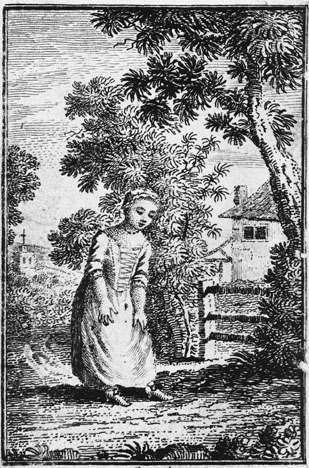
A woodcut of the eponymous Goody Two-Shoes from the 1768 edition of the novel.
In Some Thoughts Concerning Education, Locke encouraged parents to teach their children kindness to animals, warning that “the Custom of Tormenting and Killing of Beasts, will, by Degrees, harden their Minds even towards Men.” This outlook occasioned a debate about the contrasting natures of humans and animals, whether animals had souls, and how the Christian doctrine of universal charity should be applied to animals, with the consensus being that while animals should not be elevated above humans, they should be put to death only when “necessary either for the food or convenience of man” without cruelty. Thomas Boreman’s Gigantick Histories (1740), which would eventually comprise a series of ten separate volumes, was endearing to children in its depiction of animals, with stories about lions, tigers, and leopards, all of which Boreman described and illustrated with woodcuts. A book viewed as “the most representative of children’s books,” in which animals began to be sentimentalized, is Sarah Trimmer’s Fabulous Histories (1786). The book emphasizes the virtue of social hierarchy, according to which parents are above children in their authority, and humans above animals in terms of dominion and compassion, while conveying the message that kindness to animals during childhood can lead to universal benevolence adulthood.It would take all our space to describe the onrush of children’s books during this period. One of the first and most prolific publishers of books for children and juveniles was John Newbury, who consciously followed Locke in his decision to link “a Knowledge of the Letters” to “Play and Recreation.” The first book he published, in 1744, was A Little Pretty Pocket-Book, intended for the Amusement of Little Master Tommy and Pretty Miss Polly with Two Letters from Jack the Giant Killer, identified by some as “the first children’s book in history,” consisting of simple rhymes for each of the letters of the alphabet. Newbury “paid great attention to every detail” in the preparation of children’s books, “the titles, heroes, reputed authors, price, size, binding and pictures were scrupulously attended to.”

It is not an exaggeration to say that Europeans invented childhood in the late 1700s as they started showing a keen interest in children’s individuality and personalities. Prior to this time, children were depicted as small adults in their clothing, postures, and facial expressions. The appearance of boys at school was that of a small-size adult; it was only at the end of the 1700s that “special dress for children began to appear.” Children were expected to think and behave as mature people at about the same age as our children today embark on their primary education. In late eighteenth-century Britain one sees a new artistic interest (headed by the British) in young children aimed at bringing out the distinctiveness of childhood. Children had their own identity already as infants. The paintings of Sir Joshua Reynolds (1723-1792) are very important in this respect. Art historian Ann Higonnet described this new artistic phenomenon as the invention of the innocence of childhood. It was this innocence that defined children’s distinctiveness, as conveyed by one of Reynolds’ child portraits entitled “The Age of Innocence.” An innocent child’s body was “defined by its difference from adult bodies.” The stages of maturation of children came to be clearly defined sometime between 1780 and 1820: between the infant and the child, the child and the adolescent, with authors delineating the specific educational needs for these stages.
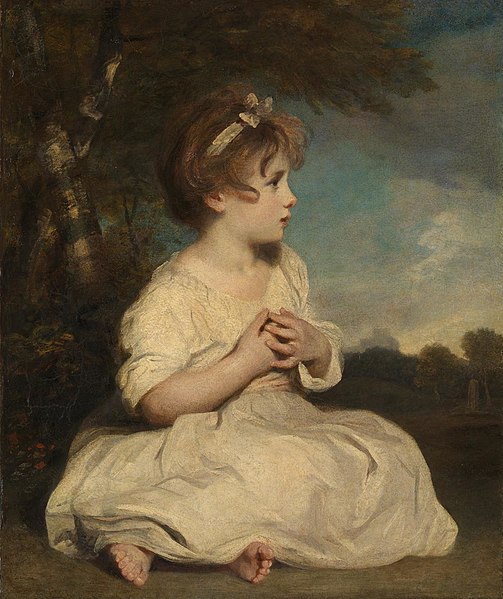
Sir Joshua Reynolds, The Age of Innocence (1785 or 1788).
Ellenor Fenn, author of numerous books, stated that “if you expect children to read with spirit and propriety they must be supplied with lessons suited to their taste, that is, prattle, like their own.” Fenn is now acknowledged “as an early advocate of child-centered teaching strategies.” A follower of Locke, she opined that “if the mind be a rasa tabula — you to whom it is entrusted should be cautious what is written upon it.” Her most popular book, Cobwebs to Catch Flies (1783), is a reading primer which consciously differentiated between reading age groups, with parts of the book aimed for children from three to five years, and later parts of the book aimed at those from five and eight. The book met children at their own age, experiences, and interests in how it addressed toys, pets, games, visits to the fair, and other subjects.
Chapbooks, Fairy Tales, Robinson Crusoe
The first books written for the delight of children in rural poor homes were “chapbooks,” that is, half-penny sheets covering a range of subjects from alphabet books and religious stories and prayers to legends of ordinary folk, short biographies, heroic tales, crime news, songs and jests, nursery rhymes such as “Who Killed Cock Robin” and “Little Tommy Tucker,” miraculous or ghost stories, prophecies and fortune-telling, and battle or adventure. Fables have always been the oral possession of the illiterate. The development of these fables and fairy tales into books began in the early 1700s. The Histories, or Tales of Past Times Told by Mother Goose (1729) was a translation of a book originally published in 1697 in the French, a collection of children’s tales including Blue Beard, Sleeping Beauty, Cinderella, Puss in Boots, and Little Red Riding Hood. These stories were original adaptations in prose of preexisting medieval folk tales.
You can buy H. L. Mencken’s The Passing of a Profit and Other Forgotten Stories here.
It is worth mentioning that, while folk tales are common to all cultures, being anonymous stories that communities passed through the generations by word of mouth, Europeans started a literary scholarship of folklore, collecting and writing these tales down in published form during the seventeenth century. The Grimm brothers, Jacob (1785-1863) and Wilhelm (1786-1859), with their background in philology, meticulously recorded the tales exactly as the people told them, writing down every variation and publishing 86 fairy tales in 1812, and 217 unique tales by 1857. Hans Christian Andersen (1805–1875), a Danish author, not only collected tales but wrote dozens of original fairy tales — The Tinder-Box, Thumbelina, The Little Match Girl — leading some to argue that he invented the literary fairy tale of pure fantasy about magical characters such as wizards, elves, trolls, gnomes, and goblins. By 1800, book publishing had increased substantially with one catalog listing 213 “amusing and instructive books for young minds.” Many were adaptations for children of well-known tales, such as Mother Bunch’s Fairy Tales (1773); nursery rhymes, such as Mother Goose Melodies; lullabies; and stories about animals, such as The Dog of Knowledge (1801) or The Adventures of a Bullfinch (1809). The most popular children’s book was The Comic Adventures of Old Mother Hubbard and Her Dog (1805) by Sarah Catherine Martin (1768-1826), which sold over 10,000 copies and is about a male dog who is mischievous and a female cat who helps with various chores around the house.
Sir Joshua Reynolds, The Age of Innocence (1785 or 1788).
Daniel Defoe’s Robinson Crusoe (1719) was intended for an adult readership but soon educationists pointed to the story’s pedagogical merit and its compatibility with Lockean pedagogical theory, providing “instruction with delight.” The New Robinson Crusoe: An Instructive and Entertaining History, for the Use of Children of Both Sexes by Joachim Heinrich Campe, published in 1788, was the earliest Crusoe for children, with countless children’s versions appearing over the years. Rousseau argued that Crusoe should be a primary text to raise children “above vulgar prejudices” and encourage them to form their own judgments by imagining themselves as “solitary adventurers” in a natural state, building their own life in circumstances of real utility. Today, Robinson Crusoe is condemned as a story that “upholds a racist ideology of white supremacy.” Crusoe was certainly the embodiment of European individualism, the Lockean ideal of recreating society and oneself out of a blank slate, the quest to become one’s own. According to Ian Watts, Robinson Crusoe was the first true novel in history in not taking its plot from mythology, history, or from previous literary genres; the first story thoroughly preoccupied with the primacy of individual experience rather than general human types, giving attention to minute details of ordinary life, with a highly introspective character where almost every action is a subject of self-examination, a monologue, centered around Crusoe’s feelings, beliefs, fears, and judgments — in isolation, the self as master.
Victorian Morals, Imagination, and Sentimentalism
In the first decades of Victorian England, 1820-1850, children’s books reflected the ideology of the new middle classes: “modesty and moderation, prudence and self-help, respectability and thrift” — a combination of Puritan morality and self-reliance. The father was still the head and the role of the mother was to attend to the moral well being of the family, which on average consisted of 4 or 5 children brought up on strict gender-based roles, with the sons expected to prepare for success in the public sphere and the daughters to become ladylike in preparation for a married life, though women did play a public role, becoming prominent writers of children’s books.
Barbara Hofland’s writing drew on the hardships of her own life as a widow and during her second marriage to an artist without money; in The Blind Farmer and his Children (1816), and Elizabeth and her Three Beggary Boys (1833), she depicted families struggling under hard circumstances (death of parents, bankruptcy) yet prevailing due to their moral integrity and Christian ways. The women in her tales showed strength not by condemning Victorianism (she was a firm advocate of marriage) but by showing strength as wives and widows even if it meant having to set up their own businesses in the face of the father’s bankruptcy. Victorian “rigidity” however saw more than didactic moral tales. Harriet Mozley’s The Fairy Bower (1841) and Family Adventures (1852) portrayed children as they are rather than as mere vehicles for adult expectations, enjoying jokes, skating, and arguing about the propriety of their own behaviors. Peter Parley’s Magazine, an English children’s magazine published monthly from 1839 to 1863, contained articles about history, travel, animals, and moral tales about school boys, wicked uncles and other subjects, colorfully illustrated, aiming to instruct and please children.
There were adventure stories about overcoming ordeals, such as The Settlers at Home, by Harriet Martineau, in which a land is flooded, with mills and barns floating away, farm animals drowning, and everyone in great peril…four children are deprived of their mother and father…the two-year-old baby dies, and they have various struggles for survival…until they are rescued. Frederick Marryat’s The Settlers in Canada (1844) was about the adventures of an immigrant English family threatened by “Red Indians” and wild animals. His The Children of the New Forest (1847) was about 4 orphaned children during the Civil War, taught by a forester how to survive by hunting and farming. This age of realism and railways was also an age of the “romantic rediscovery of the imagination.” In addition to numerous new versions of Grimm’s folktales, and translations of Andersen’s tales into English, original works of fantasy were written, most notably Phantasmion (1837) by Sara Coleridge, a story of a prince who embarks on a journey, taunted and manipulated by mysterious spirits, and finally triumphs over the forces of darkness after multiple trials.
You can buy Tito Perdue’s Love Song of the Australopiths here.
From its Puritan beginnings in the 1700s to 1870, American children’s literature experienced significant cultural shifts reflecting changed perceptions of childhood. Between 1650s-1750s children’s books were for instruction and a Puritan upbringing – to fight ignorance, the “mother of heresy,” and to restrain children’s “inborn depravity.” A widely read book was The New England Primer, published in 1680s, illustrated with woodcuts, in verse for easier memorization of its teachings – with its famous opening “in Adam’s fall, we sinned all.” Thumb bibles decorated with pictures were common, one popular book was The Duty of Parents to Pray for their Children (1703) by Increase Mather. The best known was John Bunyan’s English classic, The Pilgrim’s Progress, of which 50 editions were published in America by 1830. Children enjoyed its strong dramatic narrative of Christian, an everyman character, journeying from the “City of Destruction” to the “Celestial City” seeking deliverance from the burden of his sins. Many new titles came out after 1750s: one publisher in Massachusetts published more than 100 titles between 1775 and 1800.
While the 1800s saw a gradual shift “away from the spiritual intensity” of Puritanism “toward a more generalized moralism,” the typical children’s story before 1850 did not encourage fantasy or imagination: the focus was on moral character, not entertainment. The Story of Jack Halyard (1824) was intended “to give an account of one family of superior excellence, as a model to others.” After 1850, a new kind of writing emerged, giving “childhood a value in and by itself,” an idealized perception of childhood expressed in sentimental stories about children “which was often put at the service of some social purpose.” The matter-of-fact deathbed scenes of earlier literature gave way to vivid, melodramatic narratives, such as The Angel Mother (1854), about a mother’s death and the prolonged mourning of her children. Stories of poor children, “filthy, ragged, barefoot even in winter,” such as Alice Haven’s Nothing Venture, Nothing Have (1854) about a tenement “crowded with families as poor, and as squalid as want could make them,” were common. With the rise of cities, there was a focus on secular subjects and characters: shopkeepers, newsboys, Italian boys singing on the streets for pennies. Series books in magazines were launched, adventure tales for boys. Horatio Alger was best known for his “rags-to-riches” stories of boys rewarded for hard work, acts of bravery or kindness. The most beloved book was Little Women by Louisa Alcott, about the fortunes of four sisters in their passage to young womanhood, which inspired numerous films.
Golden Age in England and America
The history of children’s literature points to the English as the most prominent, original writers. The period 1850-1890 has been identified as a “golden age,” with writers drawing on translations of the rich repertoire of Hans Henderson’s fairy tales and fables — at the same time as Europeans came to view childhood as a crucial phase in personal development, characterized by freedom from accepted conventions, vitality of imagination, and the child’s instinctive connection to the natural world, reflecting the earliest phases of the human psyche, and thus a window to the archetypes of the unconscious. Lewis Carroll’s Alice’s Adventure in Wonderland (1865) is judged as possibly the most brilliant and original children’s book. By removing the controlling voice of the adult’s narrator and having children speak for themselves, Alice’s was the first to allow the child’s mind to occupy the centre, as the adult re-enters into their sense of puzzlement. Charles Kingsley’s Glaucus; or, The Wonders of the Shore (1855) was inspired by nature walks with children, to bring out “the miraculous and divine element underlying all physical nature.”
There was a sentimental belief in the child’s innate virtues, away from the earlier emphasis on original sin, characterized by a keen concern for the suffering of poor, homeless, vagrant children, the so-called “street arabs.” George Sergent’s book, Roland Leigh: The Story of a City Arab (1857), was about a small boy in the London underground abandoned even by the church. For Hesba Stretton children were society’s victims; her stories of children “starved of food and affection” were widely imitated; she popularized “baby talk.” Juliana Horatia Ewing, from a family of ten children, with a strong faith, is known for her efforts to bring out children’s feelings, closeness to one another and to their animals. Her stories, such as Mrs. Overtheway’s Remembrances (1869), are celebrated as the “first outstanding child-novels.”
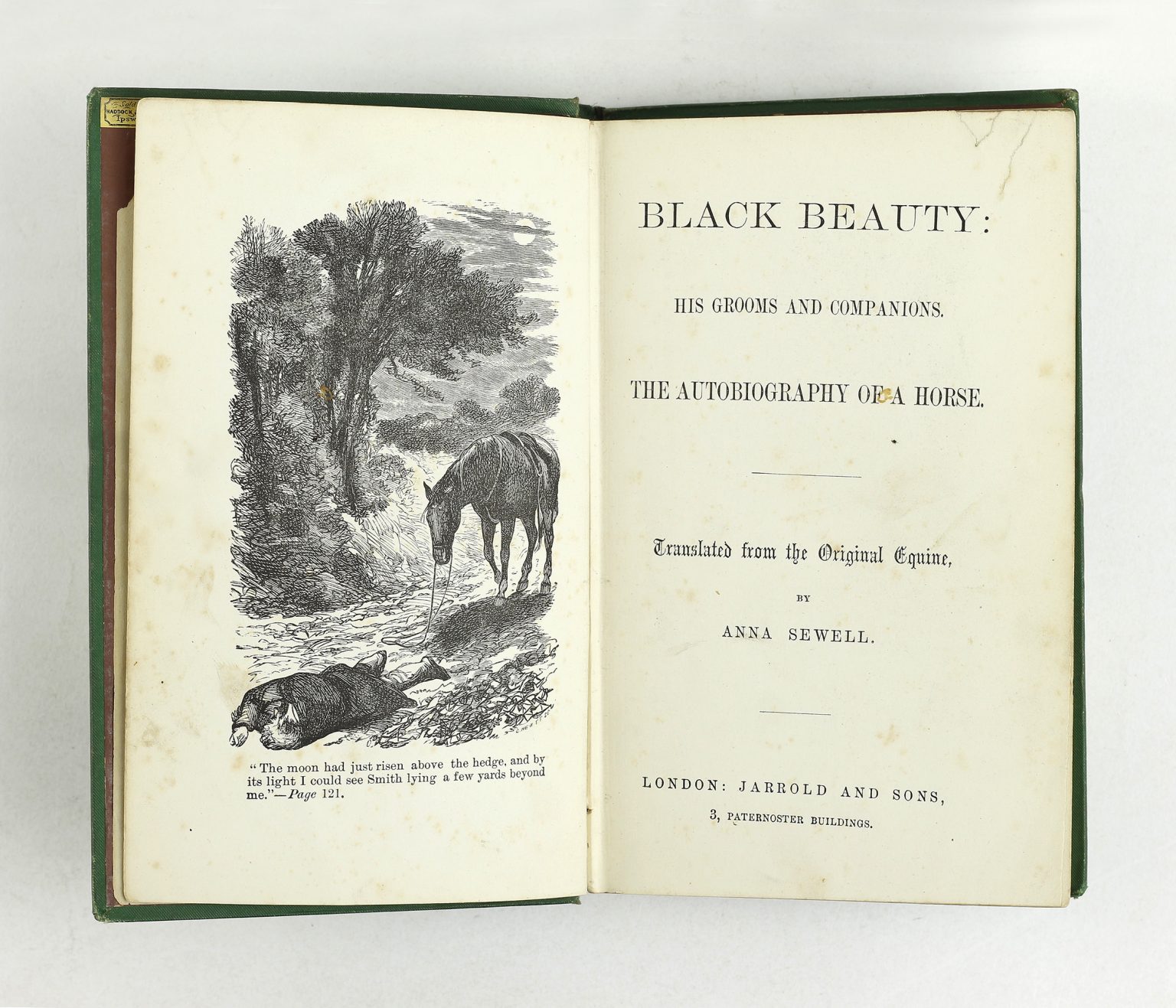
The year 1877 saw the publication of Black Beauty, one of the best-selling children books of all time, written by Anna Sewell while seriously ill — about a horse dragged down by harsh masters and vain mistresses. It is an animal autobiography, in which the horse, Black Beauty, is given some human traits such as thinking and talking, although only the readers can hear Black Beauty talking; none of the human characters in the text hear them; horses communicate with human characters using gestures and actions. Like earlier books about animals, Black Beauty is anthropomorphic, with the horse playing the role of narrator, with the readers understanding the world through the horse’s own perspective. This story is now considered one of the first animal rights books in its exploration of the suffering faced by horses at a time before the invention of automobiles when society depended on horses for transportation. Europeans have had a strong connection to horses since Indo-European peoples domesticated them in the Pontic Steppes during the fourth millennium, and then invented the techniques of horse riding, and chariots.
As England expanded across the world, adventure stories took off; one of the most widely known is Robert Louis Stevenson’s Treasure Island (1883), a story with everything boys love: treasure, pirates, strange noises, seafaring — along with unpredictable characters, a fallible hero and a “formidable and smooth” villain. The novels of the French writer Jules Verne, “father of science fiction,” were very popular among English boys, including Journey to the Center of the Earth (1864), Twenty Thousand Leagues Under the Seas (1870), and Around the World in Eighty Days (1872), taking his readers across continents, under the oceans, through the earth, and into space. George Alfred Henry’s stories, The Dragon & The Raven (1886), For The Temple (1888), Under Drake’s Flag (1883) and In Freedom’s Cause (1885), were also enjoyed, with their blending of the extraordinary with the probable, eulogizing honesty and loyalty, pluck and resilience — with his belief that the British were unequalled in these virtues. The late nineteenth century saw a sudden attraction for boarding school stories, attuned to the different interests and experiences of boys and girls. Talbot Baines Reed was the most popular writer of boys’ fiction about rivalry over games, school boy humor, and a muscular type of Christianity — The Fifth Form at St. Dominic sold 750,000 copies in 1907. The most prolific author of girl school stories was LT Meade; in addition to her books for adults, Meade wrote about 150 titles for “young readers”; A World of Girls: The Story of a School (1886) was about disruptive emotions, friendship, loyalty, and jealousy, along with Victorian attitudes of traditional roles of wives and mothers.
The enfeebled liberal West you see today publishing grooming stories about transsexuals to primary school children was once continuously creative. It was so because its blank slate individualism was still sustained by traditions, solid monogamous nuclear families, the continuing presence of Christian values, patriarchal authority, and a sense of national heritage. During the late and early twentieth centuries there is a marked preoccupation with the inner world of children, not merely with childhood as distinctive phase, but in rediscovering in the interior world of children the lost of human wholeness, the dismemberment of industrialized and wealthy humans from nature, overcoming anomie and rootlessness. The Secret Garden (1911) by F.H. Burnett has been interpreted many ways. It is through a secret garden drawn from fairy tales (outside modernity) that the orphaned Mary finds consolation and reconciliation after living as a selfish and disagreeable 10-year-old girl spoiled by her servants in colonial India and neglected by wealthy British parents. Mary finds an abandoned garden where she takes her disabled 10 year-old cousin Colin to see the garden, where he manages to stand up; they plant seeds together to rejuvenate the garden, and through their interactions with nature they discover meaningfulness and happiness in life.
But confidence in Western progress and empire was not faltering for everyone; certainly not for Rudyard Kipling, in whose stories the ideals of empire and manliness are celebrated, along with the code that public schools should train boys for their future role as rulers of the empire, as in Stalky & Co. (1899), which emphasizes the aggressive competitive aspects of boarding school as a preparation for life in colonial armies. Yet, for others, the strict moralizing lessons of Victorian times were becoming outmoded. There was an emphasis both on playfulness and on nurturing the imaginations of middle class children, as we see in A Child’s Garden of Verses (1885) by Robert Louis Stevenson, which describes children absorbed in imaginary “make believe” games, boys transforming their surroundings through fantasy, turning meadows into jungles and populating a desert with pythons, pumas, and kangaroos.

It is hard to identify one clear literary trend: there was too much variety, intersecting and contrasting cultural trends, from the creative minds of British authors. Kipling also wrote Just So Stories (1902), fantastical tales encouraging children to wonder how animals came to evolve. Use of parody for comic effect can be seen in E. Nesbit’s Nine Unlikely Tales for Children (1901). Nesbit was a founding member of the Fabian Society who gained much attention with The Story of the Treasure Seekers (1899), of children who overcome perils through pluck, and The Wouldbegoods (1901), about a middle-class family fallen on hard times, which found great appeal for its special touch for depicting how children truly speak, feel, and behave. Then came J.M. Barrie’s Peter Pan (1904), about a boy who refused to become an adult in an ideal world of daring and courage, interacting with fairies, pirates, and mermaids in a mythical paradise. And there was also Beatrix Potter’s The Tale of Peter Rabbit(1902), a best seller from the beginning, written in order to amuse a sick 5 year old boy, about a rabbit, who disobeys his mother, combining humor, adventure, and a moral lesson.
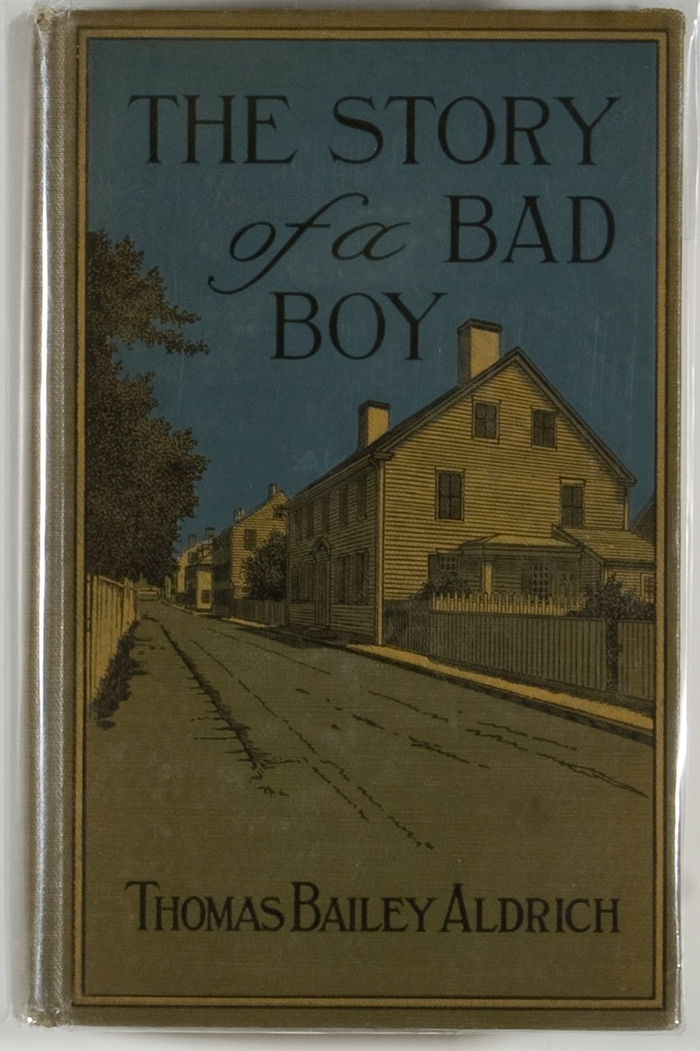
In the period 1870-1914 American children’s literature is said to have “changed radically” both in the proliferation of books with greater variety of themes and characters and the high literary quality. The liberal trend to avoid “preaching” in children’s stories, in preference of amusement, story-content, and overall optimism about prospects in life and the possibility of finding happiness. Some say it was a “golden age” characterized by such classic titles as The Wonderful Wizard of Oz (1900), by Frank Baum; The Adventures of Tom Sawyer (1876) and Huckleberry Finn (1884), by Mark Twain. There were other classics in their own right. One was T.B Aldrich’s The Story of a Bad Boy (1870), hailed as a departure in traditional children’s literature for showing boys as they were, rather than as they ought to be, which started a “bad boy” literature, of which Tom Sawyer was one, and so were C. D. Warner’s Being a Boy (1877), W.D. John Habberton’s The Worst Boy in Town (1880), and J.O. Kaler’s Ten Weeks with a Circus (1877). These stories, with their realistic images of boys as irrational, primitive, and masculine, attracted many readers. This genre is now criticized for encouraging “toxic masculinity” rather than “nice,” “caring,” “gender fluid,” and docile boys who listen attentively to their TikTok feminist teachers. In truth, these “bad boys” had an instinctive sense of what was right, rooted in small town America, with their own unique personalities built from hardship and assertiveness outside a standardized suburbia.
 Print
Print